
Israel, Gaza, Lebanon and Iran — Three Decades of Hopes for Peace and Conflict
From Arafat and the Oslo Accords to Gaza, Lebanon’s reconstruction, the assassination of Rafik Hariri and confrontation with Iran.
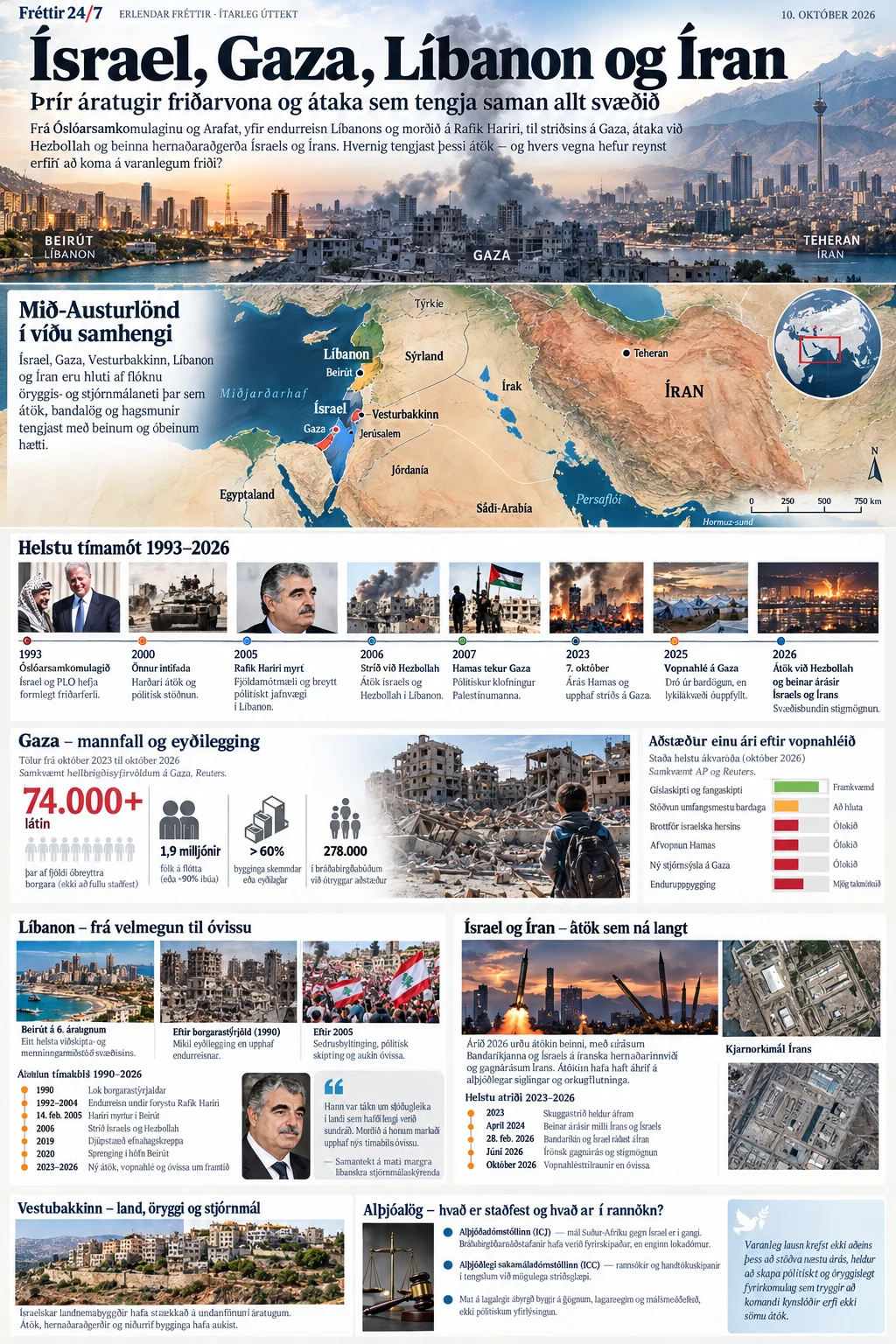
Figures and sources reflect Reuters reporting as of October 10, 2026. Figures are not inferred from the conceptual illustration above.
When Yasser Arafat and Yitzhak Rabin shook hands in 1993, it seemed possible to resolve a long-running conflict through negotiation. More than three decades later, military operations in Gaza, fighting in Lebanon and direct attacks between Israel and Iran have created fresh uncertainty.
From the Oslo Accords to renewed uncertainty
In 1993, Israel and the Palestine Liberation Organization (PLO) recognized each other and began a peace process intended to establish Palestinian self-government. Yasser Arafat and Yitzhak Rabin became the faces of new hopes for peace. But Jerusalem, borders, settlements, security and refugees remained unresolved. Rabin’s assassination in 1995, attacks by armed groups, continued settlement construction and mutual distrust weakened the process. The second intifada began in 2000. Arafat died in 2004, and Palestinian politics subsequently became even more divided.
Gaza: from political division to war
Israel withdrew its settlers and permanent military bases from Gaza in 2005, while retaining control over important access routes, airspace and maritime approaches. Hamas won Palestinian legislative elections in 2006 and took control of Gaza after fighting with Fatah in 2007. Israel and Egypt restricted movement and goods, citing security among their reasons. The effects on Gaza’s population and economy were considerable. Between 2008 and 2021, armed confrontations and attacks across the border recurred.
October 7, 2023, and Israel’s military operations
Hamas and other armed groups attacked Israel on October 7, 2023. According to Israeli figures, about 1,200 people were killed and 251 taken hostage. Israel subsequently launched extensive airstrikes and ground operations in Gaza. According to Gaza health authorities, more than 74,000 Palestinians had been killed in Israeli military operations since October 2023, as reported by Reuters on October 10, 2026. The figure does not distinguish civilians from combatants. The war has caused widespread destruction, displacement and severe humanitarian needs. Source: Reuters, October 10, 2026.
Ceasefire and unresolved questions
A ceasefire took effect on October 10, 2025, reducing the most intensive fighting. According to AP, the agreement led to hostage releases and greater humanitarian access, but central issues remain unresolved: Hamas disarmament, Gaza’s future administration, Israeli troop withdrawals and reconstruction. Reuters reported on October 10, 2026, that more than 1,400 Palestinians had been killed by Israeli fire since the ceasefire, citing Gaza health authorities. In that report Israel said four of its soldiers had been killed by militants during the period. Other Reuters reports that week cited five; the latter number is therefore not presented here as definitive. Sources: Reuters and AP, October 10, 2026.
Lebanon: from prosperity to civil war
In the 1950s and 1960s, Beirut was a major financial, commercial and cultural centre. That prosperity was not shared equally, however, and the political balance among religious communities was fragile. The 1975–1990 civil war, involving foreign states and armed groups, devastated much of the country. Israel invaded Lebanon in 1982 and subsequently maintained a military presence in the south until 2000.
Rafik Hariri and the loss of a unifying figure
Rafik Hariri became one of the most prominent figures in Lebanon’s reconstruction after the civil war. He used international connections and political influence to encourage the rebuilding of Beirut and investment. The projects were controversial, partly because of rising debt and inequality, but many Lebanese saw him as a politician who helped hold together the fragile post-war order. Hariri was a former prime minister, not president, when he was assassinated in Beirut on February 14, 2005. His killing prompted mass demonstrations, and Syrian troops withdrew from Lebanon. A special tribunal convicted three men in connection with the assassination; it did not establish that Hezbollah’s leadership or the Syrian government had ordered it. The assassination was a political turning point, although Lebanon’s economic and institutional problems had deeper roots.
Hezbollah and southern Lebanon
Hezbollah emerged in the 1980s with Iranian support and developed into both a political force and an armed organization. Israel and Hezbollah fought a war in 2006. UN Security Council Resolution 1701 provides, among other things, for security arrangements between the Blue Line and the Litani River. After October 7, 2023, renewed cross-border fire began and later escalated. Israel cites the security of residents north of the border; Lebanon’s government emphasizes sovereignty and the withdrawal of foreign forces. The fighting has displaced many residents.
The West Bank: land, security and government
Disputes over Israeli settlements, military oversight, violence and Palestinian self-government have continued in the West Bank. The International Court of Justice and much of the international community consider the settlements contrary to international law; Israel rejects that interpretation. Palestinian residents have faced displacement and attacks, while Israel describes its actions as responses to security threats. The West Bank’s status remains central to any future agreement.
Iran: from indirect confrontation to direct attacks
Iran and Israel have been locked in a bitter security and political dispute for decades. Iran has supported Hezbollah and other armed groups; Israel regards Iran’s military capabilities and nuclear programme as a serious threat. Their confrontation has involved intelligence operations, cyberattacks, military actions in third countries and, later, direct attacks. In 2026, extensive direct fighting involved Israel and the United States against Iran. Claims about particular targets and casualties require independently verified evidence, not just statements from the parties at war. Disputes over nuclear inspections, self-defence and state sovereignty remain unresolved.
International law: allegations, investigations and judgments
International humanitarian law applies to all parties to a conflict. It prohibits, among other things, deliberate attacks on civilians and hostage-taking, and requires distinction, proportionality and precautions in attacks. The International Court of Justice (ICJ) has ordered binding provisional measures in South Africa’s case against Israel over alleged breaches of the Genocide Convention. This is not a final judgment on whether genocide has occurred. The case remained pending in October 2026; in May 2026 the court set further deadlines for written submissions. The International Criminal Court (ICC) is a separate institution dealing with individual criminal responsibility. Sources: ICJ and United Nations.
What happens next?
Gaza needs solutions for administration, security, disarmament, troop withdrawals and reconstruction. Lebanon faces questions of sovereignty, border security and the role of armed groups. Israel and Iran need to reduce the risk of further direct confrontation and find a negotiated path on security and nuclear issues. No single solution automatically delivers peace on every front. Lasting security must rest on civilian protection, clear agreements and their implementation.
Editorial note: This is a conceptual illustration, not a verified map. No border shown should be interpreted as recognition of territorial boundaries or control.