
Environmental disaster in Hvalfjörður?
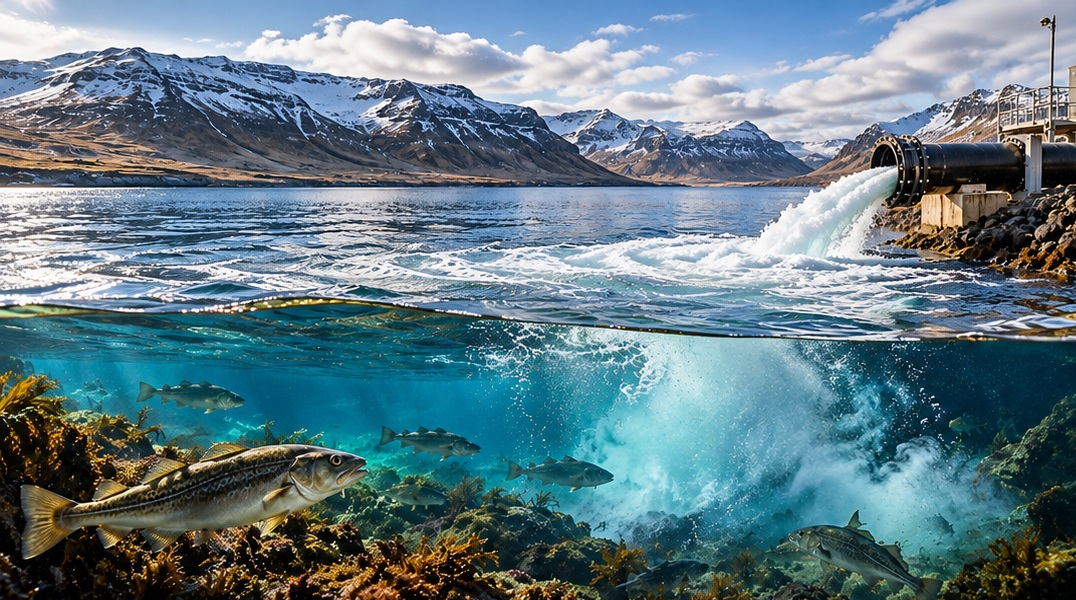
AI-generated illustration created for Fréttir 24/7. Not a photograph of the event.
In-depth report
The Icelandic marine research centre Röst has received permission to introduce eight tonnes of caustic soda into the waters of Hvalfjörður. The aim is to investigate whether changing seawater chemistry could increase the ocean’s absorption of carbon dioxide from the atmosphere. The study has raised concerns about potential effects on life in the fjord, although specialists who assessed the project consider significant harm unlikely.
Eight tonnes of caustic soda — but not all at once
The research permit was granted on 8 September. According to information available on 8 October, the study was expected to begin within the following days.
The project involves releasing up to 170,000 litres of diluted alkaline solution. The total quantity of sodium hydroxide, also known as caustic soda, will be approximately eight tonnes.
The solution will consist of approximately 95.5% water and 4.5% sodium hydroxide.
The release will take place in stages, with findings evaluated between phases. According to published information, the final stage requires further approval from the Ministry for Foreign Affairs.
Permission to release eight tonnes does not mean the chemical has already been discharged into the sea.

Why use caustic soda?
Sodium hydroxide is a highly alkaline and corrosive chemical used in industry, chemical processes and cleaning products, among other applications.
In concentrated form it can cause severe chemical burns. Its effects on aquatic organisms, however, depend on factors including concentration, dilution, dispersal and changes in pH.
Röst’s study uses an approach called Ocean Alkalinity Enhancement, which seeks to increase the alkalinity of seawater.
The ocean already absorbs some of the carbon dioxide released into the atmosphere. By increasing seawater alkalinity, scientists want to determine whether that absorption can be enhanced without unacceptable consequences for marine life.
The method remains experimental. It has not been demonstrated to be safe, economical and effective under all conditions or at large scale.
What do experts say about the risks?
Röst’s representatives expect the study’s effects to be local and temporary.
Birkir Bárðarson, director of Röst, has said the effects are expected to fade quickly and seawater pH should move back towards its previous level around a day after the release ends.
He has also said scientists and specialists have assessed the study and do not believe it poses a risk of harmful effects on the fjord’s ecosystem.
During the consultation process, experts from the Marine and Freshwater Research Institute and the Environment and Energy Agency of Iceland assessed the project positively.
Such assessments matter, but they do not replace measurements of what actually happens when the study is carried out.
Local opposition and concerns
Earlier proposals for the research met opposition in the surrounding community.
Concerns have included possible effects on fish, juvenile fish and other organisms in Hvalfjörður, as well as questions about consultation with residents and stakeholders.
Kjósarhreppur municipality opposed earlier plans. Hvalfjarðarsveit municipality, however, has issued a positive opinion on the project.
Röst’s representatives say the research plan was revised in response to comments and new studies.
They say additional monitoring, sampling and safety measures were introduced.
It is important to distinguish older proposals from the project that has now received a permit.
Who can stop the experiment?
One of the most important questions concerns oversight and the conditions attached to the permit.
The Ministry for Foreign Affairs issued the research permit. The Environment and Energy Agency of Iceland and the Marine and Freshwater Research Institute participated in assessing the project.
According to published information, results from each phase are to be reviewed before the next phase proceeds.
But for the public to judge the safeguards, it must be clear which measurement thresholds apply, who has the authority to halt the release and what response is planned if unexpected effects occur.
It also matters whether independent parties can review the findings and whether the raw monitoring data will be published.
New international guidance announced
On 9 October, the International Maritime Organization (IMO) announced that new guidance had been adopted for assessing research into marine geoengineering activities.
This includes research on ocean alkalinity enhancement, similar to the approach Röst intends to investigate in Hvalfjörður.
The guidance emphasizes environmental assessment, risk management, stakeholder consultation, scientific review, monitoring and transparent reporting.
The IMO notes that knowledge of the potential effects of such interventions on marine ecosystems remains limited.
This is not an independent assessment of the Hvalfjörður study, but it underscores the importance of careful oversight of research of this kind.
Who is funding the research?
Röst is a non-profit Icelandic marine research centre.
Its research is funded by the US-based Carbon to Sea Initiative, which supports studies into the ocean’s potential to capture carbon dioxide.
Röst has stated that the research results will be made accessible.
The funding is therefore not secret, but transparency about results, supervision and potential liability for environmental damage will remain important.
Nature and the burden of proof
If ocean alkalinity enhancement can be shown to remove carbon dioxide from the atmosphere safely and measurably, the method could become part of future climate solutions.
But obtaining the knowledge that is still missing is precisely the purpose of the research.
A government permit and a positive expert assessment are not the same as conclusive proof that no risk exists.
That is why it matters to monitor effects on marine life, make the permit conditions clear and ensure the findings are available to the public.
The question is not only whether the ocean’s uptake of carbon can be increased.
It is also whether that can be done without sacrificing the marine life that such research is partly intended to protect.