
As global attention has focused on Gaza, Israel and Iran, a new and dangerous phase has begun in Yemen’s war. Saudi-backed forces have launched a major offensive against the Houthis, while missile attacks and threats to shipping have renewed international concern. Understanding the latest fighting requires looking beyond today’s headlines to Yemen’s history, its divided institutions and the regional powers involved.
Þann 4. október tilkynnti Rashad al-Alimi, leiðtogi alþjóðlega viðurkenndra stjórnvalda í Jemen, að hernaðaraðgerðir hefðu hafist til að endurheimta landsvæði sem Hútar ráða yfir. Á næstu dögum bárust fregnir af bardögum við Bab el-Mandeb-sund. Frásagnir stríðsaðila af yfirráðum yfir einstökum stöðum hafa ekki allar verið staðfestar með óháðum hætti.
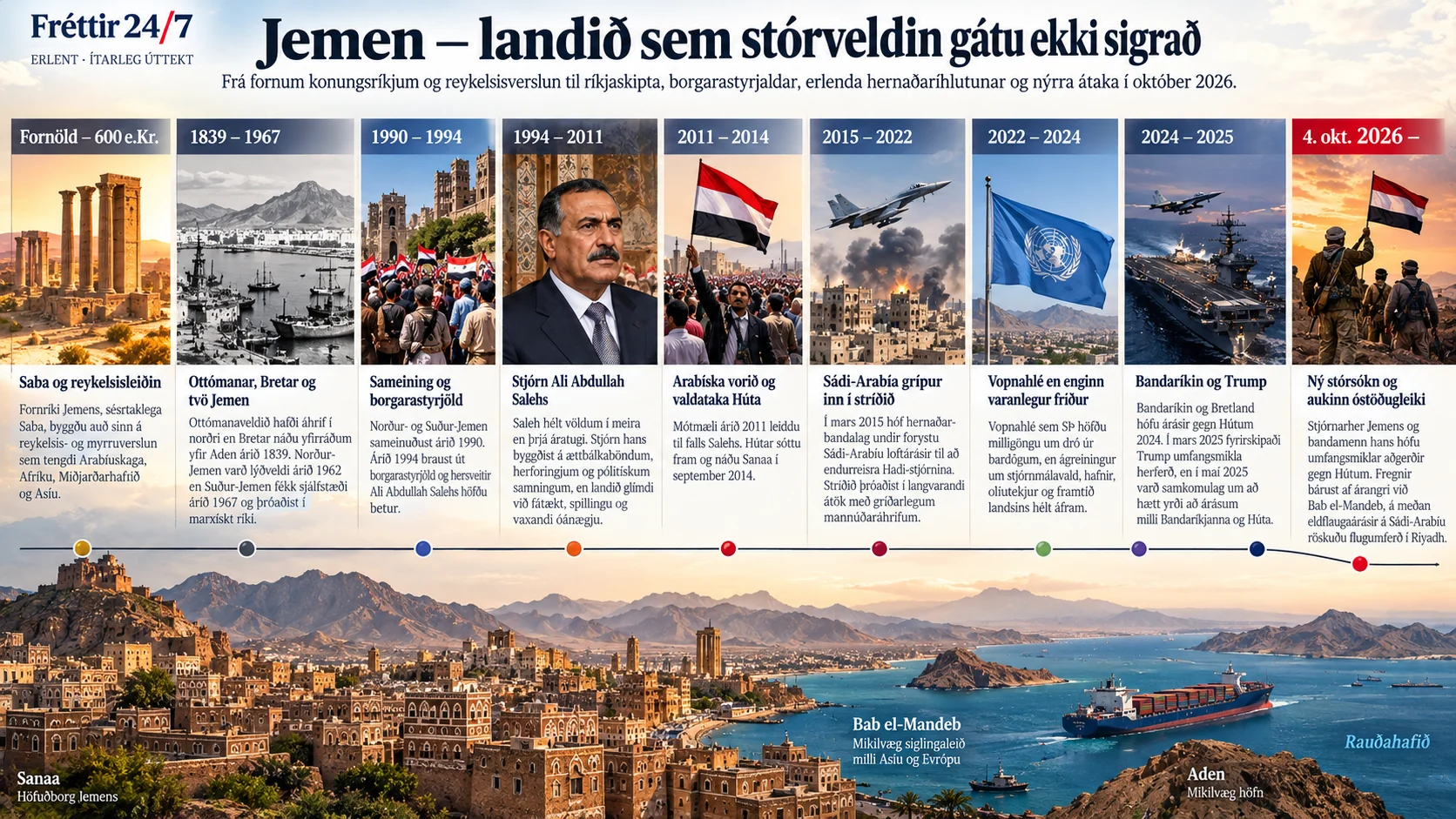
Til að skilja hvers vegna þessi átök eru svo flókin þarf að horfa mun lengra aftur en til ársins 2015, þegar Sádi-Arabía hóf hernaðaríhlutun sína. Saga Jemens nær þúsundir ára aftur í tímann.
An Ancient Land at a Strategic Crossroads
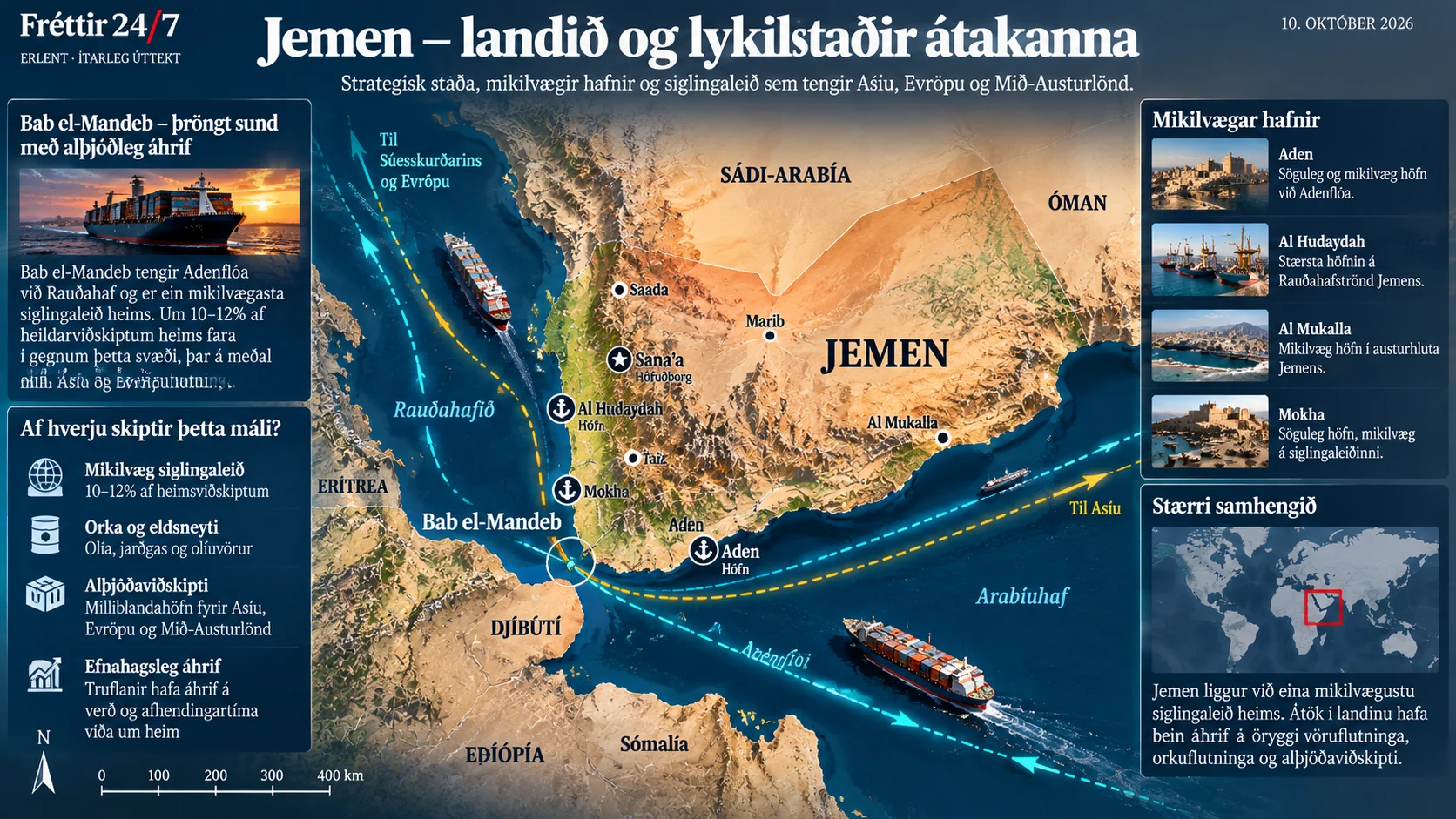
Yemen lies at the southwestern tip of the Arabian Peninsula, beside the Red Sea, Gulf of Aden and Arabian Sea. Its location has made it a crossroads of trade for centuries. Wealthy ancient kingdoms arose here, notably Saba, associated with the legend of the Queen of Sheba. Frankincense, myrrh and other valuable goods linked southern Arabia with Africa, the Mediterranean and Asia. The highlands, deserts and coastal regions developed different social structures. Tribal alliances, religious traditions and local power networks became central to Yemen’s politics and still matter today. The modern war is therefore about more than two armies: it also concerns the distribution of power, regional identity and foreign influence.
Two Yemens: Empires and the Cold War
The Ottoman Empire exercised considerable influence in northern Yemen, while Britain seized Aden in 1839. The port became an important stop on the route between Europe and Asia, particularly after the Suez Canal opened in 1869. North Yemen became a republic in 1962 following a revolution against the monarchy. A civil war followed, with Egypt and Saudi Arabia backing opposing sides. South Yemen gained independence from Britain in 1967 and later came under a Marxist government closely aligned with the Soviet Union. For decades, therefore, two separate states occupied the territory of modern Yemen. Their political and military institutions did not automatically merge when the countries united.
Unification in 1990 and Civil War in 1994
On 22 May 1990, North and South Yemen united. Ali Abdullah Saleh, who had ruled the north since 1978, became president of the new state. Unification did not settle disputes over political authority, the armed forces or public revenue. Civil war broke out in 1994 between northern and southern factions. Saleh’s forces prevailed and the southern attempt at secession failed. Many southerners felt their influence had diminished. That resentment later helped fuel separatist movements.
Ali Abdullah Saleh: Governing Through Alliances
Saleh held power for more than three decades, first in North Yemen and then in the unified republic. His rule relied on an intricate network of military commanders, tribal leaders, political parties and regional alliances. Such arrangements could provide temporary stability but left state institutions dependent on personal relationships. Yemen faced poverty, unemployment, corruption and growing pressure on water resources. Oil revenue was important to the state budget but insufficient to create a diversified economy. Opposition to Saleh’s government grew.
Who Are the Houthis?
The Houthis, who call themselves Ansar Allah, emerged from a religious and political revival movement among Zaydi Shia Muslims in northern Yemen. Zaydism has a long history in Yemen and is not identical to the branch of Shia Islam dominant in Iran. The movement was associated with Hussein Badreddin al-Houthi, who criticised the government, foreign influence and US foreign policy. Between 2004 and 2010, the Houthis fought several wars against Saleh’s army. They evolved from a local insurgency into an organised military and political force. Iran subsequently provided support, including weapons and military technology. That does not mean every Houthi decision is made in Tehran.
The Arab Spring and Saleh’s Departure
In 2011, the Arab Spring protests reached Yemen. Demonstrators demanded political reform, action against corruption and Saleh’s resignation. After prolonged unrest and clashes, Saleh agreed to leave office. His vice-president, Abdrabbuh Mansur Hadi, became president in 2012. The transition was intended to produce a new constitution and political reconciliation, but the new government had limited control over the military and the country. Old power blocs retained influence, and disagreements about Yemen’s future political structure deepened.
2014: The Houthis Take Sanaa
In September 2014, the Houthis took control of much of the capital, Sanaa. In January 2015, they seized the presidential palace and put pressure on Hadi’s government. Hadi eventually fled to Saudi Arabia. During the takeover, the Houthis benefited from forces still loyal to Saleh, although he had fought them for years. The alliance did not last: Saleh later turned against the Houthis and was killed in 2017. The seizure of the capital marked the beginning of the civil war that has since transformed the country.
2015: Saudi Arabia Intervenes
In March 2015, a Saudi-led military coalition launched air strikes in Yemen. Its stated objective was to restore Hadi’s internationally recognised government and halt the Houthi advance. Saudi Arabia also regarded Houthi military capabilities near its southern border as a security threat, particularly given the movement’s ties to Iran. The United Arab Emirates became a major participant, while the United States provided intelligence and military cooperation. The intervention did not remove the Houthis from Sanaa. The conflict became protracted, with devastating consequences for civilians. Coalition air strikes have been criticised for attacks on civilian infrastructure. The Houthis have also been accused of serious abuses, including attacks on civilian targets and obstruction of humanitarian aid. Responsibility for individual incidents must be assessed against evidence and international humanitarian law.
Saudi Arabia and the UAE: Different Priorities
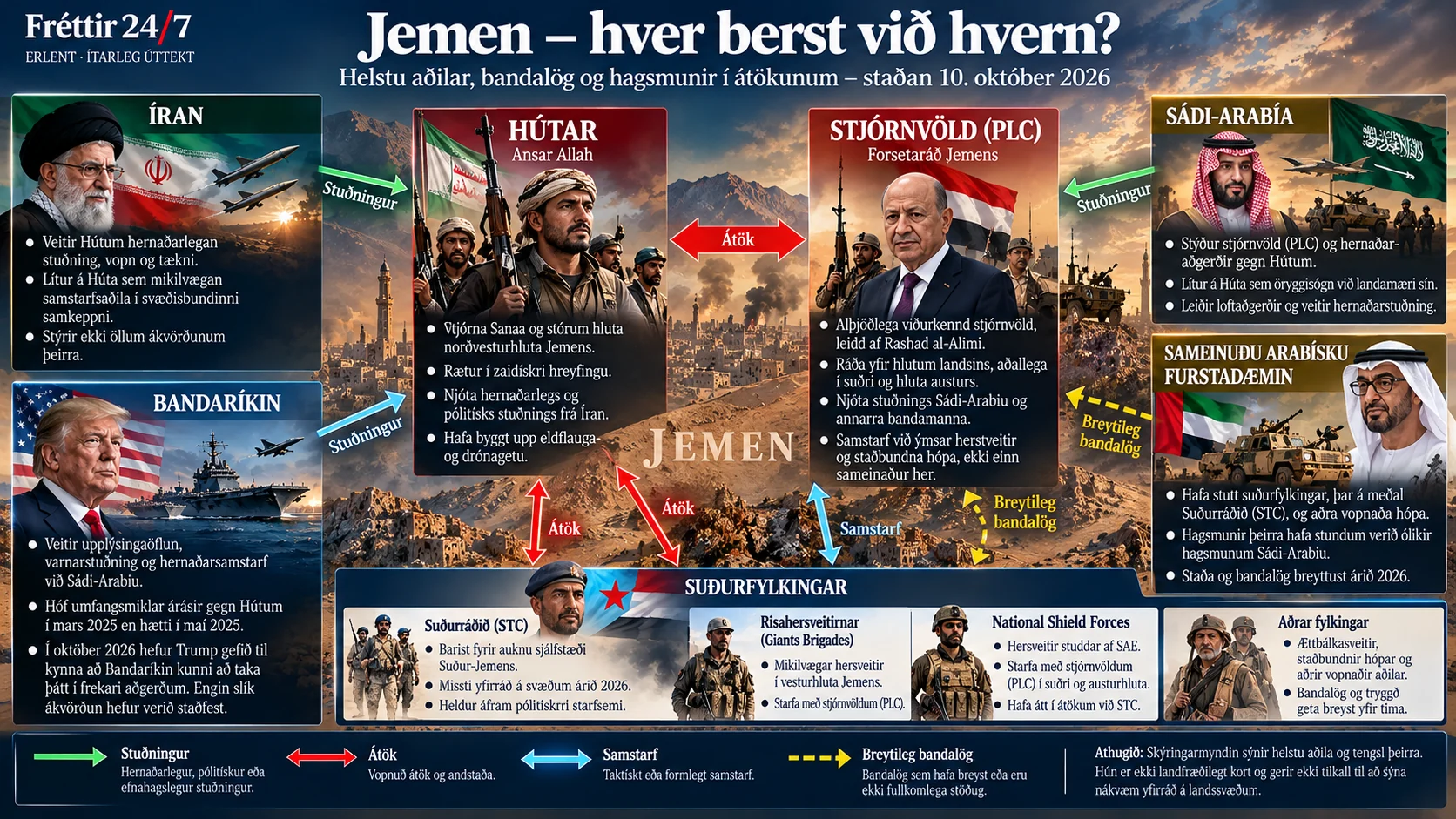
Although Saudi Arabia and the United Arab Emirates both opposed the Houthis, they did not always envision the same future for Yemen. Saudi Arabia prioritised border security and a government able to prevent attacks on the kingdom. The UAE placed particular emphasis on the south, ports, coastal areas and partnerships with local armed forces, including southern separatists and other factions. Different alliances sometimes produced fighting between groups that were all opposed to the Houthis. It is therefore misleading to describe the anti-Houthi “government forces” as though they were always one unified military organisation.
Who Actually Governs Yemen?
In 2022, Hadi transferred presidential authority to the Presidential Leadership Council, headed by Rashad al-Alimi. The council represents Yemen internationally but has never controlled the entire country. The Houthis retained Sanaa and much of the northwest, while government forces and various allied factions held other areas. The situation in the south has shifted amid political and military disputes. When reports say “government forces” have captured territory, it matters which units were involved, who supports them and whether their control has been independently verified.
The 2022 Truce: A Pause, Not Peace
A United Nations-brokered truce took effect in 2022. It significantly reduced large-scale fighting and cross-border attacks. Although the formal truce expired, a degree of military calm continued for a time. No final peace agreement followed. Disputes over civil-service salaries, oil revenue, ports, borders and the country’s future political order remained unresolved.
The Red Sea: A Local War Goes Global
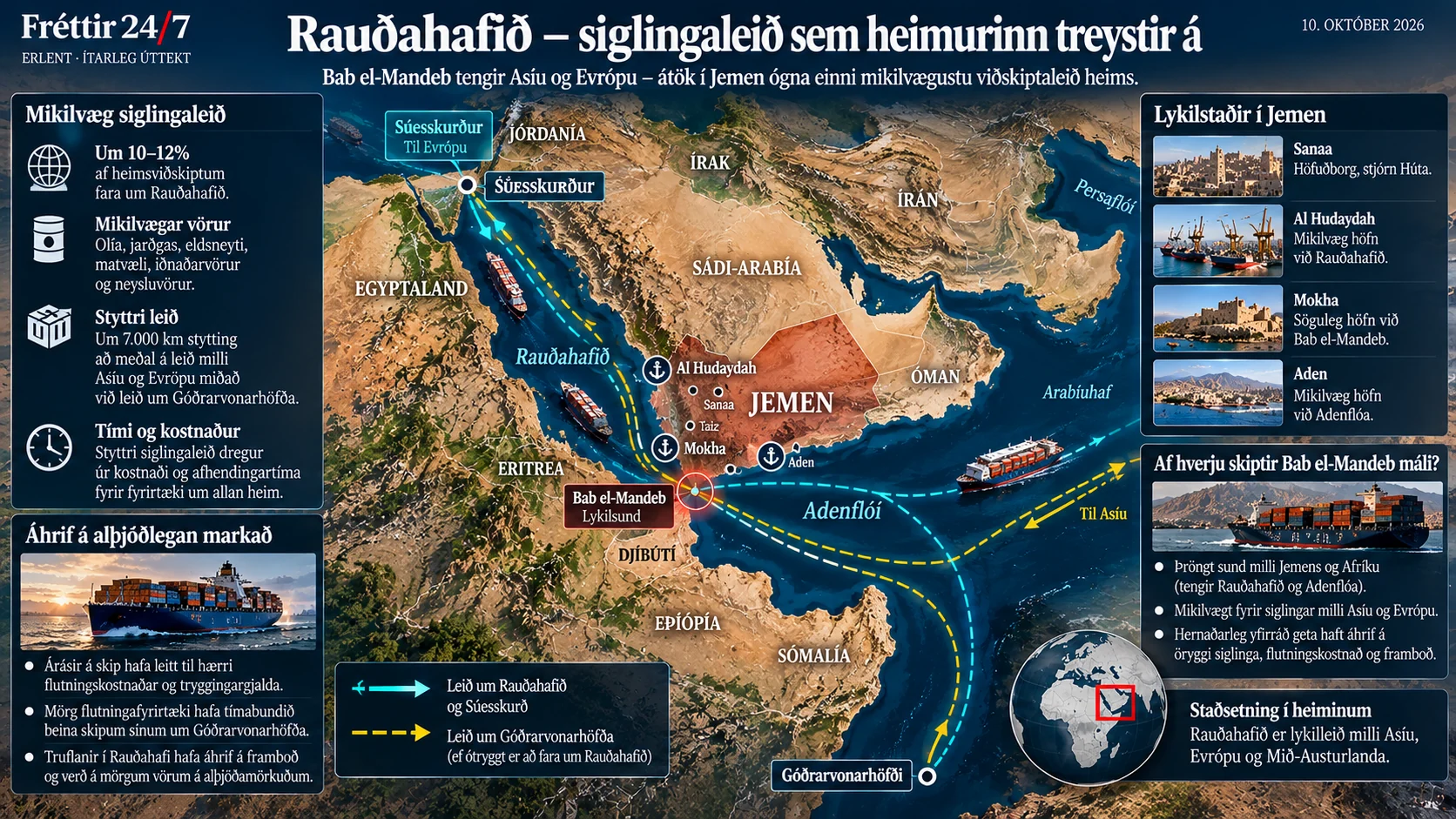
After the Gaza war began in October 2023, the Houthis started attacking ships in and around the Red Sea. They said their operations expressed solidarity with Palestinians and opposition to Israel. Yet some targeted vessels had disputed or unclear links to Israel. International shipping companies responded by rerouting some cargo around the Cape of Good Hope instead of through the Suez Canal and Red Sea. That increased journey times and costs. The Bab el-Mandeb strait thus became not only a military flashpoint but also an issue for the global economy.
The United States: Biden and Trump
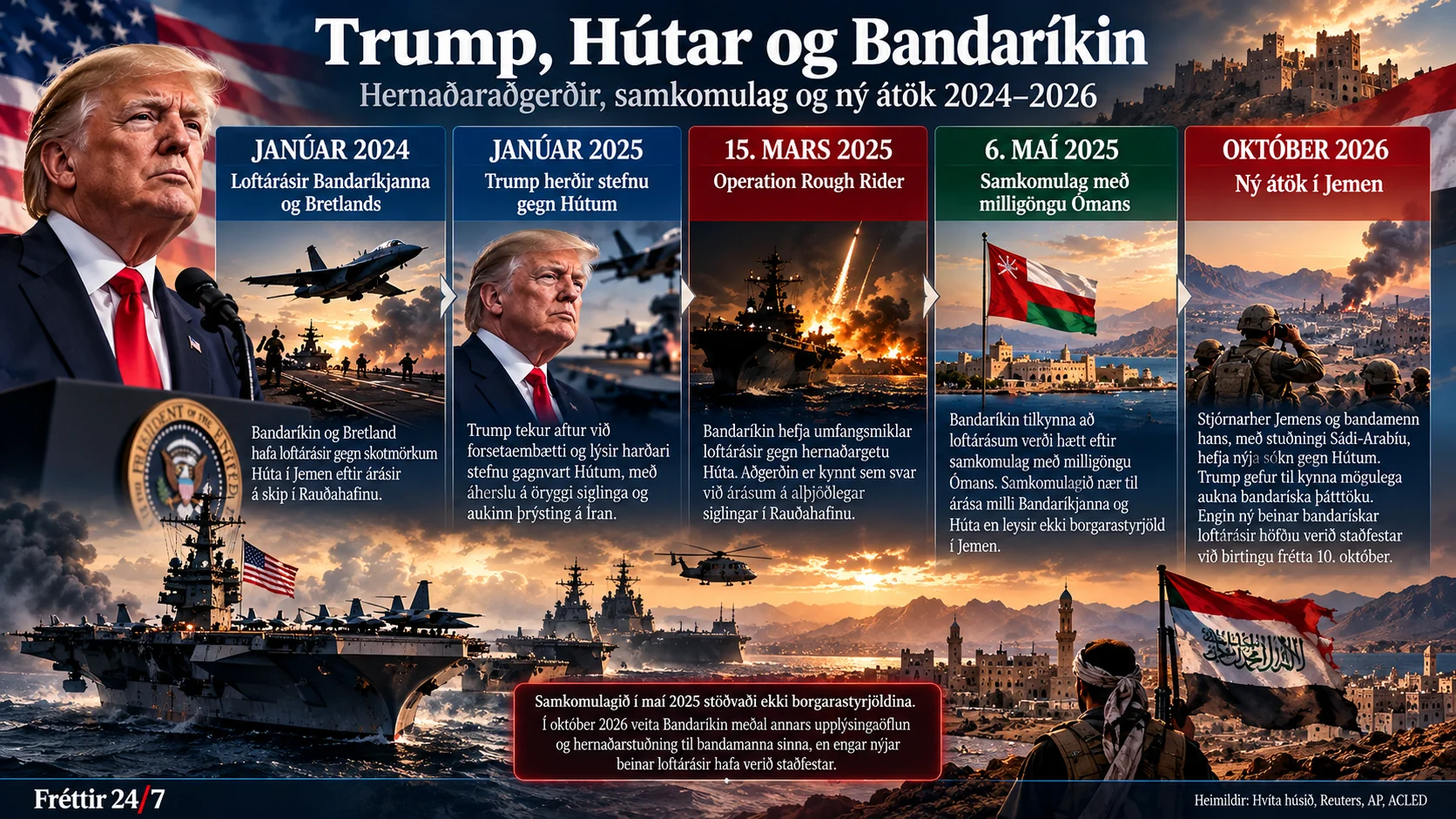
The United States and Britain began military operations against Houthi targets in 2024 under President Joe Biden. The stated goal was to reduce the group’s ability to attack ships and safeguard freedom of navigation. After Donald Trump returned to the presidency in 2025, he pursued more forceful operations. In March 2025, he ordered an extensive air campaign against Houthi positions and capabilities. Trump presented the strikes as a defence of international shipping and directed strong warnings at Iran. The operations also raised questions about civilian casualties, costs and whether air strikes alone could alter the Houthis’ military position.
May 2025: An Agreement Brokered by Oman
On 6 May 2025, Trump announced that the United States would halt strikes on the Houthis following an agreement mediated by Oman. The understanding concerned ending attacks between the United States and the Houthis and reducing threats to shipping. It did not encompass every conflict in the region. The Houthis maintained that they could continue operations against Israel, and the agreement did not end Yemen’s civil war. Trump described the outcome as a success for his military campaign, while the Houthis remained an organised armed force.
October 2026: Another Decision for Washington
New attacks on Saudi Arabia and a major offensive against the Houthis have again confronted Washington with decisions about the extent of US involvement. Trump has indicated that the United States might take part in strikes against the Houthis. Intelligence support and military cooperation, however, are not the same as a new direct air campaign. As of 10 October, the accurate description was possible increased American involvement, not a confirmed new invasion.
Iran: An Important Backer, Not the Whole Explanation
Iran has supported the Houthis and regards the movement as an important partner in its regional rivalry with Israel, the United States and Saudi Arabia. Houthi missile and drone capabilities have expanded. But the relationship with Iran does not, by itself, explain why Yemen’s civil war began. The conflict also stems from domestic struggles over power, religious and regional identities, economic difficulties and a failed political transition. Yemen’s own actors are not simply instruments of foreign governments.
Al-Qaeda and Other Armed Groups
The civil war has created opportunities for armed organisations outside the main opposing camps. Al-Qaeda in the Arabian Peninsula (AQAP) has operated in Yemen for years, exploiting the weakness of state institutions. The United States has long conducted operations against AQAP independently of its confrontation with the Houthis. AQAP and the Houthis are distinct organisations with different ideologies, objectives and alliances. The presence of additional armed groups makes peace efforts more complicated.
A Humanitarian Crisis More Than a Decade Old
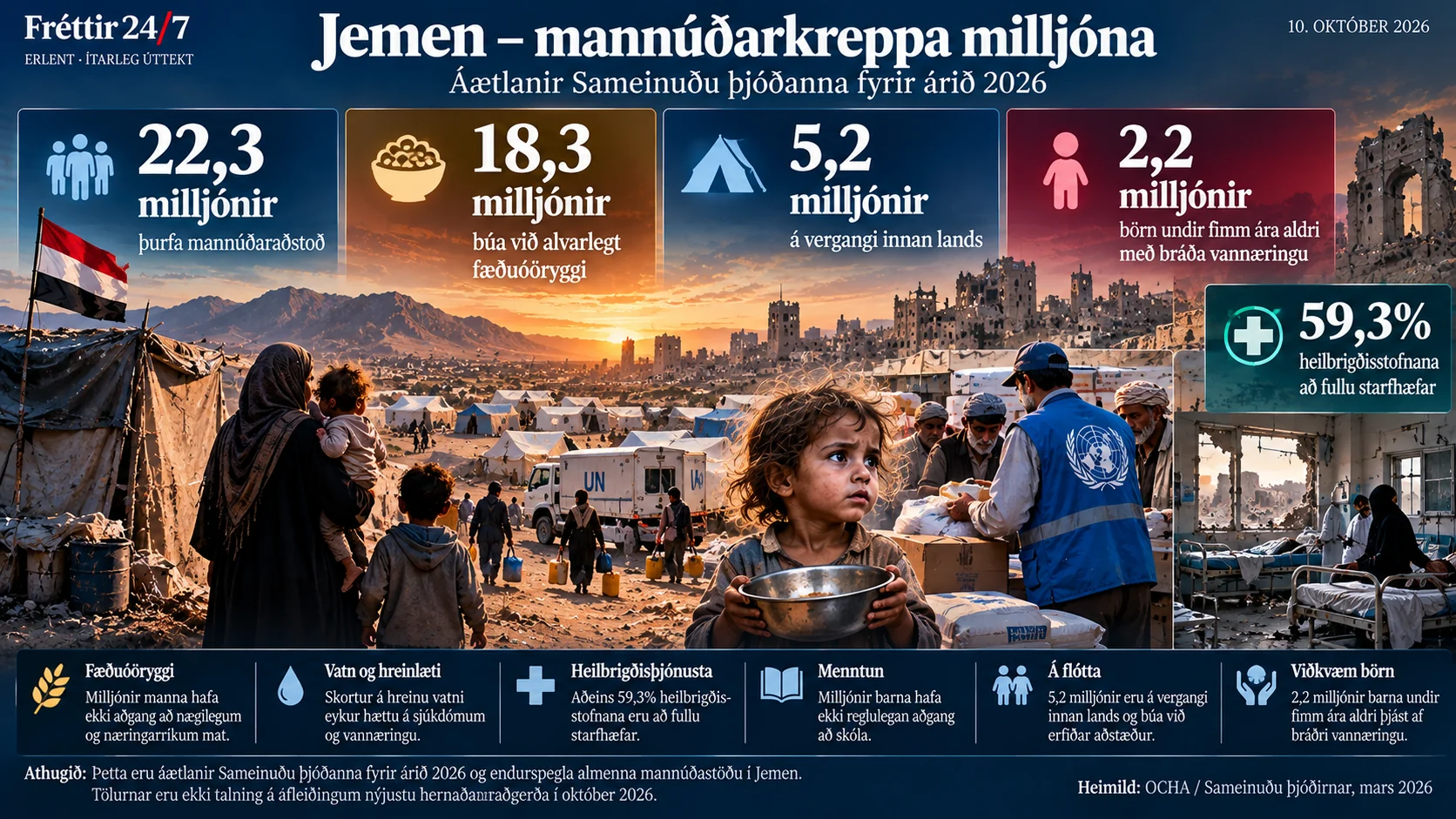
While governments, commanders and foreign allies have fought for control, Yemen’s population has paid an enormous price. According to the United Nations humanitarian plan for 2026, about 22.3 million people need humanitarian assistance and protection. Approximately 18.3 million face severe food insecurity, and 5.2 million are internally displaced. More than 2.2 million children under five suffer from acute malnutrition. These are estimates for 2026, not a count of the consequences of the latest fighting. Yemen’s economy has contracted, its currency has weakened in many areas and public services have broken down. The country imports much of its food and is vulnerable to shipping disruption, rising prices and obstacles to deliveries. According to a UN assessment, only around 59% of health facilities were fully functional.
October 2026: A New Offensive and Attacks on Saudi Arabia
In early October, Yemeni government forces and allies, backed by Saudi Arabia, launched major operations against the Houthis. One objective was to retake areas along the Red Sea and reduce the Houthis’ ability to threaten shipping through Bab el-Mandeb. Reports described a ground offensive and air strikes. Government forces claimed gains near the strait, but the Houthis disputed parts of those accounts. Not all reports of casualties or the precise front line could be independently verified. Missile and drone attacks on targets in Saudi Arabia also caused concern. Reporting on 10 October did not establish responsibility for every specific attack on Riyadh airport, although earlier attacks in the same wave had been linked to the Houthis.
Bab el-Mandeb: Why the Strait Matters
Bab el-Mandeb is a narrow strait between Yemen and Africa. Ships pass through it between the Gulf of Aden and the Red Sea on their way to or from the Suez Canal. It is one of the most important maritime connections between Europe and Asia. Military control of coastlines, islands and ports can give belligerents leverage. But holding territory beside the strait is not the same as controlling all shipping through it. That depends on military capabilities, weapons positions and naval operations. When a warring party claims to have “taken control of Bab el-Mandeb”, it is essential to establish precisely what it means.
Can Saudi Arabia Win the War?
Saudi Arabia’s superiority in the air does not guarantee victory on the ground. The Houthis have decades of experience fighting in northern Yemen’s mountains and have developed the capacity to strike targets far beyond their own territory. Their opponents are not completely united. Disputes over southern Yemen’s future, the role of tribes, control of ports and distribution of revenue could continue even if the Houthis’ military position weakens. What happens next depends on the front lines, cooperation among allies, Houthi operations and whether peace negotiations succeed.
What Might Peace Look Like?
A lasting settlement must address more than Houthi disarmament. It must consider how political power is shared, the future of southern Yemen, public finances, border security and the role of armed groups. It must also enable displaced civilians to return home, children to receive an education and health services to be rebuilt. Saudi Arabia wants security guarantees, Iran has an interest in regional influence, and the United States and other countries prioritise safe navigation. But Yemen’s future cannot be decided solely in Riyadh, Tehran or Washington.
A Country the World Must Not Forget
For thousands of years, Yemen has been a centre of trade, religious culture and political change. In recent decades, however, it has become a symbol of prolonged conflict in which domestic power struggles and foreign interests are intertwined. The new offensive in October 2026 could change the military balance, but it will not automatically resolve problems accumulated over decades. Behind reports of missiles, airports, ports and military alliances are millions of people who have lived through war for much of their lives. The question is not only who will control Yemen, but whether the country will finally have the chance to build a lasting peace.
Sources and Further Reading
OCHA – Yemen · Sameinuðu þjóðirnar · Reuters – Mið-Austurlönd · AP – Yemen · Human Rights Watch – Yemen · Council on Foreign Relations – Yemen.
Editorial note: This article reflects information available as of 10 October 2026. Claims made by warring parties are distinguished from independently verified information. Humanitarian figures are estimates for 2026, not a count of the effects of the latest fighting.