
Iceland's 2026 Football Season: Víkingur Lead the Way as Fram and Keflavík Exceed Expectations
Víkingur Reykjavík secured the Icelandic championship, KR produced the league's most prolific attack, and Fram and Keflavík emerged as two of the season's biggest positive surprises. At the other end of the table, ÍBV finished last after a demanding campaign.
The 2026 Besta deild karla season offered more than a title race. Across 12 clubs and 27 matches per team, the Icelandic men's top division produced a clear champion, an exceptionally high-scoring runner-up, unexpected progress from several sides and a difficult year for others.
Víkingur Reykjavík finished first with 64 points, eight ahead of KR. Fram completed the top three, while Keflavík's sixth-place finish represented a substantial improvement on pre-season expectations. The final standings also reflected a challenging campaign for established clubs including Stjarnan, Valur and KA.
The season's final table tells a story of consistency at the top, attacking ambition and contrasting fortunes across the division.
Víkingur set the standard
Víkingur Reykjavík finished the campaign with 19 wins, seven draws and just one defeat from 27 matches. They scored 79 goals and conceded 28, giving them a goal difference of plus 51.
Their eight-point advantage over KR provides the clearest measure of their season. Víkingur combined the league's strongest defensive record among the top two with a prolific attack, finishing ahead of every rival in the championship group.
The final round included a 2–2 draw with Fram, but the result did not change Víkingur's position at the summit. Their championship was built across the full campaign rather than decided by a single match.
KR bring goals — and a serious challenge
KR finished second with 56 points, having scored 93 goals and conceded 58. Their total of 93 was the highest in the division's final standings, underlining the attacking strength that made them one of the season's central stories.
However, their goal difference of plus 35 remained well behind Víkingur's plus 51, and the eight-point gap separated the two clubs at the end of the season.
KR's second-place finish was also notable in light of Fótbolti.net's pre-season prediction, which placed the club fifth. Finishing second made them one of the sides to outperform expectations, even though the title ultimately went elsewhere.

Fram turn expectations upside down
Fram finished third with 47 points, nine behind KR and 17 behind champions Víkingur. They recorded 13 wins, eight draws and six defeats, scoring 64 goals and conceding 55.
The result was one of the season's clearest positive surprises. Fótbolti.net's pre-season prediction had placed Fram eighth, five positions below their eventual finish.
Their third-place finish put them ahead of clubs that had been expected to compete higher up the table. It also gave the Reykjavík side a season to build on, although the final standings alone cannot tell us how much of that progress came from tactics, recruitment or individual performances.
The championship group: six different stories
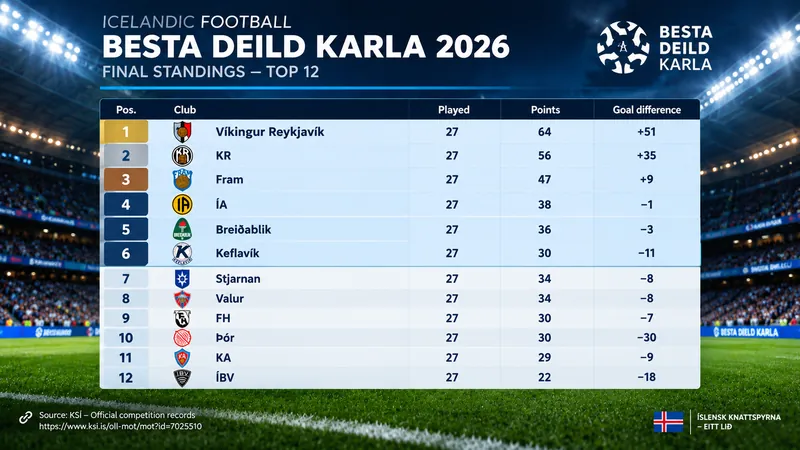
The top six entered the closing phase in the championship group, where the final standings were as follows:
| Pos. | Club | Played | Points | Goal difference |
|---|---|---|---|---|
| 1 | Víkingur Reykjavík | 27 | 64 | +51 |
| 2 | KR | 27 | 56 | +35 |
| 3 | Fram | 27 | 47 | +9 |
| 4 | ÍA | 27 | 38 | −1 |
| 5 | Breiðablik | 27 | 36 | −3 |
| 6 | Keflavík | 27 | 30 | −11 |
Source: KSÍ, official 2026 championship-group standings.
ÍA finished fourth with 38 points, a position that matched Fótbolti.net's pre-season prediction. They scored 54 goals but conceded 55, ending with a slightly negative goal difference.
Breiðablik, by contrast, finished fifth with 36 points after having been predicted to finish second. Their final record of 54 goals scored and 57 conceded suggests a campaign in which attacking output was not enough to offset defensive difficulties.
Keflavík's sixth place was a different kind of story. Predicted to finish 11th before the season, they ended the campaign with 30 points and a place in the top half. They were five positions higher than expected, making them one of the division's strongest positive surprises by that measure.
The lower group: close margins and difficult finishes
The remaining six clubs competed in the lower group. Stjarnan finished seventh overall, ahead of Valur on the season's final standings, with both clubs ending on 34 points.
| Pos. | Club | Played | Points | Goal difference |
|---|---|---|---|---|
| 7 | Stjarnan | 27 | 34 | −8 |
| 8 | Valur | 27 | 34 | −8 |
| 9 | FH | 27 | 30 | −7 |
| 10 | Þór | 27 | 30 | −30 |
| 11 | KA | 27 | 29 | −9 |
| 12 | ÍBV | 27 | 22 | −18 |
Source: KSÍ, official 2026 lower-group standings; overall positions follow the published final table.
Stjarnan's seventh place was a significant disappointment compared with their predicted third. They finished 30 points behind Víkingur and ended with a negative goal difference of eight.
Valur, predicted sixth, finished eighth. FH finished ninth, exactly where the pre-season prediction had placed them, while Þór's tenth place also matched expectations.
KA finished 11th after having been predicted seventh. They scored 47 goals over the season but conceded 56, finishing with 29 points. ÍBV ended the campaign in last place on 22 points, confirming the relegation outcome anticipated in Fótbolti.net's pre-season prediction.
The lower group was not without competition: FH and Þór both finished on 30 points, while Stjarnan and Valur were level on 34. Those close totals show how a handful of results can shape a club's final position, even when the gap to the champion is substantial.
Aron Sigurðarson leads the scoring charts
Individual performances were another important part of the season. KSÍ's competition records list KR's Aron Sigurðarson as the leading scorer in the regular-season table with 20 goals.
His scoring record helped underpin KR's outstanding attacking total. Eiður Gauti Sæbjörnsson, also of KR, was listed next with 13 goals, followed by Víkingur's Elías Már Ómarsson with 12.
These figures should be read alongside the relevant competition phase: the league's split format means regular-season statistics and later championship- or lower-group matches should not be mixed without checking the scope of each record.

What the final standings tell us
The 2026 season had three especially clear themes.
First, Víkingur combined consistency with a substantial advantage over their closest challengers. Their 64 points and plus-51 goal difference made them the clear benchmark for the division.
Second, the final table did not simply follow the pre-season forecast. Fram rose from a predicted eighth to third, Keflavík from 11th to sixth, and KR from fifth to second. Meanwhile, Breiðablik, Stjarnan and KA finished below their predicted positions.
Third, attacking football was a prominent feature of the campaign. KR scored 93 goals, Víkingur 79 and Fram 64. Yet the standings also demonstrate that scoring freely does not automatically secure the title: the balance between goals scored and conceded remained crucial.
For readers following Icelandic football from abroad, the season offered a useful snapshot of a league in which established clubs, rising challengers and sides fighting to stay clear of the bottom all contributed to the story.
Víkingur finished as champions, but the wider season belonged to more than one club. Fram and Keflavík exceeded expectations, KR supplied the division's most prolific attack, and the final table recorded both the rewards of consistency and the cost of falling short.
Sources
- KSÍ — Official 2026 Besta deild karla standings and results
- KSÍ — Championship group standings and results
- KSÍ — Lower group standings and results
- Fótbolti.net — How the pre-season predictions compared with the final table
Editorial note — 28 October 2026: This season review draws on the official KSÍ competition standings and scoring records, alongside Fótbolti.net's published comparison of pre-season predictions and final positions. The prediction comparison is attributed to Fótbolti.net; it is not presented as original Frettir247 research.
Tips, corrections or questions: ritstjorn@frettir247.news
More from Sports
 SPORTS · NFLNFL: Understanding American Football1 November 2026
 SPORTS · NBAThe NBA Enters a New Era: New York's Historic Championship and the 2026–27 Season1 November 2026
 SPORTS · WNBAGolden State Valkyries Make History: A New WNBA Champion Emerges as Women's Basketball Enters a New Era1 November 2026