
Supermarket Fridge Attacks: France Points the Finger at Iran
Paris prosecutors have opened an investigation into a unit linked to Iran's Revolutionary Guards. Researchers have also found new flaws in a widely used fridge controller.
Updated 21 November 2026 with a statement by Belgium's interior minister.
A month after hundreds of French supermarkets found their fridges and freezers running warm, France has named a suspect. On 9 November the Paris prosecutor, Laure Beccuau, announced a judicial investigation into Shahid Kaveh, a cyber unit linked to the Islamic Revolutionary Guard Corps of Iran, and into its head and two deputies.
Fréttir 24/7 explained how the attacks worked in The Night Europe's Supermarket Fridges Turned Hot on 5 November. This is what has happened since.
What the prosecutors say
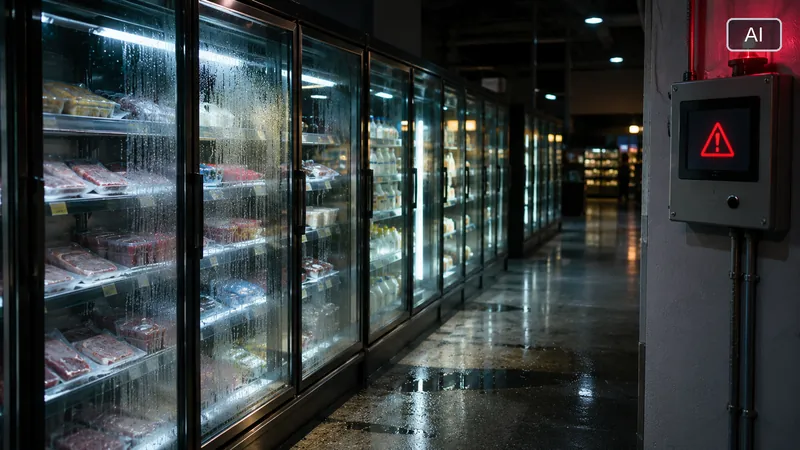
According to the prosecutors, the attackers broke into the web interfaces of refrigeration controllers made by Danfoss and Dixell in about 700 shops on the night of 11 to 12 October. They set off endless defrost cycles and switched off the temperature alarms. Large amounts of food were thrown away, and about 20 fires were reported.
The case is being investigated as unauthorised access to computer systems and as damage committed by an organised gang, with the aggravating circumstance that it was done "to serve a foreign power". Prosecutors are also investigating a criminal conspiracy to prepare a crime. Investigating judges have now taken over.
The evidence they cite includes the attackers' methods, which they say are typical of an Iranian cyber unit, the use of Farsi, and IP addresses leading to computers in Iran.
France's response
The Foreign Minister, Jean-Noël Barrot, went further the next day. "It is a terrorist organisation that has committed an attack," he told the broadcaster franceinfo, describing it as an attack of unprecedented scale and aggressiveness in France. France would summon Iran's ambassador and seek European sanctions, he said, adding that France "rules nothing out".
Iran denies carrying out malicious cyber operations, and had not responded to the accusations by the time of writing, according to Reuters.
The second wave is a separate case, for now
The attacks did not stop in France. On the night of 2 November, refrigeration units were switched into defrost mode in dozens of shops in Belgium, Luxembourg, Sweden and Ireland. No link to the October attack in France has been established. Belgium's federal prosecutor has opened a criminal investigation, which it calls "an absolute priority", but has not yet said whether it has confirmed an attack or who might be behind it. Belgium's Interior Minister, Bernard Quintin, told parliament on 12 November that, according to evidence obtained by Belgian agencies, Iran "could potentially be behind" the attacks, but he stopped short of a formal attribution. The security company SentinelOne says the question of who is responsible remains open, and that the incidents may not all have the same author.
More holes in the fridges
Meanwhile, the equipment itself is under fresh scrutiny. On 15 November the Dutch security firm Midnight Blue said its researcher Carlo Meijer had found six previously unknown flaws in Danfoss's AK-SM800A system manager, the current model of the controller that runs a whole store's refrigeration. According to the firm, the flaws affect every version of its software up to 5.3.2 and can allow an attacker to take full control of the device without a password.
Midnight Blue says it is working with Danfoss and is holding back the technical details until a fix is ready. There is no sign that these flaws were used in the attacks. France's cybersecurity agency, ANSSI, has said its early findings pointed to simpler weaknesses: admin pages left open on the internet and weak passwords.
For shops, the advice from the authorities has not changed: take the controllers off the open internet, change the passwords, and replace equipment that no longer receives updates.
Sources
- AFP via Arab News — Belgium says evidence points at Iran over fridge cyberattacks, 12 November 2026 – The Belgian interior minister's statement to parliament.
- Orange Actu (L'Express via 6Medias) — Cyberattaque contre les frigos de supermarchés : le parquet de Paris soupçonne l'Iran, 9 November 2026 – The Paris prosecutor's investigation and the Foreign Minister's response (in French).
- Intellinews — Cyberattaque contre des frigos de supermarchés : la France pointe du doigt l'Iran, 9 November 2026 – How the attack worked, the evidence and Iran's denial (in French).
- BX1 — Une enquête pénale fédérale ouverte à propos de l'attaque d'installations frigorifiques, 12 November 2026 – The Belgian federal investigation (in French).
- Cyber Security News — Researchers find six 0-days allowing takeover of supermarket refrigeration systems, 15 November 2026 – Midnight Blue's findings and ANSSI's early conclusions.
- The Hacker News — New wave of refrigeration cyberattacks hits supermarkets across Europe, November 2026 – The second wave on 2 November.
Reporting note: This article is based on French reporting by L'Express (via 6Medias), Intellinews and franceinfo, on BX1 for the Belgian investigation, and on Cyber Security News for Midnight Blue's findings. Quotes from French are translated by Fréttir 24/7. Attribution of the attacks to Iran is the position of the French prosecutors and government, and Iran denies it. No one has been charged in court.
This article was drafted with AI assistance and reviewed and edited by Fréttir 24/7's editorial team.
Tips, corrections or questions: ritstjorn@frettir247.news
More from Technology
 TECHNOLOGY · CLOUD · ANALYSISWhen Outlook Went Silent14 November 2026
 TECHNOLOGY · CYBERSECURITY · EXPLAINERThe Night Europe's Supermarket Fridges Turned Hot5 November 2026
 TECHNOLOGY · AICan AI Think Like a Supreme Court Justice? University Experiment Tests the Limits of Artificial Intelligence in Law31 October 2026