
A Billion-Euro Bet on AI – But Who Pays the Bill?
A French tech company plans to spend more than €10 billion on an AI data centre in Finland. But its financing, power supply and final scale are still uncertain.
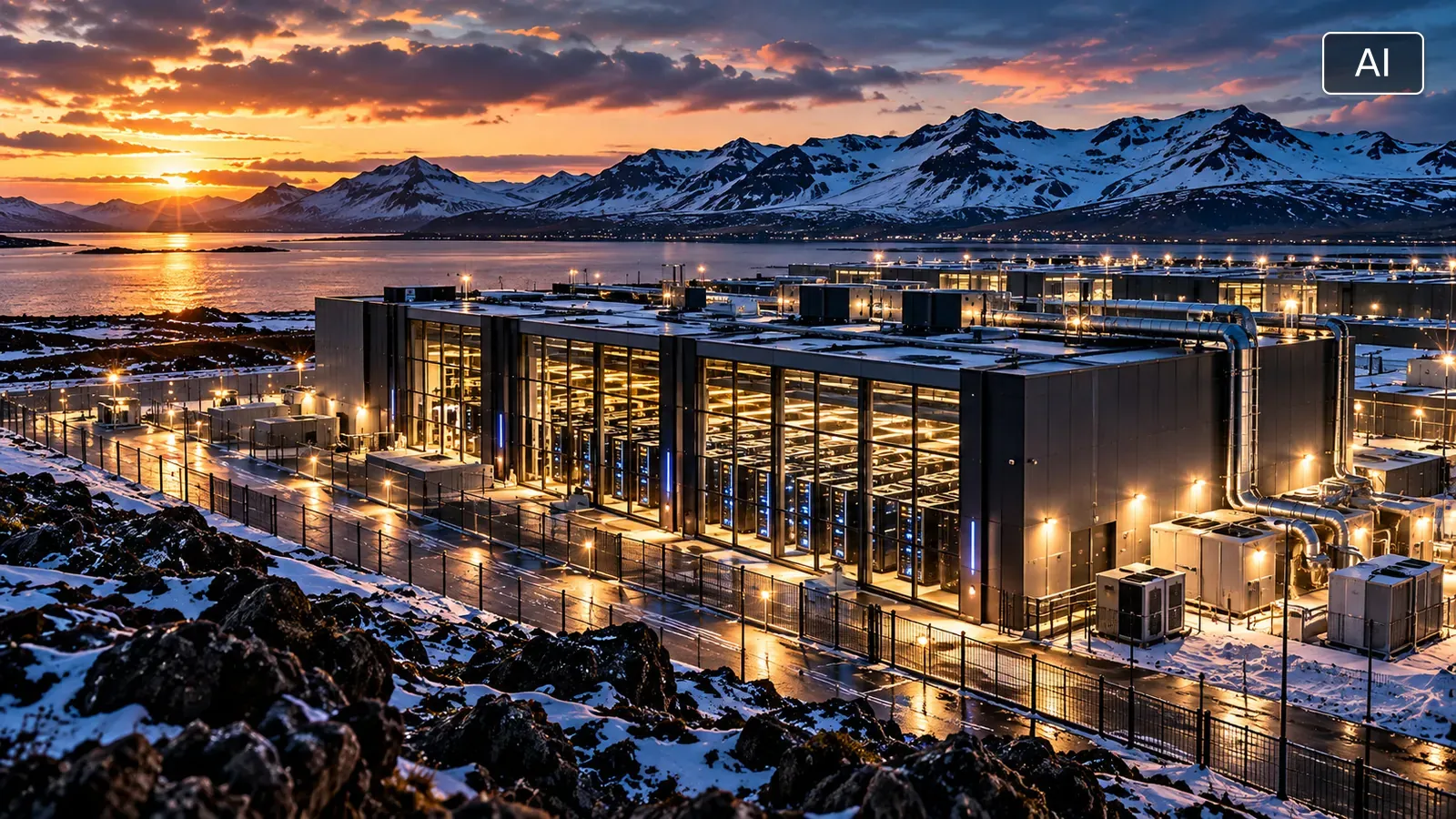
A French technology company plans to invest more than €10 billion, equivalent to around ISK 1.4 trillion, in an AI data centre in Finland. The project could become one of the largest of its kind in the Nordic countries. But although the company says it has secured a major customer, the financing, the power supply and the final execution of the project still depend on important uncertainties.
From paper mill to artificial intelligence
For decades, the Kaipola paper mill stood in the town of Jämsä in central Finland. Hundreds of people worked there in an industry that was long one of the pillars of Finnish manufacturing.
The mill closed in 2021. It left behind a large industrial site with power connections, water systems, buildings and transport infrastructure.
Now the French company Sesterce wants to use the site for a large data-centre complex for computing and training AI systems.
According to the company's announcement on 8 October, construction of the first phase, of 200 megawatts, is due to start before the end of the year. A second phase is planned to raise capacity to 600 megawatts.
The company has also set out a long-term goal of building more than one gigawatt of computing infrastructure in Finland.
Ten billion euros – but what is confirmed?
Sesterce puts the planned investment at Kaipola at more than €10 billion.
This is the company's investment plan, not confirmed money spent on construction.
Youssef El Manssouri, Sesterce's chief executive, confirmed to the Finnish public broadcaster Yle that an investment decision has been taken and a contract signed with a future customer.
He says the customer is one of the world's two leading AI research labs, but has declined to name it.
Nor has it been disclosed who is financing the project.
According to the French company register, as reported by Yle, Sesterce Group's turnover in 2024 was around €11.95 million.
The planned investment is therefore more than 800 times that annual turnover.
That is not automatically a sign that the project is unrealistic. Large data-centre projects can be financed through special project companies, loans, investors and long-term contracts.
But without information on the financing and contractual commitments, it is not possible to judge independently how secure the project's execution is.
The power demand could equal nearly a quarter of Iceland's use
A data-centre complex with 600 megawatts of electrical capacity is an enormous undertaking.
If it used all of that capacity continuously, around the clock for a full year, its electricity consumption would be about 5.26 terawatt-hours.
For comparison, the National Energy Authority's (Orkustofnun) base forecast for 2024–2050 expected Iceland's annual electricity use to be close to 22 terawatt-hours in 2035.
The data centre's calculated annual use is therefore equivalent to about 24% of that benchmark.
This is a theoretical comparison, however, not Sesterce's confirmed energy use. Actual use depends on, among other things, how fully the equipment is used, how the phases are built and whether the stated capacity covers the data centre's entire operation.
The comparison nevertheless shows how big an effect building AI infrastructure can have on power systems.
Comparison of planned capacity
Chart title: Planned data-centre capacity (MW) - Sesterce – first phase: 200 MW – Planned first phase - Sesterce – full build-out: 600 MW – Planned maximum capacity - atNorth – Salo: 230 MW – Possible total capacity Note under the chart: A comparison of announced plans, not confirmed electricity use or completed data centres. Bar lengths are scaled to 600 MW. Screen-reader label: Comparison of the planned electrical capacity of three data-centre phases, in megawatts
New renewable energy – but not necessarily from day one
Sesterce has committed to supporting the construction of one megawatt of new renewable generation for every megawatt the data centre uses.
According to the company's statement, it has up to ten years from the start of operations to meet this commitment.
Here it is important to distinguish between installed capacity and actual energy production.
One megawatt in a wind farm does not necessarily produce as much electricity over a year as a data centre that uses one megawatt continuously.
Nor does the commitment guarantee that new generation will be available from the first day of operation.
It therefore remains unclear how the project's full power demand will be met at each stage of the build-out.
Two thousand jobs during construction
Sesterce estimates that around 2,000 jobs will be created during construction and around 300 permanent jobs once the data centre is operating.
For Jämsä, where the closure of the paper mill hit the local economy hard, the project could be of great economic importance.
The town authorities have greeted the plans with cautious optimism.
Jori Reijula, the mayor of Jämsä, has stressed that the project must meet the legal requirements and go through the proper administrative processes.
According to Yle, talks on buying the former mill site were well advanced when the project was announced, but had not been concluded.
The projected jobs and investment therefore still depend on the construction actually going ahead.
The Icelandic connection: atNorth is also building in Finland
Sesterce is not the only company to have announced a large data-centre build-out in Finland.
On 5 October, atNorth, a data-centre company with Icelandic roots, announced a new data centre in Salo in southern Finland.
The company's investment is estimated at around €2 billion.
The first phase is planned at 75 megawatts, with the option to expand total capacity to as much as 230 megawatts.
According to atNorth, power for the first phase has already been secured.
The company also points out that the estimated €2 billion investment does not include servers and other equipment owned by customers. In the company's view, such investments could amount to as much as €10 billion more.
That figure is a possible future investment by customers, not a confirmed cost.
How can Iceland compete?
The build-out in Finland raises questions about Iceland's competitive position.
Iceland has renewable electricity, a cold climate and years of experience running data centres.
But the largest data-centre projects of the future need more than favourable energy. They also need access to large amounts of power, strong transmission grids, telecommunications links and sites where operations can be built up in phases.
The National Energy Authority has previously pointed out that the construction of new power plants and transmission lines has not always kept pace with growing demand for electricity in Iceland.
That can affect Iceland's chances of attracting large data-centre investments.
At the same time, atNorth's investment in Finland shows that companies with Icelandic roots can choose to build new infrastructure wherever they believe conditions are best.
What happens to the heat and the water?
Data centres of this size produce a great deal of heat, which has to be removed to keep the computer equipment within safe temperature limits.
Sesterce plans to use closed liquid-cooling systems together with rainwater and recycled water.
The company says it will not use drinking water for cooling and has also announced that it will look at ways to use the waste heat.
It has also presented plans for a €10 million community fund and annual independent audits of its environmental and social commitments.
At this stage, these are stated plans. Their real results cannot be judged until the technical solutions, measurements and operating results are available.
A new industrial revolution – but who takes the risk?
Where paper was once produced, computing infrastructure that trains and runs AI systems for customers around the world could rise in the coming years.
The project reflects how computing power, electricity and data centres are becoming an ever more important part of the global economy.
But big questions remain unanswered.
Who is the unnamed customer? Who is putting up the money? When will enough electricity be available? And how much of the construction will actually happen?
Ten billion euros is not just a figure in a press release.
An investment of that size calls for transparency about financing, energy supply, environmental impact and who bears the financial risk if the plans do not work out.
Sources
- Sesterce – Sesterce Plans a €10 Billion AI Campus in Jämsä, 8 October 2026
- Yle – reporting on the financing, the customer and the status of the project
- Orkustofnun (National Energy Authority) – Energy Forecast 2024–2050 (in Icelandic)
Note on the electricity comparison: The 22 TWh benchmark is based on the earlier Energy Forecast 2024–2050. A newer Electricity Forecast 2025–2050 has also been published, so this is a historical benchmark, not the latest forecast.
Editorial note: This article is an English translation of an analysis first published in Icelandic on 9 October 2026. Investment, capacity and job figures are the companies' own announcements, not confirmed results. The illustration was created with AI for Fréttir 24/7 and is not a photograph of the site.
Tips, corrections or questions: ritstjorn@frettir247.news