
Iceland's Strong Króna: Economic Strength or a Growing Competitiveness Problem?
How currency appreciation, persistent inflation and high interest rates are reshaping Iceland's economic outlook.
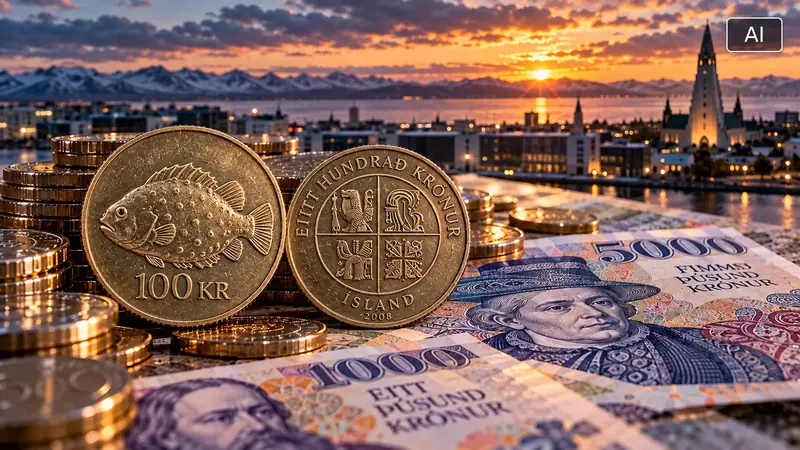
Iceland's currency has strengthened during 2026, creating an economic picture that is more complicated than the headline exchange rate might suggest.
A stronger króna can improve purchasing power, reduce the domestic cost of imported products and make foreign travel more affordable for Icelandic households. It can also make Iceland more expensive for international visitors and place pressure on companies that earn revenue abroad but pay many of their operating costs at home.
At the same time, Iceland continues to struggle with inflation, elevated interest rates and questions about the competitiveness of its export industries.
The Central Bank of Iceland has held its key interest rate at 8%, while annual inflation stood at 5.9% in October, unchanged from September. Despite these pressures, the króna has remained relatively strong, even as the country's external accounts have shown significant imbalances.
The situation raises an important question: is the strong króna a reflection of underlying economic resilience, or is it becoming increasingly difficult for Iceland's export economy to sustain?
Understanding the answer requires looking beyond the daily exchange rate.
A currency strengthening against a complicated economic background
The Icelandic króna is a relatively small and internationally less-traded currency. Its value can respond quickly to changes in investment flows, interest-rate expectations, tourism revenues, foreign trade and market confidence.
According to the Central Bank of Iceland's official exchange rates published on 30 October 2026, one euro was valued at ISK 136.00, while one US dollar was valued at ISK 121.73.
These figures provide a useful snapshot, although a single day's exchange rate cannot establish the longer-term direction of the currency.
A more meaningful assessment requires examining the trade-weighted exchange-rate index, which measures the króna against a basket of currencies representing Iceland's trading partners.
Íslandsbanki reported in October that the króna had strengthened by more than 3% in trade-weighted terms between December 2025 and August 2026. It then appreciated further, gaining just under 2% in trade-weighted terms and about 2.6% against the euro between the beginning of September and 2 October. According to the bank, the króna was then at its strongest against the euro since mid-2022.
The movement is particularly interesting because it occurred despite substantial demand for foreign currency from importers, investors and other participants in the Icelandic economy.
This suggests that the currency's strength cannot be explained by one factor alone.
The Central Bank's unusual position in the foreign-exchange market
One of the most interesting developments in Iceland's currency market during 2026 has been the Central Bank's foreign-currency purchasing programme.
In May, the Bank resumed regular foreign-currency purchases in the domestic interbank market, buying €6 million per week.
On 11 September, the Bank announced that it would double the purchases to €12 million per week from 15 September, citing Treasury foreign-currency needs that were higher than planned. At that time, the purchases were scheduled to end on 15 October unless conditions changed.
The Bank also bought €21 million, about ISK 2.9 billion, on 25 September, almost two-thirds of interbank market turnover that day, according to Íslandsbanki. By early October, its purchases since May totalled about €153 million, or more than ISK 21 billion.
The purchases are intended primarily to meet the Treasury's ordinary foreign-currency requirements and maintain the country's international reserves.
The distinction matters.
Central Bank currency purchases should not automatically be interpreted as an attempt to weaken the króna or establish a particular exchange-rate level. When it increased the purchases in September, the Bank said it did not expect them to have a noticeable effect on the exchange rate under current conditions.
Nevertheless, the programme has become an important part of the wider currency discussion.
When a central bank purchases foreign currency, it creates additional demand for foreign exchange and corresponding demand for domestic currency is reduced relative to what it otherwise might have been.
The fact that the króna has continued to strengthen despite these purchases illustrates how several competing financial flows can influence a relatively small currency market.
The Bank also retains the ability to intervene in the foreign-exchange market when it considers action necessary to reduce short-term volatility.
For Iceland, maintaining adequate international reserves is particularly important because the country depends heavily on international trade and remains exposed to external economic shocks.
Inflation remains a serious problem
A stronger currency does not automatically mean that domestic inflation disappears.
Iceland's consumer price index rose by 0.44% between September and October 2026, according to Statistics Iceland. Annual inflation was 5.9%, the same as in September and the highest rate in more than two years.
Fuel prices were among the main contributors to the monthly increase. Diesel prices rose by 11.2% and petrol by 8.0% in the month, together adding about 0.27 percentage points to the index.
When it announced its October decision, the Central Bank pointed to the conflict in the Middle East and higher public levies as major drivers of the rise in headline inflation.
Underlying inflation has remained just above 4%, indicating that domestic price pressures have not disappeared.
This creates a difficult situation for monetary policymakers.
On 7 October, the Central Bank kept its policy rate at 8%, pausing after three consecutive increases of 0.25 percentage points, the most recent in August. The Bank said further decisions would depend on economic activity, inflation and inflation expectations. Its next decision is due on 18 November.
High interest rates can help reduce demand and discourage excessive borrowing, while also supporting the króna through the relative attractiveness of domestic financial assets.
However, they create considerable costs for households and businesses.
Mortgage borrowers, companies financing investment and consumers relying on credit all feel the effects.
The challenge is that Iceland cannot depend indefinitely on high interest rates to compensate for deeper structural problems affecting productivity, wages, competition and the cost of operating businesses.
Why a strong króna is not necessarily good news for exporters
For Iceland's export economy, currency appreciation creates a complicated balance.
Fisheries, aluminium production, tourism and other internationally exposed industries generate substantial foreign-currency revenues.
When the króna strengthens, those revenues become worth fewer Icelandic krónur when converted back into domestic currency.
A simplified example illustrates the effect.
Imagine an Icelandic exporter receives €1 million for a shipment of goods.
At an exchange rate of ISK 145 per euro, the revenue converts into ISK 145 million.
At ISK 136 per euro, the same foreign-currency payment converts into ISK 136 million.
The difference is ISK 9 million, before accounting for changes in costs, hedging arrangements or other contractual factors.
For an exporter with significant domestic wages, electricity, maintenance and operating expenses, this can affect profitability.
It does not mean every exporter automatically loses money when the currency strengthens. International commodity prices, production efficiency, foreign-currency expenses and financial hedging can offset some of the impact.
This is particularly relevant to Iceland's fisheries and aluminium industries.
Favourable international prices for fish and aluminium have helped support export revenues, according to Íslandsbanki's October analysis.
However, favourable commodity prices cannot be assumed to continue indefinitely.
If international prices weaken while the króna remains strong, exporters could face a much more difficult environment.
Tourism: The cost of visiting Iceland
Tourism is another industry directly exposed to currency movements.
Iceland has built a major international tourism economy, attracting visitors through its landscapes, geothermal attractions, northern lights, culture and outdoor experiences.
However, Iceland is already an expensive destination.
When the króna strengthens, accommodation, restaurants, transport and other domestic services can become more expensive for visitors when measured in their home currencies.
This can influence decisions about where to travel, how long to stay and how much to spend.
The effect is not necessarily immediate.
International visitors make decisions months in advance, and airline capacity, household incomes, seasonal demand and competition from other destinations also influence travel patterns.
Tourism businesses must therefore manage more than visitor numbers. Revenue per visitor, operating costs, occupancy and profitability are equally important.
Íslandsbanki noted that the summer tourism season appeared to generate more revenue per visitor even though overall visitor numbers were broadly unchanged year-on-year.
That distinction is important.
A successful tourism industry should not be measured exclusively by how many people arrive. The economic contribution of each visitor matters too.
Nevertheless, a persistently high real exchange rate can make Iceland less competitive against alternative destinations.
The real exchange rate: Why the headline number is not enough
The nominal exchange rate tells us how many krónur are required to purchase a foreign currency.
The real exchange rate goes further.
It considers differences in prices and costs between Iceland and its trading partners, adjusted for currency movements.
This distinction is particularly important for Iceland because domestic wages and prices have increased considerably over recent years.
Even if the nominal króna exchange rate remains relatively stable, Iceland can become more expensive compared with competing countries if domestic prices and labour costs rise faster than those abroad.
A high real exchange rate can therefore reduce international competitiveness without requiring a dramatic movement in the daily euro-to-króna rate.
For businesses, this is often the more important measurement.
It helps explain why a currency that appears strong in financial markets can still create difficulties for industries competing internationally.
It also explains why currency appreciation should not automatically be interpreted as proof that the domestic economy has become more productive.
Pension funds, investment and foreign capital
Another important part of the story involves Iceland's pension funds.
Iceland has a substantial pension system with significant domestic and international investments.
When pension funds purchase foreign assets, they generally need to purchase foreign currency. These transactions can influence the exchange market.
Íslandsbanki reported that Icelandic pension funds purchased foreign currency equivalent to almost ISK 76 billion between January and the end of August 2026.
That was roughly a third of the amount purchased during the same period in 2025.
The bank also noted that foreign-currency assets represented around 42% of pension funds' total assets at the end of July, against a statutory ceiling of 54.5%.
These figures demonstrate that pension funds are important participants in the currency market.
The investment decisions of these institutions are influenced by diversification, long-term returns, risk management and regulatory limits.
Their currency purchases can create demand for euros, dollars and other foreign currencies, even when the króna is strengthening for other reasons.
Foreign investors also matter.
Purchases of Icelandic government securities and other domestic financial assets can create additional demand for krónur.
The resulting exchange-rate movement depends on the balance between these different flows.
A current-account deficit that deserves attention
Perhaps the most interesting contradiction in Iceland's current economic position is the strength of the currency alongside a sizeable current-account deficit.
The current account measures transactions between Iceland and the rest of the world, including trade in goods and services, investment income and transfers.
A deficit means that, over the measured period, payments and outflows exceeded corresponding receipts and inflows.
Central Bank figures published in early September showed a current-account deficit of around ISK 120 billion in the second quarter of 2026, as reported by Morgunblaðið. Íslandsbanki described the deficit as substantial, while expecting it to narrow.
That is a substantial imbalance.
However, it should not be interpreted without examining what is driving it.
Investment in data centres, infrastructure and other capital-intensive projects can require significant imports of equipment and technology.
These imports can initially worsen the current-account balance while creating productive capacity that may generate future revenues. The IMF noted in July that the deficit widened in 2025 mainly because of imports for data centres.
The financing of those investments also matters. Foreign investment can fund imports without creating the same immediate pressure on domestic foreign-exchange reserves as an entirely domestically financed expansion.
This is one reason why the current-account deficit and the króna's exchange-rate performance do not necessarily move together.
The important question is whether today's investment eventually produces sufficient export revenues, productivity improvements and economic value.
If it does, the current imbalance may be part of a longer-term development strategy.
If it does not, Iceland could face a more difficult external position.
Can Iceland diversify beyond tourism and fisheries?
Iceland's economic structure has traditionally depended heavily on a relatively small number of export industries.
Fisheries remain important. Aluminium production has become another major source of export revenue, supported by the country's renewable electricity resources.
Tourism has expanded dramatically over the past decade, creating employment and supporting businesses throughout the country.
But the economy is changing.
Data centres, digital infrastructure, intellectual property and land-based aquaculture are increasingly discussed as potential sources of future growth and export revenue.
Diversification can make Iceland more resilient.
A country relying on fewer industries is more vulnerable when one sector experiences a downturn.
However, diversification is not simply a matter of attracting investment.
New industries must generate sustainable economic value, create productive employment and make effective use of the country's resources.
Energy availability is an especially important issue.
Iceland's renewable electricity system is a significant competitive advantage, but electricity generation and transmission capacity are not unlimited.
Expanding electricity-intensive industries without adequate investment in energy infrastructure could create new constraints for existing businesses and households.
The success of economic diversification will therefore depend on more than investment announcements.
It will depend on whether Iceland can translate its natural resources, infrastructure and human capital into internationally competitive production.
What does the outlook suggest?
Economic forecasts differ, but there is broad agreement that Iceland faces a period in which inflation, interest rates and external competitiveness will remain important.
Íslandsbanki's September 2026 forecast projected GDP growth of 1.2% in 2026, 1.8% in 2027 and 2.3% in 2028.
It expected inflation to average 5.4% in 2026, declining to 4.5% in 2027 and 3.6% in 2028.
The bank also projected a gradual weakening of the króna, ending the forecast period in 2028 about 4% weaker than in August 2026. It expected the policy rate to remain at 8% until spring 2027 and then fall gradually.
These are forecasts, not guaranteed outcomes.
The International Monetary Fund's July assessment similarly highlighted the risks associated with elevated inflation, wage growth and rising costs that threaten export competitiveness. The IMF projected average inflation of about 5.2% in 2026 and 3.2% in 2027, with a return to the 2.5% target in early 2028.
The IMF also considered Iceland's international reserves adequate for precautionary purposes, while recommending that they be built up further and that the foreign-exchange market be deepened.
The overall message is that Iceland's economic foundations remain important strengths, but monetary stability cannot be taken for granted.
What could cause the króna to weaken?
Several developments could put downward pressure on the currency.
1. Lower interest-rate differentials
If Iceland begins reducing interest rates while rates abroad remain relatively attractive, the incentive for some investors to hold króna-denominated assets could weaken.
2. Weaker tourism revenues
A difficult winter tourism season or a decline in spending per visitor could reduce foreign-currency income.
3. Falling export prices
Lower international prices for fish, aluminium or other exports would reduce foreign-exchange earnings.
4. Reduced investment inflows
If major investment projects slow down, foreign capital entering the country could decline.
5. Deteriorating international conditions
Changes in global energy prices, geopolitical tensions and international financial markets could affect Iceland through trade, investment and investor confidence.
None of these developments automatically means a currency crisis is approaching.
They are risks that policymakers, investors and businesses need to monitor.
What would a weaker króna mean for Icelandic households?
The effects would be mixed.
A weaker króna could make imported goods more expensive, increasing pressure on household budgets.
Foreign holidays, imported vehicles, electronics and many consumer products could become more expensive.
Businesses relying on imported raw materials and equipment could also face higher costs.
However, exporters and tourism businesses could benefit from improved price competitiveness and higher domestic-currency revenues from foreign sales.
The final effect would depend on how quickly prices adjust, how much businesses rely on imports and whether increased export revenues translate into additional employment and economic activity.
For households, the most important issue is not whether the króna is stronger or weaker in isolation.
It is whether wages, purchasing power and the general cost of living develop in a sustainable direction.
The bigger question: Is Iceland becoming more competitive?
The strength of the króna is an important economic development, but it should not become the sole measure of Iceland's economic performance.
A strong currency can provide benefits.
It can also expose weaknesses when domestic costs rise faster than productivity and international competitors become relatively cheaper.
Iceland's challenge is to maintain monetary stability while building an economy capable of competing internationally without relying excessively on high interest rates or favourable external conditions.
That requires investment in infrastructure, improved productivity, sustainable energy development, competitive businesses and a broader export base.
It also requires careful economic policymaking.
The Central Bank must control inflation without unnecessarily damaging productive activity. The government must balance investment with fiscal discipline. Businesses must adapt to changing international conditions.
For now, the króna remains strong, but the economic picture behind it is more complicated than the exchange rate alone suggests.
The real test will be whether Iceland can turn that position into lasting economic resilience.
A strong currency is useful.
A competitive economy is much more important.
Sources
- Central Bank of Iceland — Official exchange rates, 30 October 2026 – Official euro and US dollar rates of ISK 136.00 and ISK 121.73.
- Central Bank of Iceland — Central Bank of Iceland increases regular foreign currency purchases, 11 September 2026 – The €6 million weekly purchases from May, the increase to €12 million from 15 September and the scheduled end date of 15 October.
- Trading Economics — Central Bank of Iceland leaves key rate unchanged at 8%, 7 October 2026 – The October rate decision, underlying inflation and the contraction in the second quarter.
- Statistics Iceland — Consumer price index in October 2026, 29 October 2026 – The 0.44% monthly rise, 5.9% annual inflation and the diesel and petrol price increases.
- Íslandsbanki — Krónan styrkist þrátt fyrir viðskiptahalla, 6 October 2026 – Trade-weighted and euro exchange-rate movements, Central Bank purchases, pension fund currency purchases, export prices and tourism revenue.
- Íslandsbanki — Macroeconomic forecast: Hægur vöxtur, vaxandi þróttur, 29 September 2026 – Forecasts for GDP growth, inflation, the policy rate and the króna for 2026–2028.
- Morgunblaðið — 120 milljarða króna halli, 3 September 2026 – The current-account deficit in the second quarter of 2026.
- International Monetary Fund — IMF Executive Board concludes 2026 Article IV consultation with Iceland, 30 July 2026 – Inflation projections, competitiveness, the current account, reserve adequacy and the foreign-exchange market.
Reporting note: This is an independent Fréttir 24/7 economic analysis based on information available on 31 October 2026. It first appeared on 9 October 2026 and has been rewritten and expanded. Forecasts and projections are attributed to the institutions that made them and are not guaranteed outcomes. The Central Bank's regular currency purchases were scheduled to end on 15 October; Fréttir 24/7 has not been able to independently confirm any later change to the programme.
Tips, corrections or questions: ritstjorn@frettir247.news
More from Business
 BUSINESS · CRYPTOCURRENCYBinance Faces $4.7 Billion in Net Withdrawals After Record Crypto Theft — A Test of Trust for the World's Largest Exchange31 October 2026
 BUSINESS · ECONOMYIceland's Economy at a Crossroads: What the IMF Sees Ahead31 October 2026
 BUSINESS · INDUSTRYIceland's Next Economic Chapter: Building New Industries Beyond Tourism and Fisheries31 October 2026