Spain Holds Its First General Strike Over Housing
Spain's first general strike in 14 years, and its first ever over housing, came 18 days before an election that could bring the far right into government.
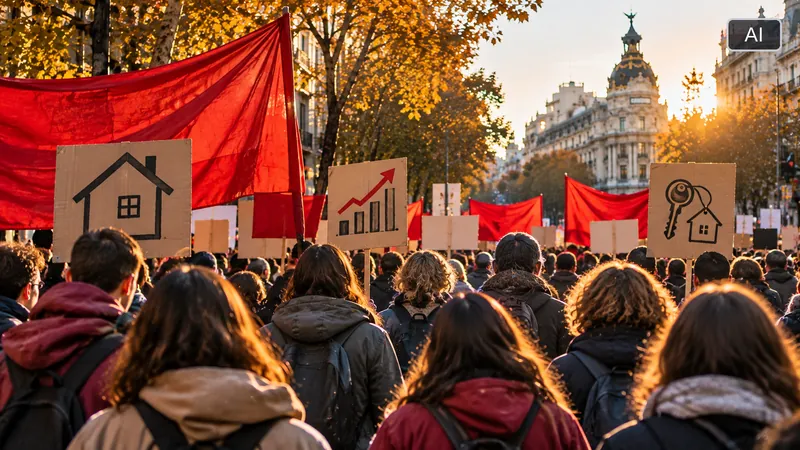
On Wednesday, 11 November, the production lines at Volkswagen in Navarre and Seat in Martorell stopped, the container terminal at Algeciras fell silent and more than 300 flights were cancelled. Spain was holding its first general strike since November 2012, and the first in its democratic history called over housing.
What set it apart was where it came from. Spain's general strikes have been called by the big unions against labour reforms and austerity. This one began with tenants. The Tenants' Union (Sindicato de Inquilinas) campaigned for weeks for a nationwide stoppage before the two largest unions, CCOO and UGT, took up the call on 7 October. Smaller unions, among them CGT and CNT, joined; USO and CSIF stayed out. The demands ran from affordable homes, limits on speculation and more public housing to higher wages and a higher minimum wage.
It was unusual, too, in having the government on its side. Pedro Sánchez's Socialist-led coalition backed the strike, which the head of the employers' federation CEOE, Antonio Garamendi, called "official", "atypical" and "preventive".
How many stopped
The numbers depended on who was counting. The unions said about four million people took part, around 17% of the workforce, with 84% in Catalonia, 75% in Andalusia and Aragon and about 90% in public education. The employers' groups CEOE and Cepyme put participation below 5%. Organisers said more than 500,000 marched in Madrid; the central government's office in the city said 120,000. In Barcelona it was 400,000 against 55,000.
The disruption was easier to measure. A quarter of high-speed and long-distance trains were cancelled, along with one in ten commuter and regional services. In Barcelona the metro and buses ran on reduced service until mid-afternoon, and around 50 roads in Catalonia were blocked.
A rent that eats a salary
Behind the strike is a housing market that has left pay far behind. Rents in Spain rose by 87% between 2015 and 2025, while wages rose by about 30%, according to El País. The Youth Council of Spain says the average rent, €1,176 a month, is nearly 99% of the average monthly salary of a worker aged 16 to 29. Young Spaniards now leave the family home at 30.2 on average, and only 14.5% of them live independently, a record low. The Bank of Spain estimates the country is short of about 750,000 homes, a gap it says could pass one million by 2028.
From one eviction to a nationwide strike
The protests grew out of a single case. On 23 September Maricarmen Abascal, 87, was evicted from her flat in Madrid's Retiro district after her landlord sought to raise her rent fivefold. She died in hospital two weeks later, before she could return home. Protest camps went up in Madrid's Puerta del Sol, Barcelona's Plaça de Catalunya and squares in Bilbao and Oviedo.
The government answered with two emergency decrees, including a ban on evicting vulnerable tenants until 2030 and limits on investment funds buying discounted property. On 2 October Congress rejected both, by 178 votes to 172 and 184 to 166, with the conservative Partido Popular (PP), the far-right Vox and the Catalan party Junts voting against. Three days later Sánchez called a snap election for 29 November.
Batons, looting and more than 70 arrests
Most of the day passed off peacefully, but not all of it. Police charged protesters on Madrid's Gran Vía with batons and pepper spray, and 15 workers were hit by pepper spray at Mercamadrid, the city's wholesale food market. CCOO in Madrid says it will file a criminal complaint. "There is no democratic society without a democratic police," said the union's leader, Unai Sordo.
By 5pm the Interior Ministry and regional police had counted 52 arrests and 919 incidents. In the evening, after a largely peaceful march in Barcelona, groups of protesters looted shops, set bins alight, threw fireworks and fought with Catalan police. By the end of the day more than 70 people had been arrested.
Everyone blames someone
"This is not a strike against anyone," Sánchez said. The PP's leader, Alberto Núñez Feijóo, called it "a general strike against the opposition", and its secretary-general, Miguel Tellado, "an electoral strike". The Vox leader, Santiago Abascal, called it a "campaign for Sánchez". The Madrid regional government of Isabel Díaz Ayuso described the unions as "an appendage in the service of sanchismo".
The Tenants' Union spared nobody. Its spokesperson, Valeria Racu, called the left-wing government "very disappointing" on housing, said PP policies had helped create the crisis, and said the movement would not accept "mere patches".
What is at stake on 29 November
The polls disagree. The state pollster, CIS, puts the Socialists first on 33.3%, ahead of the PP on 25.5% and Vox on 18.4%, from interviews carried out in October. Most private polls put the PP first. One for El País and Cadena SER, published on 13 November, gives the PP 31.5% and the Socialists 29.4%, with the PP and Vox together on 190 of the 350 seats, above the 176 needed for a majority. Most polls give Vox 60 to 70 seats, nearly double the 33 it won in 2023.
If the PP needs Vox to govern, a far-right party would enter Spain's central government for the first time since the death of Franco. Whoever wins inherits the same rents.
Sources
- elDiario.es — La primera huelga general por la vivienda moviliza a millones de personas y eleva la tensión con PP y Vox, 11–12 November 2026 – Participation figures from unions and employers, transport disruption, reactions from employers, PP and Vox, police charges and the evening violence in Barcelona (in Spanish).
- Demócrata — España vuelve a la huelga general 14 años después con la vivienda como detonante, 11 November 2026 – How the Tenants' Union started the call, which unions joined, the demands and the timeline from the eviction to the election (in Spanish).
- Demócrata — La huelga del 11N suma más de 50 detenidos y casi 1.000 incidencias en España, 11 November 2026 – Interior Ministry figures for arrests and incidents up to 17:00 (in Spanish).
- El Salto — La clase trabajadora sale en tromba en una huelga general masiva, 11 November 2026 – Stoppages at the car plants and Unai Sordo's comments on the police (in Spanish).
- ARA — 11 de noviembre: catorce años después, habrá una huelga general, 7 October 2026 – The date the strike was set and the unions involved (in Spanish).
- ARA — ¿Qué dicen las encuestas de las elecciones españolas del 29-N?, updated 13 November 2026 – The main election polls side by side, including El País/Cadena SER and the CIS (in Spanish).
- CIS — El PSOE lograría el 33,3% de los votos en las elecciones generales del 29N, 12 November 2026 – The state pollster's estimate, from fieldwork carried out 7–30 October (in Spanish).
- Euronews — Acampadas por la vivienda en España, 2 October 2026 – The protest camps in Madrid, Barcelona, Bilbao and Oviedo (in Spanish).
- Euronews — Spain grinds to a halt in first general strike in 14 years, 12 November 2026 – Crowd figures in Madrid and Barcelona, Valeria Racu's comments and the arrest total.
- TIME — Spain's general strike, the housing crisis and the election, 12 November 2026 – Housing figures from El País, the Youth Council and the Bank of Spain, the eviction, and the comments by Sánchez, Feijóo, Tellado and Abascal.
- The Olive Press — Sánchez dealt major blow as Spain housing reform is defeated, 2 October 2026 – What the two housing decrees contained and how Congress voted.
Reporting note: This article is based mainly on Spanish reporting by elDiario.es, El Salto, Demócrata and ARA, on the CIS poll, and on Euronews, TIME and The Olive Press. Participation figures from unions, employers, organisers and the authorities differ widely, and all are given with their source. Quotes are translated by Fréttir 24/7. Earlier coverage: Spain's Unrest (October 2026).
This article was drafted with AI assistance and reviewed and edited by Fréttir 24/7's editorial team.
Tips, corrections or questions: ritstjorn@frettir247.news