A City in Mourning: Kraków After the Main Square Shooting
Candles line the cordon, and for half a day the trumpet on St Mary's tower fell silent. On Saturday afternoon a 24-year-old man drove onto Kraków's Main Square and fired at random people, killing six. Three of his relatives were later found dead at his home. Poland, long used to thinking of itself as one of the safest countries in Europe, is in national mourning.
Updated 21 November 2026: the gunman died in hospital on 9 November, and the dispute over his motive has continued. An earlier version said Ostrowiec Świętokrzyski is about 200 kilometres north of Kraków; it is about 150 kilometres north-east.
At about three o'clock on Saturday afternoon, a man drove a car onto the Main Market Square in Kraków, the medieval heart of Poland's most visited city, and, according to police, "began firing at random people from his car". Six people were killed, four women and two men. Sixteen were injured.
Police say the gunman, a 24-year-old Polish citizen, was shot and wounded in an exchange of fire with officers a short distance from the square. He died in hospital early on Monday 9 November. Hours later, police found the bodies of three more people, two women and a man, at his home in Ostrowiec Świętokrzyski, a town about 150 kilometres north-east of Kraków. Police believe they were his parents and sister. All three had been shot. A spokesman for the prosecutor's office said it was "highly likely" that the same person carried out both sets of killings.
The government has called it a terrorist attack. It is, according to Al Jazeera, the deadliest shooting in Poland since the fall of communism in 1989.
The victims
Four of the six dead have been identified, though their names have not been released. Four were Polish, and one was a British man. The sixth was a foreign woman; according to Reuters, she was Austrian. Among the injured are five foreign nationals, from Austria, Germany, Portugal, Russia and Britain. As of Sunday, all of the injured were alive.
Kraków drew around 16 million visitors last year, and the Main Square is where most of them go. Many of the witnesses who spoke to reporters were tourists, among them an American student studying in Italy, a visitor from Brussels and a British couple.
Two officers
Two police officers were shot in a close-range gunfight as they confronted the attacker: Senior Constables Jakub Kulik and Artur Morański. Both underwent surgery and have since been brought out of comas, according to Interior Minister Marcin Kierwiński.
Prime Minister Donald Tusk, who travelled to Kraków from Warsaw on Saturday, called them "true heroes". "They likely saved many human lives, disregarding the risk to their own," he wrote. The regional governor, Krzysztof Klęczar, said their intervention prevented a higher death toll.
The suspect
Police have described a man who prepared. He wore military-style clothing, a helmet and a face covering, and used a semi-automatic rifle of the AR-15 type. "He was well-prepared, well-armed and knew what he was doing," said police spokesman Andrzej Fijołek. Investigators have since recovered several more firearms and a large quantity of ammunition. According to the Associated Press, his father legally owned more than ten guns.
The suspect had no criminal record, was a member of a shooting club and held a firearms licence. Defence Minister Władysław Kosiniak-Kamysz denied rumours that he was a soldier, saying he had never had any link to the military. Under Polish practice, suspects are usually identified only by first name and initial.
Justice Minister Waldemar Żurek said the man is being investigated for murder as a terrorist offence, because he "acted with the aim of seriously intimidating a large number of people". A separate murder charge relates to the deaths in Ostrowiec Świętokrzyski. Prosecutors who specialise in terrorism are leading the case, and autopsies are due to begin on Monday.
A disputed motive
Within hours of the attack, Kierwiński said that "everything indicates he was fascinated by far-right ideologies", describing the suspect's views as "ultranationalistic" and "very, very radical". He stressed that the investigation was continuing.
That assessment has been challenged. Przemysław Czarnek, deputy leader of the main opposition party, Law and Justice (PiS), wrote that "if Kierwiński has misinformed the public, he should face political consequences." With the gunman dead, there will be no trial; the motive is for investigators to establish.
The picture has stayed contested. On 9 November, Przemysław Nowak, a spokesman for the National Prosecutor's Office, said it was "too early to speak categorically about motives, inspiration or any ideology", and that investigators had found no obvious extremist symbols in the gunman's room.
The next day, Waldemar Żurek, who is both Justice Minister and Prosecutor General, told Radio Kraków that there were "very strong traces of right-wing extremism". He said the gunman's search history included websites about Anders Breivik, the Norwegian far-right terrorist who killed 77 people in 2011, that a silencer had been found in his car, and that he had left no letter or other message explaining his motive. Michał Wójcik, an MP for PiS, told Reuters he was "outraged" by the minister's comments. Prosecutors say the gunman's death does not end the investigation.
The argument comes at a tense moment in Polish politics. The government and President Karol Nawrocki are locked in a bitter dispute over control of the judiciary. Nawrocki said on Saturday that he was awaiting a full explanation, and that the safety of Poles was "an absolute priority".
Candles and silence
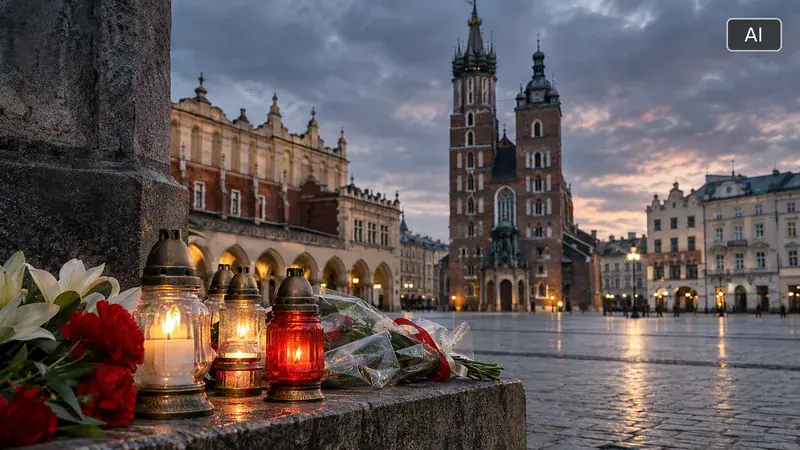
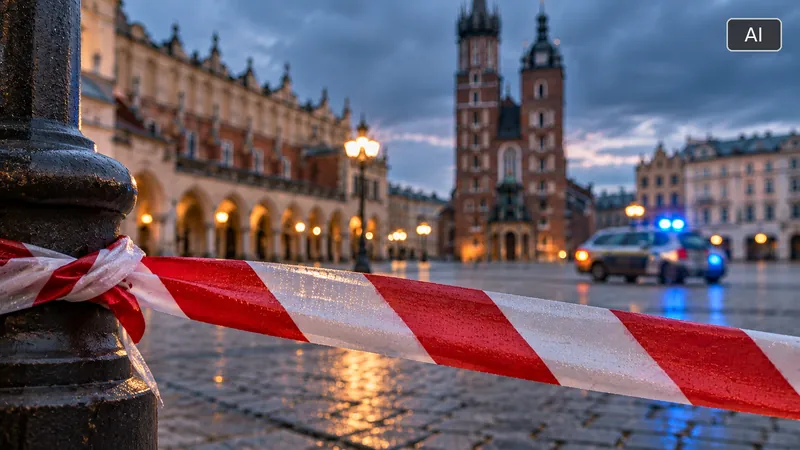
Poland began two days of national mourning on Sunday. In Kraków, flags flew at half-mast over the city hall, and people left candles and flowers at the edge of the cordon. The hourly trumpet call from the tower of St Mary's Basilica, played over the square for centuries, was suspended for 12 hours; according to the Polish news agency PAP, it is the first time it has fallen silent since 1939.
Part of the square reopened on Sunday, though forensic teams were still at work. The city's mayor, Łukasz Gibała, said Kraków would stay open to visitors. "The square will belong to us again," he said.
In Warsaw, police stepped up patrols in tourist areas and put barriers across streets leading to the Royal Route.
Messages of condolence came from across Europe and beyond, including from Pope Leo XIV, the EU's foreign policy chief Kaja Kallas ("Poland does not stand alone"), German Chancellor Friedrich Merz, Britain's Foreign Secretary Ed Miliband, who said the UK "deeply mourns" the British victim, and Ukrainian President Volodymyr Zelensky.
"An island of safety"
Mass shootings are extremely rare in Poland, a country of 38 million with strict gun laws by American standards. But the number of people licensed to own guns has risen sharply. Police figures show more than 50,000 licences were issued in 2025, a record, bringing the total to about 411,000.
The attack also follows a string of knife attacks in Polish schools in October, which officials linked to extremist content online and which Tusk denounced as part of a "cult of violence".
The daily Rzeczpospolita called Saturday's shooting a "brutal end to an era in which Poland was considered an island of safety". Whether that proves true will depend partly on what the investigation finds, and partly on what Poland decides to do next.
Sources
- AFP via France 24 — What to know about the Krakow mass shooting, 9 November 2026 – The gunman's death and where Ostrowiec Świętokrzyski lies.
- Brussels Signal — Nothing links Polish mass shooter to a particular ideology, says prosecutor's office, November 2026 – The prosecutor's spokesman on 9 November.
- Brussels Signal — Kraków gunman dies in hospital as Poland mourns victims, 9 November 2026 – The investigation continues after his death.
- Notes from Poland — Strong traces of right-wing extremism in activity of Kraków terrorist, says justice minister, 10 November 2026 – The Justice Minister's interview with Radio Kraków.
- Al Jazeera — Poland gunman fascinated by Norway's neo-Nazi mass killer Breivik, 10 November 2026 – The silencer and the opposition's response.
- Reuters via The Jerusalem Post — Poland mourns victims of Krakow mass shooting as reports of far-right motive deepen security fears, 8 November 2026 – The officers' condition, the dispute over the motive, the weapons recovered and the suspension of the trumpet call.
- NBC News via Yahoo News — Kraków shooting that killed 6 was motivated by far-right views, authorities say, 8 November 2026 – The Justice Minister's statement on the terrorism investigation, the officers' names and international reactions.
- Notes from Poland — Six killed in terrorist shooting in Polish city of Kraków, 7 November 2026 (updated 8 November) – The police account, the suspect's equipment, the Defence Minister's denial, visitor numbers and gun-licence figures.
- Al Jazeera — At least six people killed in shooting in Poland's Krakow main square, 7 November 2026 – The Prime Minister's and President's statements, the assessment that this is the deadliest shooting since 1989, and licence statistics.
- CBS News — Mass shooting in Krakow, Poland market leaves at least 6 dead, 7 November 2026 – Mayor Łukasz Gibała's statement and the first police account.
- Euronews — What we know about the Kraków shooting that left six people dead, 8 November 2026 – The suspect's background, the weapons used and the officers' injuries.
- CBS News (AP) — Poland mourns victims of Krakow mass shooting as terrorism probe launched, 8 November 2026 – The victims' nationalities, the guns legally owned by the suspect's father and the national mourning.
- Euronews — Independent Gibała beats Tusk's party to win Kraków mayoral run-off, 12 October 2026 – Background on the city's mayor.
Reporting note: This article is based on reporting by Reuters, NBC News, the Associated Press, Al Jazeera, Euronews, CBS News and Notes from Poland, and on statements by Polish officials. The suspect has not been named, and no court has established his motive. Figures are as of the evening of 8 November 2026 and may change. Quotes from Polish officials are English translations as reported by those outlets. The illustrations are AI-generated.
This article was drafted with AI assistance and reviewed and edited by Fréttir 24/7's editorial team.
Tips, corrections or questions: ritstjorn@frettir247.news