
Interest Rates in Iceland: What They Mean for Mortgages, Savings and Everyday Life
From monthly loan payments to the cost of running a business, interest rates influence many parts of the Icelandic economy. Understanding how they work helps explain the decisions behind the headlines.
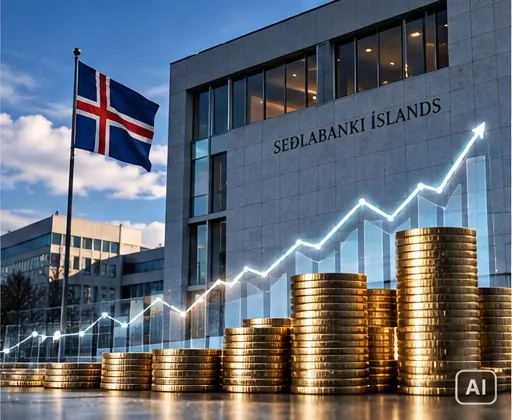
Interest rates are often discussed as a single number. In practice, they affect different people in different ways. They can influence the cost of borrowing, the return on savings and the financial decisions made by households and businesses.
Understanding the relationship between interest rates and inflation also makes it easier to follow the Central Bank of Iceland’s decisions — and to understand why their effects are not always immediate.
What is the Central Bank’s policy rate?
The Central Bank of Iceland uses monetary policy to promote price stability. Its main tool is its key policy rate, which influences interest rates across the financial system.
On 7 October 2026, the Bank’s Monetary Policy Committee kept its key rate at 8.00%. The Bank reported that inflation had reached 5.9%, its highest level in two years, while underlying inflation had remained relatively stable at just over 4%.
The Committee said that economic activity was slowing, but inflation and inflation expectations remained too high. It also noted that inflation could ease relatively quickly in 2027, although uncertainty remained.
These figures describe the situation reported in October 2026. They should not be taken as a statement of current rates or a prediction of the next decision.
Source: Central Bank of Iceland — Monetary Policy Committee statement, 7 October 2026
How can interest rates affect households?
Mortgages and other loans
When interest rates rise, borrowing can become more expensive. The impact on a mortgage depends on its terms, including whether the interest rate is fixed or variable, when it can be adjusted and how the loan is structured.
A change in the Central Bank’s policy rate does not mean that every mortgage payment changes immediately or by the same amount. Banks’ lending rates and individual loan agreements determine how the change reaches each borrower.
For anyone considering a loan or reviewing an existing mortgage, understanding the interest terms and the possibility of future payment changes is more useful than looking at the policy rate alone.
Savings and purchasing power
Higher interest rates can make some savings accounts and interest-bearing deposits more attractive. The actual return depends on the account’s rate, fees and conditions.
Inflation matters here, too. If prices rise faster than the interest earned on savings, the money may lose purchasing power even while the account balance grows.
This is one reason interest rates and inflation are often discussed together: one concerns the cost of borrowing and the return on saving, while the other measures changes in the general price level.
Businesses, investment and employment
Businesses also respond to borrowing costs. Higher rates can make it more expensive to finance equipment, property, expansion or day-to-day operations. Some companies may delay investment, while households facing higher loan costs may reduce other spending.
These changes can contribute to slower economic activity. However, interest rates are only one factor affecting investment and employment. Demand, wages, productivity, taxes and international conditions also matter.
Why does inflation matter?
Inflation measures how quickly the general level of prices rises. When prices increase, the same amount of money buys fewer goods and services than before.
The Central Bank’s inflation target is 2.5% over twelve months. Its monetary policy aims to bring inflation towards that target over time.
Higher interest rates can help moderate demand by making borrowing more expensive and saving more attractive. But monetary policy does not work instantly, and interest rates cannot directly control every cause of higher prices.
Energy costs, exchange rates, public charges, wages, supply disruptions and international events can all influence inflation. Policymakers therefore consider a range of economic indicators rather than relying on one figure alone.
Further reading: Central Bank of Iceland — Monetary policy
Why is Iceland’s situation distinctive?
Iceland’s economy is affected by both domestic conditions and developments abroad. Changes in international energy prices, the exchange rate of the króna, wages and household demand can all influence prices and the economic outlook.
The Central Bank must assess these pressures alongside the effects of interest rates on households, businesses and economic activity.
This creates a difficult balance. Keeping rates high may help contain inflation, but it can also increase borrowing costs and weigh on spending. Reducing rates can ease financial pressure, but doing so too soon may make it harder to bring inflation under control.
The appropriate course depends on the evidence available at the time, which is why policy decisions can change as economic conditions develop.
What should readers watch?
A few indicators help make sense of future interest-rate decisions:
- Inflation: Are prices rising faster or more slowly?
- Underlying inflation: Are broader price pressures easing?
- Wages and employment: How are incomes and labour-market conditions changing?
- Economic activity: Is demand strengthening or slowing?
- Central Bank announcements: What evidence and risks does the Monetary Policy Committee identify?
No single indicator can reliably predict the next decision. Official statements and published economic forecasts provide the best starting point for understanding the Bank’s assessment.
The bigger picture
Interest rates are more than a financial-market statistic. They connect monetary policy with the decisions people make about borrowing, saving, spending and investing.
Understanding that connection helps readers interpret economic news without assuming that every rate change will affect everyone in the same way.
The most useful question is not simply whether rates are high or low, but why they are at that level, what economic conditions the Central Bank is responding to, and how those conditions may affect different parts of society.
Editorial note: This educational explainer includes historical figures from the Central Bank of Iceland’s statement of 7 October 2026. It explains general economic mechanisms and does not offer a forecast of future rates or personal financial advice.
Tips, corrections or questions: ritstjorn@frettir247.news
More from Business
 BUSINESS · ECONOMYIceland's Strong Króna: Economic Strength or a Growing Competitiveness Problem?31 October 2026
 BUSINESS · CRYPTOCURRENCYBinance Faces $4.7 Billion in Net Withdrawals After Record Crypto Theft — A Test of Trust for the World's Largest Exchange31 October 2026
 BUSINESS · ECONOMYIceland's Economy at a Crossroads: What the IMF Sees Ahead31 October 2026