Chess: The Game of Kings, Strategy and a Global Obsession
A board of 64 squares, 32 pieces and an almost endless number of possibilities. Chess has survived centuries of change, challenged some of the world's greatest minds and become one of the most recognised games on the planet.
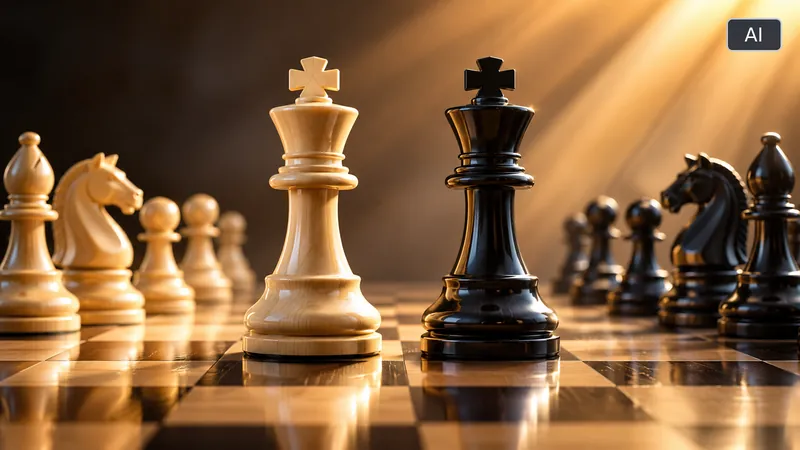
Two players sit opposite each other. Between them is a chessboard, its pieces arranged in familiar formation. There is no dice to roll, no card to draw and no element of luck deciding which piece can move.
Every decision belongs to the players.
A pawn advances. A knight jumps into position. A bishop controls a diagonal, while the queen moves across the board with extraordinary freedom. One player builds an attack, the other searches for a weakness. Sometimes a single move changes the entire game.
Chess is easy to recognise but difficult to master. Its basic rules can be learned in an afternoon, yet even the strongest players continue to discover new ideas and possibilities.
It is a game played in homes, schools, clubs, parks and international tournaments. It is also a game with a remarkable connection to Iceland, where chess has become part of the country's sporting and cultural identity.
Where did chess come from?
Chess has a long history, but its precise beginnings are not recorded with complete certainty.
Most historical research traces its development to northern India, where a game known as chaturanga was played around the sixth or seventh century.
The name is associated with the four divisions of an Indian army: infantry, cavalry, elephants and chariots. These military elements were represented in the early game through pieces that became the ancestors of the modern pawn, knight, bishop and rook.
From India, the game travelled into Persia, where it developed into a form known as chatrang. It was later adopted and adapted across the Islamic world, becoming known as shatranj.
As trade, travel and cultural exchange connected different regions, chess spread towards Europe. It was being played in parts of Europe by the early medieval period and gradually became familiar among different social classes.
The rules were not yet the same as those used today. The queen and bishop, for example, had much more limited movement in earlier versions.
A major transformation took place in Europe during the late fifteenth century. Changes to the movement of the queen and bishop made the game faster and more powerful. These developments helped create the foundations of modern chess.
Over the centuries, the game continued to evolve, but the central contest remained the same: two players, one board and a struggle to checkmate the opposing king.
Understanding the chessboard
A standard chessboard contains 64 squares arranged in eight rows and eight columns. The squares alternate between light and dark.
Each player begins with 16 pieces:
- One king.
- One queen.
- Two rooks.
- Two bishops.
- Two knights.
- Eight pawns.
White always moves first, and the players then take turns.
The objective is to checkmate the opponent's king. This happens when the king is under attack and there is no legal move that can remove the threat.
The king is the most important piece, but it is not the most powerful. That distinction belongs to the queen.
How the pieces move
Understanding how each piece moves is the first step towards playing chess.
The king
The king moves one square in any direction: horizontally, vertically or diagonally. It cannot move onto a square attacked by an opposing piece.
Although it is restricted in movement, protecting the king is the central concern of the game.
The queen
The queen is the most powerful piece on the board. It can move any number of squares horizontally, vertically or diagonally, provided its path is not blocked.
The rook
The rook moves horizontally or vertically across any number of unoccupied squares. It is particularly powerful on open files and ranks.
The bishop
The bishop moves diagonally. Each player begins with one bishop on a light square and another on a dark square, meaning each bishop remains on its original colour throughout the game.
The knight
The knight moves in an L-shaped pattern: two squares in one direction and one square at a right angle. It is the only piece that can jump over other pieces.
The pawn
Pawns move forward one square at a time, although they may move two squares on their first move if the path is clear. They capture diagonally rather than moving straight ahead to take an opponent's piece.
A pawn that reaches the opposite end of the board can be promoted, usually to a queen, although a rook, bishop or knight may also be chosen.
These different movements create the foundation of chess strategy. Each piece has strengths and limitations, and understanding how they work together is more important than simply knowing their individual movements.
The special rules
Chess also contains several special rules that make the game more interesting.
Castling is a move involving the king and one rook. Under certain conditions, both pieces move during the same turn. Castling is commonly used to protect the king and bring a rook closer to the centre of the board.
En passant is a special pawn capture that can occur immediately after an opponent advances a pawn two squares from its starting position, passing a square that could have been attacked by your pawn.
Promotion allows a pawn reaching the final rank to become another piece, most commonly a queen.
These rules may seem complicated at first, but they become familiar with practice.
Checkmate, stalemate and the possibility of a draw
Chess does not always end with one player winning.
A game ends in checkmate when a king is attacked and cannot escape. The player delivering checkmate wins.
However, a game can also end in a draw.
One example is stalemate. This happens when the player whose turn it is has no legal move, but their king is not in check.
Draws can also occur through agreement, repeated positions, certain insufficient-material situations or the fifty-move rule.
In tournament chess, these rules are important. A player who is behind on material may still be able to save a game through careful defence and accurate decisions.
From informal games to international competition
For centuries, chess was played in royal courts, private homes and local communities. Eventually, organised competition developed.
The London tournament of 1851 is widely regarded as a landmark in the history of international chess competition. It brought leading players together in a format that helped establish the idea of major international tournaments.
Wilhelm Steinitz and Johannes Zukertort contested a match in 1886 that is generally recognised as the first official World Chess Championship match. Steinitz won and became the first recognised world champion.
The international organisation FIDE, the Fédération Internationale des Échecs, was founded in Paris in 1924. It later became the principal governing body for international chess, overseeing world championship competitions, player titles and international rules.
Chess had become more than a popular pastime. It was developing into an organised international sport.
How professional chess works today
Modern competitive chess takes several forms.
Classical chess gives players substantial thinking time. A single game can last several hours, sometimes longer, and requires careful planning throughout.
Rapid chess uses shorter time controls. Players have less time to consider each move, creating a faster and often more dynamic contest.
Blitz chess is faster still. Games are commonly played with only a few minutes on the clock for each player.
Bullet chess takes speed to another level, with extremely short time limits. It is particularly popular on online platforms.
In competitive chess, players can earn internationally recognised titles. The best-known is Grandmaster, awarded by FIDE to players who achieve demanding performance and rating requirements.
Other titles include International Master, FIDE Master and Candidate Master.
There are also separate women's titles, although women can and do earn the open titles as well. The strongest players compete in national championships, international events and world championship cycles.
The Icelandic connection: why chess feels different here
Chess has a particularly interesting place in Iceland.
The country is sometimes described as a chess nation, and the game is often referred to as Iceland's national sport. Whether or not one treats that description as a formal title, it reflects a genuine and unusual cultural connection.
For a country with a relatively small population, Iceland has produced internationally respected players and maintained a strong chess community.
One important figure was Friðrik Ólafsson (1935–2025), who became Iceland's first Grandmaster. His success helped raise the profile of chess at home and encouraged wider participation.
But the event that brought Iceland to the attention of the entire chess world took place in Reykjavík in 1972.
That summer, American challenger Bobby Fischer faced the reigning Soviet world champion Boris Spassky in a match that became known as the Match of the Century.
The contest was much more than a sporting event. It took place during the Cold War, when competition between the United States and the Soviet Union extended into science, technology, culture and sport.
Chess had become a symbolic arena in which the two superpowers could demonstrate intellectual strength.
The match attracted worldwide attention, with enormous international interest in every development. After 21 games, Fischer won by 12½ points to 8½, becoming the eleventh World Chess Champion.
For Iceland, hosting the match was a defining moment. Reykjavík became part of one of the most famous episodes in chess history, and the event helped introduce the country to a worldwide audience.
The connection has never entirely disappeared. Iceland continues to celebrate the match and its place in the country's sporting history.
There is a deeper story here, too: how a small nation developed such a strong relationship with a game usually associated with international grandmasters, major tournaments and intellectual competition. It is a subject worth returning to.
When computers challenged the human champions
Chess has also played an important role in the development of artificial intelligence.
For decades, researchers attempted to build computers capable of competing with the strongest human players.
In 1997, IBM's Deep Blue defeated reigning world champion Garry Kasparov in a six-game match. It was a landmark moment in the history of computing and a major turning point in public understanding of machine intelligence.
The victory did not mean that chess had been solved. Instead, it demonstrated how powerful computers could become at calculating possible moves and evaluating positions.
Modern chess engines are vastly stronger than the systems of the 1990s. They can analyse positions with extraordinary accuracy and are used by professionals and beginners alike.
Computers have changed how players study openings, examine mistakes and prepare for opponents. They have also made high-level chess analysis accessible to people who would once have needed specialist books or expert coaching.
Chess in the online world
The internet has transformed the way people play chess.
Players no longer need to find a local opponent or visit a club to enjoy a game. Online platforms allow people to compete against opponents around the world at almost any hour.
Beginners can play against computer opponents, follow lessons, solve tactical puzzles and gradually improve their understanding.
Online chess has also helped popularise rapid and blitz formats, where games can be completed in just a few minutes.
Live broadcasts, commentary and online tournaments have introduced chess to audiences who may never have followed traditional competitions.
The game has also gained a wider entertainment audience through streaming, documentaries, films and popular culture.
Yet the essential attraction remains unchanged. The board is still 64 squares, the pieces still follow their familiar rules, and every player still has to decide what to do next.
Is chess good for the mind?
Chess is often associated with intelligence, memory and concentration. It requires players to consider possibilities, recognise patterns, anticipate an opponent's plans and make decisions under pressure.
It can be an enjoyable way to practise these skills, but claims that playing chess automatically makes someone more intelligent or guarantees improved academic performance should be treated with caution.
The value of chess does not depend on exaggerated promises. It offers a demanding and rewarding challenge in its own right.
A beginner may enjoy learning how the pieces move. A club player may spend hours studying an opening. A Grandmaster may examine a single position for days.
There is room for all of them on the same board.
A game without an expiry date
Chess has travelled through centuries, crossed cultures and adapted to every major change in how people play games.
It has moved from royal courts to public parks, from printed books to computer screens, and from local clubs to international online competitions.
Its rules are stable, but its possibilities are not. Every game begins with the same arrangement of pieces, yet no two contests need follow the same path.
That is perhaps the greatest reason chess has endured.
When Entertainment Becomes a Challenge: Chess at Fréttir 24/7
Some games are enjoyed for a few minutes. Others become lifelong interests, bringing together people of different ages, backgrounds and generations.
Chess belongs firmly in the second category.
It is a game with a remarkable history, but it is also something that continues to evolve. Played in homes, schools, clubs and international competitions, chess has found a place in traditional entertainment and in the modern digital world.
For Fréttir 24/7, it is also a particularly interesting addition to our growing Entertainment collection.
Our earlier introductions to Sudoku and Mahjong explored two very different experiences: one built around individual logic and the other around tiles, strategy and social interaction. Chess brings another dimension, where planning, patience and the ability to anticipate another player's decisions are central to the experience.
It also brings us a little closer to home.
Iceland has a special relationship with chess. The famous 1972 World Championship match between Bobby Fischer and Boris Spassky in Reykjavík remains one of the most memorable events in the history of the game. It is a story that helped put Iceland on the international chess map, and one that deserves to be explored further.
There is much more to that connection than a single historic match, and we hope to return to it in greater detail.
For now, our aim is to introduce readers to the game itself: its history, its basic rules and the reasons it continues to attract players around the world.
As Fréttir 24/7 Entertainment develops, we also want to explore ways of making games and other enjoyable activities part of the experience of visiting our website. We will take that step by step, introducing new opportunities as they become ready.
Whether you are an experienced player, someone who has not touched a chessboard in years or a complete beginner, there is always something new to discover.
And perhaps that is what makes chess such a fitting addition to this collection. It is familiar, challenging and endlessly replayable.
Because sometimes entertainment is not about knowing what happens next. It is about deciding what happens next.
It can be a quiet game between friends, a family tradition, a competitive sport or a serious intellectual pursuit. It can be learned by a child and studied by a world champion.
And in Iceland, it carries an additional meaning: a reminder that a small country can leave a remarkable mark on a game played across the entire world.
The board is ready. The pieces are waiting.
The next move is yours.
Sources
- History.com — Bobby Fischer becomes first American winner of the World Chess Championship, 1 September 1972 – The 1972 match in Reykjavík, its Cold War context and the result.
- Encyclopaedia Britannica — Bobby Fischer – Fischer's career and the 12½–8½ victory over Boris Spassky.
- FIDE — Fridrik Olafsson (1935–2025) – Iceland's first Grandmaster and his place in Icelandic and international chess.
- FIDE World Chess Museum — FIDE history – The founding of FIDE in Paris in 1924 and its role as the game's governing body.
- History.com — Deep Blue defeats Garry Kasparov in chess match, 11 May 1997 – IBM's Deep Blue and the six-game match against the reigning world champion.
Reporting note: This is an explainer feature for Fréttir 24/7 Entertainment. Historical dates and rules were checked against the sources listed; rules vary between clubs and versions, and the account here is an introduction rather than a complete rulebook. The illustration is AI-generated.
Tips, corrections or questions: ritstjorn@frettir247.news