Mahjong: The Chinese Tile Game That Became a Worldwide Tradition
A game of colourful tiles, careful decisions and changing fortunes — Mahjong has travelled across continents while keeping its place at the heart of social entertainment.
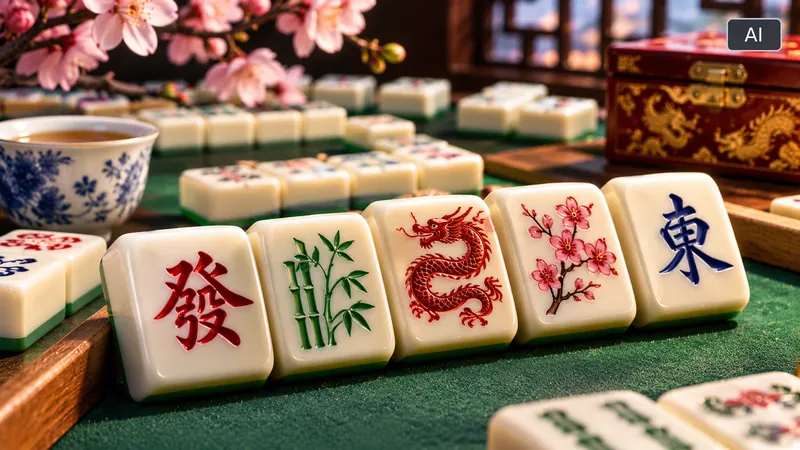
A table, four players and hundreds of small tiles. The sound of pieces being shuffled, the anticipation of a useful draw and the excitement when someone finally declares a winning hand.
For generations, Mahjong has brought people together around a table. It is a game of observation, memory, strategy and chance, but it is also something more: a social tradition that has adapted to different cultures without losing its identity.
Today, Mahjong is played in many forms across Asia, Europe and the Americas. Some versions are relaxed family pastimes, while others have developed into highly competitive games with detailed scoring systems and organised tournaments.
Its worldwide popularity is remarkable, particularly because Mahjong is not one single set of rules. As the game travelled, different communities developed their own ways of playing.
To understand Mahjong is to discover not only a fascinating game, but also a story about culture, migration and the way entertainment travels around the world.
The origins of Mahjong
Mahjong is generally understood to have developed in China during the nineteenth century, although its precise origins remain uncertain.
It emerged from an older tradition of Chinese games played with cards and numbered or illustrated pieces. Historians have examined possible connections with earlier games such as madiao, but there is no universally accepted account identifying one inventor or one exact moment when Mahjong was created.
The modern game took shape in China during the later Qing dynasty, with its development commonly associated with the Yangtze River Delta and surrounding regions.
By the late nineteenth and early twentieth centuries, Mahjong was spreading through Chinese cities and becoming an increasingly familiar part of social life.
The game was played in homes, social gatherings and public gaming rooms. Its combination of chance, decision-making and interaction made it appealing to a wide range of players.
Unlike many games that can be played alone, traditional Mahjong brings four people together. Every draw and discard changes the possibilities for everyone at the table.
How Mahjong reached the rest of the world
Mahjong's international journey gathered momentum in the early twentieth century.
Foreign visitors and businesspeople encountered the game in China, where it was already established as a popular pastime. Among those who helped introduce it to Western audiences was Joseph Park Babcock, an American businessman who had spent time in China.
Babcock helped simplify and promote a version of the game for English-speaking players. His rulebook, commonly known as the Red Book, appeared in the early 1920s and helped make Mahjong easier to market and learn in the United States.
The result was a major Mahjong craze. Tile sets became fashionable household purchases, shops promoted the game and social groups formed around it.
The popularity was not limited to the United States. Mahjong also spread to other countries, including Japan, where it developed into distinctive local forms.
As the game crossed borders, it changed. Different communities adjusted the rules, scoring systems and even the number of tiles used. These variations are now an important part of Mahjong's worldwide identity.
Understanding the tiles
A traditional Mahjong set contains a collection of illustrated tiles. The exact number depends on the version being played, but many common Chinese sets contain 144 tiles.
The main tiles are divided into three numbered suits:
Dots or circles: These tiles display circular patterns and are numbered from one to nine.
Bamboo: These feature bamboo-like markings and also run from one to nine.
Characters: These carry Chinese number characters, again numbered from one to nine.
Each numbered tile normally appears four times in a standard set.
There are also special tiles:
Winds: East, South, West and North.
Dragons: Red, Green and White.
Flowers and seasons: Bonus tiles included in many versions of the game.
The numbered suits form the foundation of most hands, while winds, dragons and bonus tiles introduce additional possibilities and scoring opportunities.
The tiles are designed to be recognisable by their markings, allowing players to identify them quickly as the game progresses.
How traditional Mahjong is played
The familiar traditional form of Mahjong is usually played by four people, each trying to complete a winning collection of tiles.
Although the details differ between regional versions, the basic idea is relatively straightforward.
Players begin with a hand of tiles. They take turns drawing a new tile from the remaining supply, commonly called the wall, and discarding one they do not need.
The objective is to build a complete hand using combinations of tiles.
In many common versions, a standard winning hand consists of:
- Four sets of three tiles.
- One pair of identical tiles.
The sets can take different forms. A kong, made of four identical tiles, counts as one set.
Pung: Three identical tiles.
Chow: Three consecutive numbers in the same suit, such as four, five and six of bamboo.
Kong: Four identical tiles.
The pair consists of two identical tiles.
As players draw and discard, they must think about their own hand while watching what others are collecting. A discarded tile may help another player complete a set, so every decision can affect the game.
When a player completes a valid winning hand under the rules being used, they declare Mahjong and the round ends.
This is the basic structure, not a complete rulebook. Scoring, special hands, minimum requirements and the way players can claim discarded tiles vary considerably between versions.
Not all Mahjong is the same
One of the most interesting things about Mahjong is how differently it is played around the world.
The familiar tiles provide a common foundation, but the rules can change significantly depending on the tradition.
Chinese Mahjong
There are several Chinese versions, reflecting the game's regional history. Some are relatively straightforward to learn, while others have complex scoring systems and special winning combinations.
Modern competition has also encouraged the development of standardised rules, allowing players from different places to compete under a shared system.
Hong Kong Mahjong
Hong Kong-style Mahjong is a popular Cantonese version. It generally uses a familiar four-player structure, with scoring based on the combinations and patterns in a winning hand.
Its rules are often considered approachable compared with some more elaborate versions, although experienced players can still develop considerable skill.
Japanese Riichi Mahjong
Japan developed its own distinctive version, commonly called Riichi Mahjong.
It includes additional rules and strategic decisions, including the possibility of declaring riichi when a player's hand is one tile away from completion and certain conditions are met.
The game places particular emphasis on scoring patterns, risk management and reading the table. It has a strong competitive and online following.
American Mahjong
American Mahjong developed its own identity after the game became popular in the United States during the 1920s.
It uses distinctive rules, including jokers and a system built around a published card of permitted winning hands. The National Mah Jongg League, founded in 1937, helped establish a standardised American version.
The annual card means that the combinations players are trying to build change from year to year.
These differences matter. Someone who knows one version of Mahjong may need to learn a new set of rules before joining a table playing another.
Mahjong Solitaire: a different kind of game
There is another game that many people recognise from computers, phones and online puzzle websites: Mahjong Solitaire.
Despite sharing the name and tile designs, it is not the traditional four-player Mahjong game.
Mahjong Solitaire is a single-player tile-matching puzzle. Tiles are arranged in a layered pattern, and the player removes matching pairs that are not blocked by other tiles.
The objective is to clear the board.
It requires observation and planning, but it does not use the same turn-taking, hand-building or scoring system as traditional Mahjong.
Its digital popularity has introduced millions of people to Mahjong-style tiles, even if they have never played the original game with four people.
The distinction is worth remembering: traditional Mahjong is a social tile game, while Mahjong Solitaire is a separate puzzle built around matching pairs.
More than a game: a social tradition
Mahjong has remained popular partly because it offers something that is difficult to reproduce in a purely solitary activity.
A game involves conversation, competition, anticipation and shared moments of surprise. Players react to one another, celebrate a winning hand and sometimes spend as much time talking around the table as concentrating on the tiles.
In many Chinese families and communities, Mahjong has become associated with gatherings, holidays and time spent with relatives and friends.
Its cultural importance has also grown in other communities. In the United States, American Mahjong developed strong social traditions, including organised groups and clubs that have passed the game between generations.
The game has not always had the same cultural meaning everywhere. Its history includes commercial marketing, changing social customs and different interpretations as it travelled internationally.
But its ability to create a shared experience has remained one of its most enduring qualities.
Mahjong in the digital age
Like many traditional games, Mahjong has found a new audience through digital technology.
Online platforms allow people to play against friends, strangers or computer-controlled opponents. Mobile applications make it possible to practise whenever there is time, while tutorials and digital rulebooks help newcomers understand the different versions.
Digital Mahjong also makes it easier for players to experience styles of the game that may not be commonly played in their own communities.
For experienced players, online competition provides an opportunity to test strategy against opponents from around the world. For beginners, it can offer a less intimidating way to learn the basic combinations and rules.
Mahjong Solitaire has also become a familiar part of digital puzzle entertainment, giving the game's visual language a life of its own.
The technology has changed, but the attraction remains recognisable: look at the tiles, consider the possibilities and decide what to do next.
A tradition that continues to evolve
Mahjong has survived and adapted through changing generations, different countries and new forms of entertainment.
Its history is not simply the story of a Chinese game becoming popular elsewhere. It is also the story of communities making the game their own while continuing to recognise its shared origins.
Whether played around a family table, in a local club, in a competitive tournament or through a digital platform, Mahjong offers a combination of chance, skill and social connection that has kept it relevant for generations.
For newcomers, the best way to understand it is to start with the tiles and learn the basic combinations. The variations can come later.
And for those who already know the game, every new round brings the familiar possibility that the next tile could change everything.
Bringing Games, Traditions and New Experiences to Fréttir 24/7 Entertainment
Some forms of entertainment are always changing. Others have been bringing people together for generations.
Mahjong is a wonderful example of the latter. A traditional game with roots in China, it has travelled across the world, developed different regional identities and found new audiences in the digital age.
Its story also reflects something we want to explore further at Fréttir 24/7: entertainment is not limited to what we watch, read or follow. It can also be something we learn, play and share.
Our introduction to Mahjong is part of a growing collection of articles exploring familiar games and pastimes, their histories and the reasons they continue to attract people around the world.
We began this journey with Sudoku, a puzzle built around numbers and logic. Mahjong brings a different experience, combining patterns, strategy, chance and social interaction. Other classic games offer their own challenges and traditions, each with a story worth discovering.
Our ambition is to gradually build on this idea and give readers more ways to enjoy the Entertainment section directly on Fréttir 24/7.
That development will take place over time. We want to introduce new experiences carefully, making sure they are enjoyable and worthwhile for the people who visit our site.
In the meantime, there is plenty to discover. Whether you are learning the rules of a traditional game for the first time or revisiting something you have enjoyed for years, we hope these features offer both an interesting read and a reason to try something new.
Fréttir 24/7 Entertainment is continuing to grow, and we are looking forward to what comes next.
Because sometimes the best entertainment is not just discovering a game, but becoming part of it.
Sources
- The Strong National Museum of Play — Chow, pong and kong: mahjong – Mahjong's development in Qing-era China, Joseph Park Babcock's simplified rules and the 1920s craze in the United States.
- Encyclopaedia Britannica — Mah-jongg – The tiles, suits and basic play, and the game's spread from China.
- Wikipedia — Mahjong culture – Regional variants, American Mahjong and the National Mah Jongg League, founded in 1937.
Reporting note: This is an explainer feature for Fréttir 24/7 Entertainment. Historical dates and rules were checked against the sources listed; rules vary between clubs and versions, and the account here is an introduction rather than a complete rulebook. The illustration is AI-generated.
Tips, corrections or questions: ritstjorn@frettir247.news