Sudoku: The Number Puzzle That Turned Logic into a Global Pastime
A simple grid, nine numbers and a challenge that has captivated millions of people around the world.
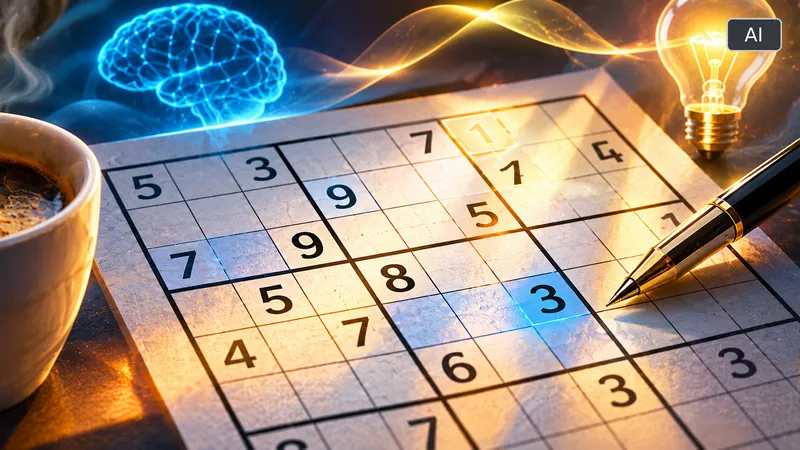
At first glance, Sudoku looks almost too simple to become a worldwide obsession. A square divided into smaller boxes, a collection of numbers and a series of empty spaces waiting to be filled.
Yet the puzzle has an unusual ability to hold a person's attention. One missing number leads to another, a difficult section begins to make sense, and a grid that initially looks confusing gradually reveals its solution.
Sudoku does not require advanced mathematics, specialist knowledge or even a particular language. Its appeal lies in something much more accessible: observation, patience and logical thinking.
It is a game that can be enjoyed for a few minutes over breakfast or become a serious challenge for someone working through the most difficult puzzles.
Where did Sudoku come from?
Although its name is Japanese, the modern Sudoku puzzle did not originate in Japan.
Its mathematical background is connected to the idea of Latin squares, in which symbols are arranged so that each appears only once in every row and column. The mathematician Leonhard Euler explored this type of arrangement in the eighteenth century.
The recognisable modern puzzle appeared much later.
In 1979, an American puzzle constructor named Howard Garns created a puzzle called Number Place. It was published in Dell Pencil Puzzles and Word Games in the United States. Garns is credited with developing the familiar format that uses a nine-by-nine grid divided into nine smaller squares.
The puzzle travelled to Japan in 1984, when the publisher Nikoli introduced it to Japanese readers. It became known as Sudoku, a shortened form of a Japanese expression commonly translated as “single number”.
Japan played an important role in developing and popularising the puzzle. Its name eventually became recognised around the world, although its modern form had first appeared in an American publication.
Sudoku's international breakthrough came in the early 2000s. Wayne Gould, a retired judge from New Zealand, encountered the puzzle in Japan and developed software capable of producing large numbers of puzzles. In November 2004, The Times in London began publishing Sudoku puzzles supplied through his work.
Other newspapers followed, and by 2005 Sudoku had become a major international puzzle phenomenon.
The game had moved from specialist puzzle publications into newspapers, books, websites and eventually mobile applications.
How to play Sudoku
The standard Sudoku puzzle uses a grid of 81 cells, arranged into:
- Nine horizontal rows.
- Nine vertical columns.
- Nine smaller boxes, each containing nine cells.
Some numbers are already placed in the grid. These are the starting clues. The player's task is to fill every remaining empty cell using the numbers from 1 to 9.
There are only three basic rules:
- Every row must contain the numbers 1 to 9 without repetition.
- Every column must contain the numbers 1 to 9 without repetition.
- Every three-by-three box must contain the numbers 1 to 9 without repetition.
That is the entire foundation of classic Sudoku.
The numbers are not added, multiplied or used in calculations. They could theoretically be replaced by nine different symbols without changing the underlying puzzle.
The challenge is to work out where each number belongs while respecting all three rules at the same time.
How to approach your first puzzle
A common beginner's mistake is to look at the entire grid and try to solve too much at once.
A better approach is to work methodically.
Start by looking at a row, column or three-by-three box that already contains several numbers. Identify which digits are missing, then check the intersecting rows and columns to see whether any of those digits can only fit in one position.
For example, imagine a row is missing the numbers 2, 5 and 8. There may be three empty cells, but the surrounding columns and boxes could rule out certain placements. If only one of those cells can legally contain an 8, the answer becomes clear.
This is the central idea behind Sudoku: each placement reduces the possibilities elsewhere.
More experienced players often use small pencil marks to record which numbers could fit into an empty cell. These possible numbers are known as candidates. As the puzzle develops, candidates can be eliminated until a cell has only one possible answer.
Two useful techniques for beginners are:
Scanning: Look across rows, down columns and through the smaller boxes to identify missing numbers and possible positions.
Single candidates: If an empty cell has only one number that satisfies all three rules, that number must be the answer.
There is no need to rush. A good Sudoku puzzle rewards careful observation more than speed.
Why does Sudoku have different difficulty levels?
Sudoku puzzles are commonly labelled easy, medium, hard or expert. However, difficulty is not determined simply by counting the empty cells.
A puzzle with fewer starting numbers is not necessarily harder than one with more. The arrangement of the clues and the logical steps required to complete the grid also matter.
An easy puzzle may be solved largely through straightforward scanning. A more difficult one may require players to keep track of several possible numbers, recognise patterns and use more advanced elimination techniques.
Experienced solvers sometimes work with methods such as pairs, triples and more complex candidate patterns. These techniques allow them to eliminate possibilities without guessing.
The best starting point is a puzzle that offers a challenge without becoming frustrating. As familiarity grows, more difficult grids become an opportunity to learn new techniques.
More than just a newspaper puzzle
Sudoku's popularity has survived the decline of many traditional newspaper pastimes because it has adapted easily to changing technology.
Printed puzzle books remain popular, but Sudoku is also widely available through websites, mobile applications and digital newspapers. Players can solve puzzles on a phone during a journey, on a computer during a break or on paper at the kitchen table.
Digital versions have introduced features such as timers, automatic error checks, hints, difficulty selection and the ability to save an unfinished puzzle.
The basic experience, however, has remained remarkably consistent. The player still faces the same grid and the same three rules.
Sudoku has also developed into a competitive activity. The World Sudoku Championship was first held in 2006, bringing together skilled solvers from different countries. For some participants, solving puzzles is no longer simply a relaxing pastime but a test of speed, concentration and technique.
Does Sudoku improve the mind?
Sudoku is often described as a brain-training activity because it requires concentration, pattern recognition, memory of possibilities and logical reasoning.
It can provide an enjoyable way to practise these skills and keep the mind engaged. However, claims that Sudoku prevents dementia, guarantees better memory or improves general intelligence should be treated cautiously. Enjoying a puzzle is worthwhile in itself, without needing to promise medical or scientific benefits that have not been established.
For many players, the real reward is simpler: the satisfaction of solving a problem through their own reasoning.
A game that remains relevant
Sudoku's success is built on an unusual combination. Its rules are simple enough for a beginner to understand, but its puzzles can become demanding enough to challenge experienced players for a long time.
It does not depend on a particular culture, language or specialist equipment. A printed page and a pencil are enough, while digital versions make it available almost anywhere.
That accessibility helps explain why a puzzle first published under the name Number Place has become familiar to people across the world.
Sudoku is proof that entertainment does not always need complicated rules, elaborate graphics or a large production behind it. Sometimes, all it takes is a grid, a little patience and the satisfaction of finding the one number that fits.
A New Dimension to Fréttir 24/7 Entertainment
Entertainment comes in many forms. Sometimes it is a story worth reading, sometimes a challenge that tests our thinking, and sometimes simply a few minutes spent enjoying a favourite game.
At Fréttir 24/7, our Entertainment section has traditionally been a place to explore the people, stories, interests and activities that capture our attention. We now want to broaden that idea.
Sudoku is the first step in that direction.
It may seem like a simple choice, but Sudoku represents something we find particularly interesting about entertainment: an activity that is accessible to almost everyone, yet offers a challenge that can keep people coming back.
The same can be said of many familiar games and pastimes. Chess has challenged players for centuries. Mahjong has brought people together across generations and cultures. Crossword puzzles, card games and classic arcade games have all found audiences that continue to enjoy them, even as technology and entertainment habits change.
These activities are more than ways to pass the time. They can offer a challenge, encourage friendly competition, create moments of relaxation and give people something enjoyable to return to.
Our intention is to gradually develop Fréttir 24/7 Entertainment to reflect this wider understanding of entertainment. Alongside our articles and features, we want to introduce experiences that readers can enjoy and take part in directly on our website as this part of the project develops.
We will build it carefully and introduce new experiences as they become ready. There is no need to rush the process. We would rather create something enjoyable and worthwhile than promise more than we can deliver.
For now, we invite you to discover Sudoku, learn about the game and perhaps try a puzzle yourself.
This is a beginning, and we look forward to expanding the possibilities of Fréttir 24/7 Entertainment over time.
Because entertainment isn't always about watching. Sometimes it's about taking part.
Sources
- Encyclopaedia Britannica — Sudoku – The puzzle's rules, its origins as Number Place in Dell Pencil Puzzles and Word Games, its Japanese name and its spread through newspapers.
- World Sudoku Championship 2006 — official site, Lucca, Italy – The first World Sudoku Championship, held in 2006.
- Wikipedia — World Sudoku Championship – List of championships since 2006 and their organisation under the World Puzzle Federation.
- The Globe and Mail — The crack cocaine of games, 2005 – Wayne Gould's role in bringing Sudoku to The Times and to newspapers worldwide.
Reporting note: This is an explainer feature for Fréttir 24/7 Entertainment. Historical dates and rules were checked against the sources listed; rules vary between clubs and versions, and the account here is an introduction rather than a complete rulebook. The illustration is AI-generated.
Tips, corrections or questions: ritstjorn@frettir247.news