Estonia to Close Its Border With Russia for Six Months
All road crossings shut on 1 December after attacks Estonia blames on Russian military intelligence. The closure will be reviewed after six months.
Updated 21 November 2026: the government took the formal decision on 20 November. The first version of this article was published on 15 November, before the decision.
Estonia will close all its road crossings into Russia on 1 December. The government took the decision on Friday 20 November, six days after what its security police describe as a sabotage attack ordered by Moscow on an Estonian defence company.
On Saturday 14 November a group tried to break into the premises of Threod Systems in Viimsi, just north of Tallinn, with the aim of causing an explosion and setting the building on fire. Threod makes reconnaissance and attack drones. No one was hurt, and the company says its production and deliveries were not affected. Eight suspects were detained, all from Latvia, according to the Estonian public broadcaster ERR, and prosecutors asked a court to remand five of them in custody.
Estonia's Internal Security Service, KAPO, says the attack was ordered by Russia's military intelligence service, the GRU. Investigators are working with Latvia's security service. It was the second attempt this year to set fire to an Estonian defence company, after Milrem Robotics in Tallinn was targeted in August in an attack that KAPO has also blamed on Russian intelligence.
The decision
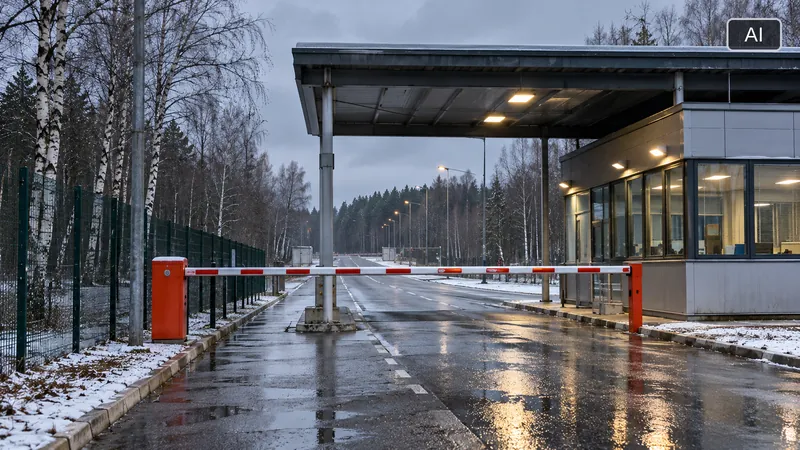
- What closes: Crossings at all of Estonia's road checkpoints on the Russian border, Narva-1, Narva-2, Koidula, Luhamaa and Saatse, are suspended from 7 a.m. on 1 December, for pedestrians and vehicles alike.
- What stays open: Rail freight continues under existing restrictions and strict customs controls.
- For how long: Six months, after which the government will assess whether the restrictions need to stay in place.
- Why: The government says the crossings gave Russian intelligence services opportunities to recruit people and exert influence, and that closing them will make it harder to evade sanctions or move goods illegally across the external border of the EU and Schengen.
"Russia's hostile actions have consequences," the Prime Minister, Kristen Michal, said on Friday. "We will not allow Russia to use our openness against us." He said Russia's hostile activities were showing no signs of abating.
The Foreign Minister, Margus Tsahkna, said Russia bears responsibility for the closure. He also summoned Russia's chargé d'affaires over the attempted arson attack on Threod Systems.
Who is affected
Residents of Narva and Setomaa, many of whom have relatives, jobs or property in Russia, will be hit hardest, and the government says it will discuss measures to soften the impact on south-eastern Estonia and Ida-Viru County. People from Estonia who are now in Russia are urged to plan their return well in advance, since after 1 December they will need another, longer and more expensive route home.
The government expects the wider effect on the economy to be limited. Goods exports to Russia are about a third of their 2021 level, and exports of Estonian-made goods about a fifth.
Not everyone in the government was convinced at first. In an opinion piece, the Defence Minister, Martin Herem, had warned that emotional debate over border closures risked feeding a Russian information operation, and questioned whether Estonia was overreacting, ERR reported. On Friday, Michal said Herem had confirmed his full support for the closure.
How it began
On Sunday 15 November, the day after the attack, Michal asked the Interior Ministry and the Government Office to prepare the steps needed to close the border. "Closing the border would reduce the danger to Estonian people," he said then. "Attacking Estonia's defence industry and defence capability is unacceptable." Russia's goal, he said, is to make Estonians afraid and hesitant. "We will not be intimidated."
The Interior Minister, Igor Taro, proposed closing all road crossings to pedestrians and vehicles from the beginning of December. "Hostile actions have both consequences and a price," he said. The Foreign Minister, Margus Tsahkna, said the same day that the road crossings would close on 1 December, and that "Russia must understand that hostile actions against Estonia come with consequences".
Before the decision, three road crossings into Russia were still open: Narva in the north-east, where only pedestrians could cross, and Luhamaa and Koidula in the south-east, which were open to vehicles.
Estonia follows Finland, which has kept its land border with Russia closed since December 2023. Latvia, Lithuania and Poland have also tightened their eastern borders in recent years, and are building bunkers, ditches and concrete barriers along them together with Estonia.
Sources
- ERR News — Estonia to close land border with Russia from December 1, 20 November 2026 – The government's decision and what it covers.
- Estonian World — Estonia to close all road crossings with Russia after attacks on defence firms, 20 November 2026 – The reasons, the people affected and the Prime Minister's words.
- ERR News — PM: Defense Minister Herem backs closing eastern border with Russia, 20 November 2026 – The Defence Minister's opinion piece and his support.
- ERR — Michal: ette valmistada Eesti-Vene piiri sulgemiseks vajalikud sammud, 15 November 2026 – The Prime Minister's statement, the Threod attack, the suspects and the GRU attribution (in Estonian).
- ERR News — Estonia to close border crossings with Russia after GRU-linked sabotage attacks, 15 November 2026 – The Interior Minister's proposal and the crossings.
- Newsweek — NATO member Estonia to shut Russia border after foiled 'attack', 15 November 2026 – The Foreign Minister's announcement.
Reporting note: This article is based mainly on reporting by the Estonian public broadcaster ERR, in Estonian and English, and on Estonian World and Newsweek. The Prime Minister's quotes of 15 November are translated from Estonian by Fréttir 24/7; his quotes of 20 November and the other ministers' quotes are as published in English. The article was first published on 15 November, when the closure had been proposed but not yet decided, and was updated on 21 November.
This article was drafted with AI assistance and reviewed and edited by Fréttir 24/7's editorial team.
Tips, corrections or questions: ritstjorn@frettir247.news