Dragon's Teeth and Bunkers: NATO's Eastern Edge Digs In
From Estonia to Poland, countries on Russia's border are building ditches, bunkers and concrete barriers, and turning their swamps into defences.
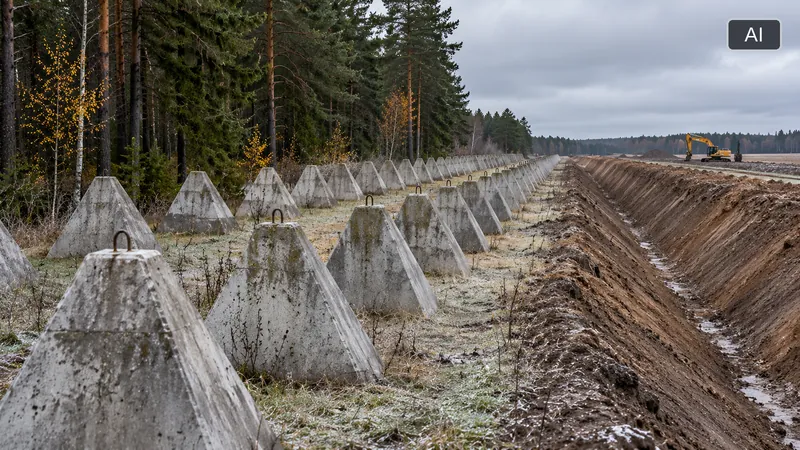
In the forests of eastern Latvia, engineers are digging ditches more than five metres wide and setting out rows of concrete blocks, each weighing a tonne and a half. The blocks, known as dragon's teeth, stand just over a metre high and are placed in three rows. "These obstacles are positioned at such a distance that the enemy cannot cross them with their vehicles," Staff Sergeant Edgars Briedis of the Latvian National Guard told the public broadcaster LSM last week.
Latvia has so far dug about 4 km of the 89 km of anti-tank ditches it plans, and laid about 5 km of dragon's teeth. The first 27 km are due to be finished next spring, and work will go on through the winter. The country has set aside €303 million to fortify its border by 2029, a sum that also covers other defence systems.
Latvia is not alone. All along NATO's eastern edge, from the Gulf of Finland to the Polish-Belarusian border, countries that share a frontier with Russia or Belarus are building physical defences on a scale not seen in Europe for decades.
The Baltic Defence Line
Latvia's work is part of the Baltic Defence Line, agreed by the defence ministers of Estonia, Latvia and Lithuania in January 2024. Together the three countries share a border of about 950 km with Russia and Belarus. The line is not a single wall. It is a layered system of anti-tank ditches, dragon's teeth, roadblocks, bunkers, bridges prepared for demolition, depots of equipment, natural barriers such as marshes and lakes, and, in wartime, minefields.
Estonia plans up to 600 bunkers along its roughly 100 km section of the line by the end of 2027, at a total cost of up to €60 million. Each bunker is about 35 square metres, houses a unit of ten soldiers and is built to withstand a direct hit from a 152 mm artillery shell, a calibre widely used by Russian forces. The first bunkers near Narva, on the Russian border in the north-east, were completed at the end of October, bringing the total so far to 28. Legal disputes over procurement had slowed the work, but the Estonian Centre for Defence Investment says they have now been resolved. Estonia also plans up to 40 km of anti-tank ditches, and says no explosives will be placed on the border in peacetime.
Lithuania updated its plans in August. A strip 20 metres wide, and up to 150 metres in places chosen by the military, is being cleared along its borders with Belarus and the Russian region of Kaliningrad. Defences are planned in three belts, 3, 20 and 50 km from the border. The number of depots holding ready-made obstacles is to rise from 27 to 50 by the end of 2028, and bridges are being fitted so they can be blown up quickly. Lithuania is also restoring swamps in selected areas, so that within a few years they will be impassable for heavy military vehicles.
Poland's East Shield
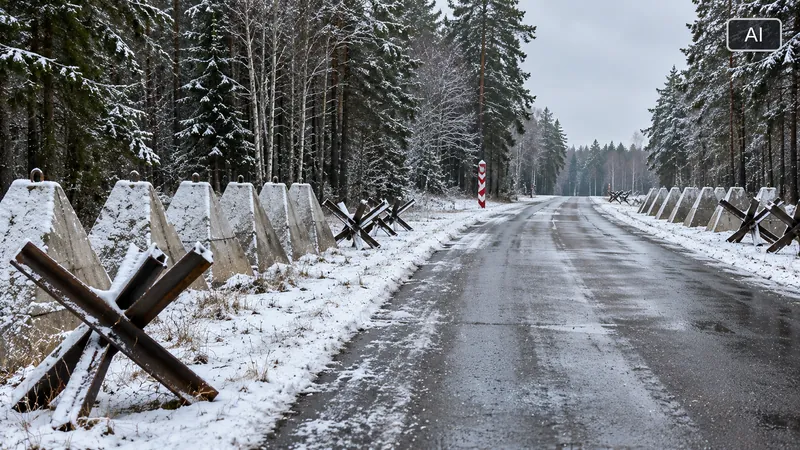
Poland's programme, the East Shield, covers its borders with Belarus and Kaliningrad, a frontier of almost 700 km. By the end of 2025, about 60 km of the border had been protected, including about 10 km of permanent barriers, according to the Polish armed forces. This year Poland plans to cover more than 200 km more, most of it with obstacles stored in depots ready to be put in place in a crisis. By the end of 2026 that would bring the total to nearly 260 km, more than a third of the border.
Progress on the ground has been slower than those figures suggest. The Polish defence publication Defence24 reported in July that only about 1 km of new construction had been completed in the first half of the year. Like Lithuania, Poland is also turning to nature: about 120 million złoty is set aside to restore peat bogs and wetlands in areas of military importance.
Why now
The governments involved point to Russia's war in Ukraine and to a string of sabotage, drone incursions and other hostile acts in Europe that they blame on Moscow. Poland, Finland and the three Baltic states have also withdrawn from the Ottawa Convention, which bans anti-personnel mines, so that they can lay them on their borders if needed.
Finland, which has NATO's longest land border with Russia at 1,343 km, has kept its crossings closed since 2023. "Russia is a superpower, and we're a small country," said Colonel Matti Pitkäniitty, commander of the North Karelia Border Guard District, earlier this year.
Moscow rejects the idea that it plans to attack. In August the Kremlin spokesman, Dmitry Peskov, dismissed reports of a Russian attack plan as "scare-story material" that had "nothing to do with reality".
Slowing, not stopping
None of these defences is meant to stop an army on its own. Their purpose is to slow an attacker down, channel it into places where it can be fought, and buy time for allied forces to arrive. In the worst case, Ben Hodges, a former commander of the US Army in Europe, has warned that the Baltic states might have to hold out for up to two weeks before reinforcements reached them.
The work is being done in peacetime, the Estonian military says, precisely because there would be little time to do it once a crisis began. In Latvia, the diggers will keep going through the winter.
Sources
- LSM — Latvia continues to secure eastern border, 9 November 2026 – Progress on Latvia's ditches and dragon's teeth, funding and the National Guard quote.
- EUobserver — Dragon's teeth and ditches: inside the Baltics' new 950km defence barrier against Russia, 22 July 2026 – How the Baltic Defence Line is built up in layers.
- Estonian Centre for Defence Investment — Baltic Defence Line – Estonia's bunkers, ditches, costs and timeline.
- ERR News via UA.News — First bunkers of Baltic Defense Line completed near Narva, 30 October 2026 – The Narva bunkers and the state of the work in Estonia.
- Estonian World — Estonia begins installing first bunkers on border with Russia, 18 December 2025 – What the bunkers are built to withstand.
- LRT — Lithuania expands border defences, extends timeline for counter-mobility measures, 12 August 2026 – Lithuania's updated plans, depots, bridges and swamps.
- Rynek Infrastruktury — Tarcza Wschód w 2026 roku zabezpieczy ponad 200 km granicy, 27 January 2026 – The Polish armed forces' figures for the East Shield (in Polish).
- UNITED24 Media — Poland's eastern border program records one kilometer of new construction in first half of year, 14 July 2026 – Defence24's report on actual construction in 2026.
- Politico via RBC-Ukraine — NATO's eastern flank reshapes defenses, 5 July 2026 – Finland's border, the Ottawa Convention and Ben Hodges' warning.
- Newsweek — NATO state lays 'dragon's teeth' on defense line to stop Russia, 12 November 2026 – The Kremlin's response.
Reporting note: This article is based on reporting by Latvia's public broadcaster LSM, Lithuania's public broadcaster LRT, Estonia's public broadcaster ERR (via UA.News), Estonian World, Politico, EUobserver, Newsweek, Defence24 (via UNITED24 Media), and on official information from the Estonian Centre for Defence Investment and the Polish armed forces. The defences described are national projects coordinated within NATO, not a single NATO programme. Polish figures for 2026 are plans. Quotes from Latvian are as translated by LSM.
This article was drafted with AI assistance and reviewed and edited by Fréttir 24/7's editorial team.
Tips, corrections or questions: ritstjorn@frettir247.news