
Germany's Generation Z Takes to the Streets: Anger Over Military Service, Education and an Uncertain Future
Young people marched in dozens of German cities on 31 October under the banner Gen Z regelt. Opposition to the new military-service law was a rallying point, but the protests revealed a wider frustration over education, living costs and the place of the younger generation in Germany’s priorities.
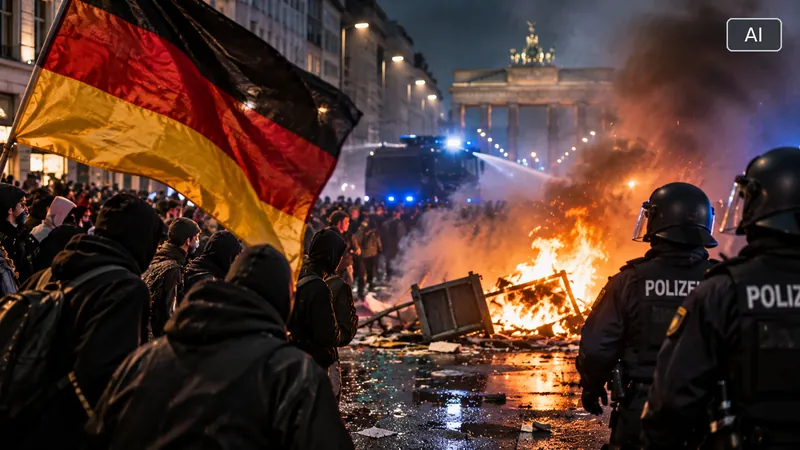
Young people took to the streets across Germany on Saturday in demonstrations organised under the banner Gen Z regelt, demanding better education, affordable living conditions, greater social investment and a stronger voice in decisions affecting their future. Opposition to Germany's new military-service arrangements became one of the movement's most prominent issues, but the demonstrations revealed a broader frustration with the country's political priorities and the opportunities available to its younger generation.
Tens of thousands participated in demonstrations planned across 34 cities. Although more than 182,000 people had indicated on the organisers' website that they would attend, actual attendance was considerably lower. Most gatherings remained peaceful, although confrontations and police interventions occurred in several locations.
The demonstrations raise a question extending beyond one Saturday of protest: are younger Germans increasingly questioning whether the country's political and economic arrangements offer them a fair share of its future?
A movement spreading across Germany
The demonstrations were organised under the name Gen Z regelt, a campaign whose message can be translated as Generation Z taking charge.
Events were planned in 34 cities, including Berlin, Hamburg, Frankfurt, Munich, Cologne, Leipzig, Stuttgart and Hanover. The campaign's central organisers directly coordinated major demonstrations in four cities, while associated local initiatives organised or supported events elsewhere.
The movement brought together young people with different political backgrounds and concerns. Its demands included increased investment in schools and universities, better mental-health services, affordable housing, action on rising living costs, stronger climate protection and opposition to compulsory military service.
The organisers presented the demonstrations as a peaceful expression of frustration among younger people who believe their concerns have received insufficient attention from political leaders.
The organisers argued that young people were being asked to shoulder an increasingly unfair share of the country's economic and social responsibilities. As the day went on, one organiser complained that coverage was focusing on violence rather than on the movement's demands.
However, the campaign has not been without controversy. Germany's national body representing school students, the Bundesschülerkonferenz, distanced itself from the October 31 demonstrations, citing opaque organisational structures.
This distinction is important. The October demonstrations should not be treated as an official representation of all German students or the wider Generation Z population.
Military service becomes a central point of disagreement
One of the most politically sensitive issues is Germany's changing military-service policy.
The country suspended compulsory military service in 2011, ending the system under which eligible young men could be called into military service during peacetime.
The security environment has changed considerably since then. Russia's full-scale invasion of Ukraine, increasing European defence requirements and concerns about NATO's ability to respond to future threats have placed military readiness much higher on Germany's political agenda.
The government has consequently introduced a new military-service framework.
The Wehrdienstmodernisierungsgesetz, which took effect on January 1, 2026, establishes a new system for identifying potential recruits.
All German citizens reaching the age of 18 receive a questionnaire. Men must complete it, while women may participate voluntarily. The questionnaire asks about personal suitability, qualifications and willingness to serve.
Mandatory medical assessments are also being introduced for men born in 2008 and later, with the wider scheduled rollout beginning in July 2027.
Crucially, the current system does not automatically require young men to join the armed forces. Military service itself remains voluntary.
However, the legislation provides a mechanism through which the Bundestag could introduce a needs-based compulsory-service system if voluntary recruitment proves insufficient or security requirements change.
For many young protesters, this is precisely the concern.
They see the new arrangements as a possible first step towards a return to compulsory military service. Others object to the principle of compulsory registration and medical assessment, even if actual military participation remains voluntary.
There is also a wider disagreement about national priorities. While the government argues that Germany must strengthen its defence capabilities, protesters question whether greater military expenditure is being accompanied by sufficient investment in schools, healthcare and social infrastructure.
These are not necessarily mutually exclusive responsibilities. Germany's security concerns are real, but so are the social pressures facing its younger population.
The debate is therefore not simply about whether young people are willing to defend their country. It is also about what responsibilities the state has towards the generation it may eventually ask to serve.
Education and the condition of public services
Education was another major theme.
Many protesters described deteriorating school facilities, shortages of teachers, insufficient resources and growing pressure on students.
The problems are not limited to secondary schools. University students have also raised concerns about ageing buildings, inadequate study facilities and overcrowded educational environments.
Such experiences help explain why education became a central demand of the demonstrations.
Young people are repeatedly told that qualifications and skills are essential for securing employment and economic independence. Yet some believe the institutions responsible for preparing them for that future are themselves underfunded and struggling.
The campaign also called for greater support for mental-health services, including psychological assistance and improved access to treatment.
This adds another dimension to the protests. The concerns are not exclusively about money or political ideology. They also concern the everyday experience of growing up, studying and preparing for adult life in a society where many young people feel under increasing pressure.
The economic question: who gets to build a future?
Germany remains Europe's largest economy, but its recent economic difficulties have created a challenging environment for younger people.
Weak growth, uncertainty in industry and pressure on public finances have complicated the country's economic outlook.
For young Germans, the consequences are particularly important when considering the transition from education into employment and independent living.
Housing costs are a significant concern, especially in major cities where students and young workers compete for limited affordable accommodation.
The cost of everyday essentials also influences how quickly young people can become financially independent.
Employment is another part of the discussion. Although Germany continues to have a substantial industrial and service economy, the availability of secure and appropriately paid work cannot be taken for granted by every young person entering the labour market.
These concerns are part of a wider European pattern.
Across the European Union, young adults are more exposed than average to the risk of poverty or social exclusion, and the cost of living ranks among their main concerns. Those figures describe Europe as a whole rather than Germany specifically, but they illustrate the pressures confronting younger Europeans.
Germany also faces a longer-term demographic challenge. As the large post-war baby-boom generation retires, the working-age population is under pressure, placing additional demands on pensions, healthcare and public finances.
Younger taxpayers will eventually help finance these systems.
That creates a difficult political question: how should the financial responsibilities of an ageing society be distributed between generations?
The protesters' argument is that younger people are being asked to accept more responsibility without receiving sufficient guarantees of affordable housing, quality education, economic security or influence over the decisions shaping their lives.
It is an argument about fairness as much as affordability.
A turnout gap and questions about representation
One of the most notable features of October 31 was the difference between the expected and actual turnout.
By early afternoon, more than 182,000 people had indicated on the organisers' website that they would attend.
However, an online indication of willingness to attend is not the same as a person physically joining a demonstration.
Police estimates varied widely between cities and over the course of the day. In Berlin, police counted up to 5,000 people at the Brandenburg Gate at the peak, while organisers claimed more than 11,000. Munich police counted about 1,800. In Frankfurt, police estimates rose to a maximum of about 8,000, against 9,000 claimed by organisers. In Cologne, police reported several thousand participants, well below the 15,000 registered. In Hamburg, police spoke of a mid four-figure crowd, while organisers put it at 6,000 to 7,000.
The national picture remains difficult to establish because Germany did not have a single consolidated police attendance figure available in the reporting reviewed.
Several factors may have contributed to the gap. Online registrations do not guarantee attendance, and the large number of local demonstrations made coordination more complicated. Concerns about the campaign's organisation and political associations may also have discouraged some potential participants.
The Bundesschülerkonferenz's decision to distance itself from the initiative is particularly relevant.
The organisation represents a much wider student constituency, and its objection to the campaign's opaque structures raised questions about who was speaking on young people's behalf.
The demonstrations therefore reveal two separate developments: genuine frustration among young people and disagreement about who should speak on their behalf.
Neither should be confused with the other.
Peaceful demonstrations give way to serious violence in several cities
Updated 1 November 2026
The main demonstrations on 31 October were largely peaceful during the afternoon. However, the situation deteriorated in several cities as the official events ended and groups remained on the streets.
The most serious disorder was reported in Frankfurt. Groups smashed shop windows and looted businesses on and around the Zeil shopping street. A gun shop was also attacked; police said they seized two weapons and arrested several people there. Officers were attacked with stones, bottles, firecrackers and Molotov cocktails, some of them thrown from ambush positions, and barricades were built in the city centre.
Police deployed more than 1,000 officers, including special units, water cannon and a helicopter. At a press conference on 1 November, Hesse's Interior Minister Roman Poseck said 54 people aged between 13 and 29 had been arrested and that 100 police officers had been injured, one of them seriously after being hit in the face by a stone. He estimated that between 1,000 and 1,500 people had been involved in the disorder, far more than the figure of around 100 he had given on the evening itself. These are the authorities' figures and their assessment of the operation.
Hamburg also experienced serious disorder after its main demonstration had largely proceeded peacefully. Groups in the St Georg district pulled road barriers, construction fences and bins into the street and set barricades alight, and clashes with police continued for hours. Police said about 120 people were taken into custody. A child and a police officer were hurt when a firework battery tipped over, and a federal police officer was injured by a firecracker.
In Cologne, the city banned the planned march at short notice because participants had covered their faces and set off pyrotechnics, and a stationary rally went ahead instead. Police used water cannon after officers were attacked. In the evening, about 200 people clashed with police on the square between the cathedral and the main railway station, throwing bottles, firecrackers and bicycles. Police reported one injured officer and five people taken into custody. Cologne's police chief, Johannes Hermanns, said officers had found incendiary bottles and emergency hammers on masked individuals.
Berlin requires a particularly careful distinction. The main Gen Z regelt gathering at the Brandenburg Gate, attended by up to 5,000 people according to police, was described by police as almost free of disruption. A separate march under the banner Gen Z hat genug!, which began at Rosenthaler Platz and grew to as many as 3,500 people, was stopped early after participants threw stones and set off flares and firecrackers. Berlin police reported 27 officers slightly injured and at least 56 people detained.
In several cities, the violence developed after the principal demonstrations had ended or around their edges.
The organisers of Gen Z regelt publicly distanced themselves from the violence, stating that peaceful protest was central to their movement. They also said they had no influence over events that took place after the official gatherings ended.
That distinction matters, but it does not make the events less serious. The looting, attacks on police and emergency services, injuries and damage to businesses deserve to be reported fully. At the same time, the actions of violent groups should not be attributed indiscriminately to everyone who attended the demonstrations.
Poseck described the Frankfurt violence as a catalyst for a tougher approach, while noting that most of those arrested were German citizens. These are a minister’s characterisations; responsibility for individual offences will be established through criminal proceedings.
The events exposed the challenges of a large, loosely coordinated protest movement operating across many cities, where different groups and interests can converge on the same public gatherings.
The political debate has therefore moved beyond the original issues raised by the demonstrations. Authorities are now addressing public safety, attacks on emergency services and damage to businesses, while the campaign's organisers argue that the peaceful demands of young people should not be defined by the actions of violent groups.
The challenge for political leaders is to address both sides of the events: maintaining public order while taking seriously the concerns about education, affordability, military obligations and future opportunities that brought people onto the streets.
Criminal investigations expand as authorities identify suspects
FRANKFURT — 2 November 2026. German prosecutors have opened criminal investigations following the violence and looting that accompanied the aftermath of the October 31 Generation Z demonstrations, with authorities identifying dozens of individuals suspected of involvement in offences in Frankfurt.
Hesse's Justice Ministry announced on Monday that 54 people had been identified by name and were subject to investigations based on initial suspicion of criminal activity. The suspected offences include serious public-order violations, dangerous bodily harm, burglary-related theft, resisting and attacking police officers, trespassing, property damage and breaches of assembly legislation.
One of the most significant developments concerns the attack on a firearms shop during the disorder in Frankfurt's city centre.
According to the Justice Ministry and subsequent reporting, an 18-year-old suspect was brought before a judge and placed in pretrial detention in connection with the alleged theft of a weapon from the shop.
Pretrial detention is not a conviction. The suspect remains entitled to the presumption of innocence, and prosecutors must establish the allegations through the criminal justice process.
The investigations represent a new phase in the authorities' response. Police are no longer dealing solely with the immediate aftermath of street violence but are working to establish individual responsibility for specific criminal acts.
Different groups, different motives
Frankfurt police have also cautioned against treating everyone involved in the disturbances as part of one political organisation.
Their preliminary assessment distinguishes between violence that developed around the original demonstration and later looting in the city centre. Police have suggested that some individuals involved in the nighttime disorder were not primarily motivated by the political demands of the Generation Z movement.
Hesse's Interior Minister Roman Poseck has attributed parts of the violence to left-wing extremists and other violent groups. He has also made claims about the migration backgrounds of some individuals involved.
These remain official assessments, rather than judicial findings about individual suspects or proof of a common motive. Establishing responsibility will require evidence concerning the actions of particular individuals.
The distinction is especially important because the principal demonstrations in many German cities were peaceful, and the organisers of Gen Z regelt publicly rejected the violence.
Hamburg releases new arrest figures
Authorities in Hamburg have also provided a more detailed account of the disorder that followed the largely peaceful demonstration there.
Police reported that nearly 130 people were temporarily detained, including 43 minors. Some of the young people were subsequently released to their parents after police checks.
Twelve police officers were reported injured. Authorities said suspected offences included attacks on officers, violations of assembly rules and the use of fireworks.
The presence of minors among those detained adds a further consideration to the investigations. Temporary police detention does not establish criminal guilt, and the legal treatment of young suspects differs from that of adults.
Debate over future demonstrations
The violence has also prompted debate about whether further demonstrations should be permitted under similar conditions.
Hesse's Interior Minister Roman Poseck has questioned whether a comparable demonstration should take place in Frankfurt on November 20, citing the severity of the violence and the need to protect public safety.
However, a minister's call for restrictions is not the same as a formal prohibition. Any decision to restrict or prohibit an assembly must be assessed under Germany's legal protections for peaceful demonstration.
The Gen Z regelt initiative has meanwhile announced plans for further activity, including events at schools and universities and participation in future youth protests.
For the movement, the challenge is now twofold: maintaining public attention on education, housing, affordability and military-service policy while separating its peaceful political demands from criminal acts committed during the disturbances.
For investigators, the task is more specific. They must establish who committed which offences, whether individuals acted independently or in coordination, and whether the available evidence supports prosecution.
The events of October 31 have therefore moved from a debate about youth protest into a criminal investigation with potentially serious legal consequences for individual suspects. That process is still at an early stage.
Political leaders face a difficult response
The demonstrations have created an uncomfortable challenge for Germany's political leadership.
The government must address legitimate questions about defence requirements and military recruitment while also recognising that education, housing and economic opportunities are essential to long-term national stability.
Chancellor Friedrich Merz's government faces pressure from competing priorities, including defence spending, economic recovery, pension commitments and public investment.
The political response has so far been mixed.
Greens parliamentary group leader Katharina Dröge said young people were right to be angry because the federal government did not take their concerns seriously enough. Left Party co-chair Luigi Pantisano backed the protests and pointed to planned pension and care reforms. AfD co-leader Alice Weidel warned that extremists could take over the demonstrations, as she said had happened in France.
Security officials focused on maintaining public order and on preventing extremist groups from exploiting the demonstrations.
These responses highlight a tension in the political debate. Authorities have a responsibility to protect public safety, but an emphasis on potential disorder cannot replace a serious discussion of the grievances that brought people onto the streets.
The German government has not, in the reporting reviewed, announced a comprehensive policy response specifically addressing the campaign's demands.
Part of a wider European youth movement
Germany's demonstrations did not emerge in isolation.
Throughout 2026, youth-led movements have become increasingly visible across Europe.
In France, demonstrations have centred on education, living costs, housing and public services, with some events descending into serious disorder.
In Italy and Belgium, students have raised concerns about educational conditions, economic opportunities and the cost of independent living.
In Albania, student-led demonstrations have focused on corruption, employment prospects and dissatisfaction with political leadership.
Serbia provides a particularly significant example of the potential political influence of youth activism. After nearly two years of student-led demonstrations, the country's political landscape underwent a major change, with the movement contributing to an electoral defeat for long-time leader Aleksandar Vučić.
These movements are not identical, and there is no evidence that every demonstration is controlled by one international organisation.
Their common feature is a growing belief among sections of younger European society that traditional political channels have failed to address their concerns.
Germany's situation is different from countries experiencing more severe political instability. Its democratic institutions remain established, and its economy is substantially stronger than those of several countries involved in the wider protest wave.
Nevertheless, the similarities in the grievances are difficult to ignore.
A generation asking what comes next
The significance of October 31 should not be measured exclusively by the number of people attending.
The turnout was below the organisers' expectations, the movement faced questions about its leadership and the demonstrations did not produce a unified political programme.
But the underlying issues are not resolved by a smaller crowd.
Germany is attempting to strengthen its military capabilities, manage an ageing population, revive economic growth and maintain public services under financial pressure.
Younger citizens are entering this debate at a time when housing, education and economic independence can appear increasingly difficult to secure.
They are also being asked to consider new obligations towards national security.
For the government, these are legitimate policy challenges. For the protesters, they represent a question of whether the future is being planned with their interests in mind or largely on their behalf.
It would be wrong to conclude that all German young people oppose military service, distrust the government or support the same political programme. The demonstrations do not establish that.
What they do demonstrate is that a section of the younger generation is prepared to organise publicly around questions of fairness, opportunity and political influence.
The next test will be whether those concerns lead to meaningful dialogue and policy changes, or whether October 31 becomes another moment when young people feel they were heard briefly before being forgotten again.
Germany's younger generation is not speaking with one voice. But an increasingly visible part of it is demanding to be included in the decisions that will determine the country it inherits.
Sources
- Tagesspiegel — live blog: barricades burn in Hamburg, firecrackers in Berlin, water cannon in Cologne, 31 October 2026 – Police and organiser attendance figures by city, the incidents in Hamburg, Cologne, Frankfurt and Berlin, and Roman Poseck's statements.
- WirtschaftsWoche (dpa) — “Gen Z regelt”: nationwide youth protests under way, 31 October 2026 – The 34 cities, the 182,000 online sign-ups, the Bundesschülerkonferenz's position, and reactions from Katharina Dröge, Luigi Pantisano and Alice Weidel.
- beck-aktuell — Bundestag passes the law modernising military service, 5 December 2025 – The new military-service framework that took effect on 1 January 2026.
- Global News — Serbia's Vučić concedes defeat to student-led opposition, October 2026 – The outcome of Serbia's parliamentary election.
- hessenschau — Police tally: 100 injured officers and 54 arrests after riots in Frankfurt, 1 November 2026 – The Frankfurt arrests and injuries, the attack on the gun shop, Molotov cocktails, and Roman Poseck's estimate and statements.
- Euronews — "Gen Z protests" escalate: violence and looting overnight, 1 November 2026 – City-by-city account of Frankfurt, Hamburg, Cologne and Berlin and the organisers' response.
- Berliner Kurier — Gen Z protests: riots in Frankfurt, Cologne, Hamburg and Berlin, 1 November 2026 – The Cologne ban, the evening clashes near the cathedral, and police chief Johannes Hermanns' statement.
- Yahoo Nachrichten (AFP) — Riots after GenZ protest in Berlin: 27 lightly injured officers, 1 November 2026 – Attendance at the Brandenburg Gate, the separate march from Rosenthaler Platz, and Berlin police figures.
- Yahoo Nachrichten (AFP) — Riots in Frankfurt: 54 suspects known by name, 2 November 2026 – The 54 suspects identified by the Frankfurt prosecutors and Hesse Justice Ministry, the suspected offences, and the 18-year-old in pretrial detention.
- WNOZ (dpa) — After outbreak of violence: 18-year-old in pretrial detention, 2 November 2026 – The full list of suspected offences and the pretrial detention over the weapon theft.
- Die Vossische — Gen Z riots: 54 suspects identified, 2 November 2026 – Frankfurt police’s distinction between attacks at the end of the demonstration and the later looting, and Roman Poseck’s claims.
- t-online — Hesse examines demonstration ban after “brutal violence”, 1 November 2026 – Roman Poseck on whether the 20 November demonstration in Frankfurt can be permitted.
- The Local Germany — Fact check: what really happened at Germany’s Gen Z protests?, 2 November 2026 – Gen Z regelt’s plans for schools, universities and further youth protests.
- Tageblatt (dpa) — Riots in Hamburg: the police tally, 2 November 2026 – 129 people provisionally arrested, 43 minors handed over to their guardians, 12 injured officers and the suspected offences.
Reporting note: This is a developing story, first published on 31 October and updated on 1 November 2026 with the violence that followed the demonstrations. Arrest, injury and crowd figures are those given by police and interior ministers and may be revised. Attendance figures are police and organiser estimates for individual cities; no consolidated national police figure was available. Fréttir 24/7 has not independently verified these figures or interviewed participants. Editorial update, 2 November 2026: This article has been updated following announcements by Hesse's Justice Ministry and new police reporting from Hamburg. Prosecutors in Frankfurt are investigating 54 identified individuals in connection with suspected offences following the October 31 demonstrations. An 18-year-old suspect has been placed in pretrial detention over an alleged weapon theft. Hamburg police have also reported nearly 130 temporary detentions, including 43 minors, and 12 injured officers. The investigations remain ongoing, and allegations against individual suspects have not been established in court.
Tips, corrections or questions: ritstjorn@frettir247.news
More from World
 WORLD · EUROPEEurope Burns? France’s October Riots Expose a Crisis of Public Order30 October 2026
 WORLD · UNITED STATESUS Midterm Elections 2026: Trump Faces a Crucial Test as Control of Congress Goes to the Voters31 October 2026
 WORLD · POLANDPoland's Constitutional Crisis Deepens as President Nawrocki and Prime Minister Tusk Clash Over Control of the Judiciary31 October 2026