
Europe Burns? France’s October Riots Expose a Crisis of Public Order
France’s failure to contain widespread violence on 17 October was followed by a more heavily resourced, better-prepared operation a week later. The contrast exposes questions about police intelligence, political leadership and social cohesion — and challenges governments to explain where protest ends and public disorder begins.
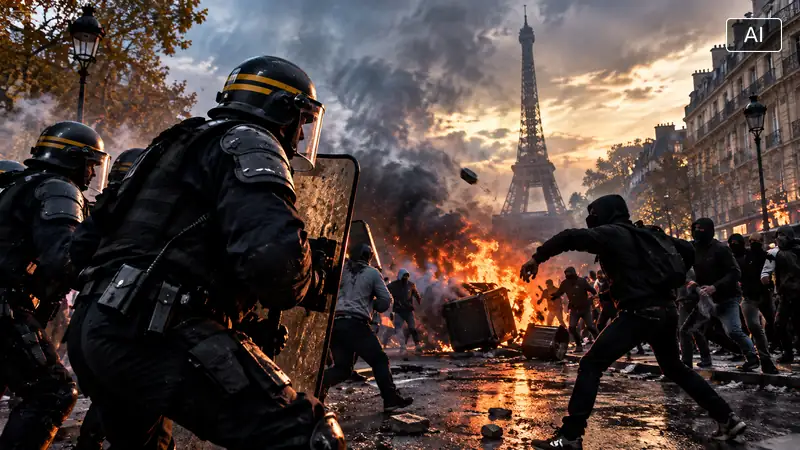
PARIS — Three consecutive weekends of demonstrations have tested France's ability to protect public order while preserving the right to peaceful protest.
On 17 October, the authorities struggled with the scale and fragmentation of the mobilisation. Reporting identified weaknesses in intelligence assessments and police deployment, and senior government officials acknowledged shortcomings in their preparations.
On 24 October, the government deployed additional personnel, expanded preventive checks and adopted a more mobile policing strategy. Reported levels of property damage and looting fell substantially, although confrontations and injuries continued.
The third weekend, on 31 October, brought another substantial mobilisation, albeit a smaller one according to government estimates. Police again deployed approximately 70,000 personnel, and clashes occurred in Paris and other cities. The events demonstrated that greater preparedness could not eliminate violence or the underlying grievances driving the demonstrations.
The available evidence supports a conclusion that France's security response changed significantly over the three weekends. It does not establish precisely how much each tactical adjustment contributed to the different outcomes.
That distinction matters. The government should face scrutiny over the original intelligence assessments, the deployment decisions, the proportionality of police interventions and the handling of suspected offenders through the justice system.
But policing is only one part of the challenge.
The demonstrations have also exposed continuing frustration over living costs, education, public services and confidence in political institutions. Those grievances cannot be resolved by security operations alone, just as legitimate political concerns cannot excuse arson, assaults or looting.
France's experience offers a broader democratic lesson. A government must be capable of protecting peaceful dissent while preventing violent groups from exploiting it. It must investigate failures, correct mistakes and enforce the law without treating an entire protest movement as criminal.
The measure of success will not simply be whether the next demonstration produces fewer arrests or less damage. It will be whether France can restore confidence that public safety, political accountability and civil liberties can be protected together.
The warning signs were there
The demonstrations of 17 October did not emerge from nowhere. Student protests had been building for weeks, while concerns about the cost of living, education funding and public services helped broaden the movement. Organisers hoped to turn separate grievances into a national show of opposition to government policy.
The size of the mobilisation was disputed from the outset. France’s Interior Ministry counted 550,000 participants nationwide; the CGT trade union put the figure at 800,000. Even allowing for the difference between official and union estimates, this was a mass demonstration, not a small gathering that unexpectedly spiralled out of control.
What followed was not one continuous riot involving every demonstrator. It was a series of confrontations and episodes of destruction involving different groups in different locations. Peaceful marchers shared the wider streets with people prepared to fight police, damage property or loot businesses. The distinction matters: the actions of violent minorities should not be attributed to everyone who attended a protest.
But the scale and spread of the disorder exposed weaknesses in the security response.
In Marseille, groups forced their way into the city hall and damaged its interior. In Limoges, the town hall was set on fire. In Paris, mobile groups moved between gathering points, creating several simultaneous flashpoints. In Lyon and Bordeaux, clashes and looting added to the strain on police resources.
A detailed investigation by Le Monde, published on 20 October, described a security operation that had not been adequately sized for the mobilisation that materialised. Intelligence estimates had failed to anticipate how much online organising and weeks of student activity would translate into people taking to the streets. In Lyon, the local estimate was particularly wide of the mark: authorities had expected around 8,000 people, while more than 20,000 were reported to have moved through the city in an unauthorised and fragmented mobilisation.
The difficulty was not simply that there were too few officers for one enormous crowd. Groups gathered at multiple locations, moved quickly and created simultaneous demands on units that were already spread thin. In Paris, a small group of officers reportedly found itself facing hundreds of people and had to retreat until reinforcements could arrive. In Marseille, the mayor, Benoît Payan, publicly questioned why his city had not been adequately protected.
Prime Minister Sébastien Lecornu acknowledged on 19 October that mistakes had been made. Interior Minister Laurent Nuñez also conceded that the authorities needed to improve their anticipation of how the mobilisation would develop.
That acknowledgement matters. It shifts the question beyond the familiar claim that violent demonstrators are difficult to control. The government’s own subsequent statements, together with the reporting on intelligence and deployment, point to a failure to match the security plan to the threat that emerged.
The warning signs had included the possibility of urban violence, damage to property and looting. The intelligence failure was not necessarily an inability to imagine disorder; it was a failure to estimate the scale and translate the risk assessment into an adequate operation.
Sources: Le Monde: Police overwhelmed by October 17 protest turnout; Le Monde: Intelligence failures and insufficient police presence.
A week later, France changed the calculation
On 24 October, the authorities approached the mobilisation differently. The Interior Ministry reported 410,000 demonstrators nationwide, including 110,000 in Paris. The CGT again claimed a national turnout of around 800,000. The official estimate was therefore lower than on 17 October, although the union’s estimate suggested a similar level of participation.
The security deployment, meanwhile, rose from approximately 60,000 personnel on 17 October to 70,000 on the 24th.
The extra personnel were part of the explanation, but the operation also changed in how and where forces were used. According to the National Gendarmerie’s account, preventive checks began on the evening before the demonstrations. Officers searched people and vehicles on routes towards major cities and at transport hubs. The Gendarmerie reported seizing dangerous objects, including pyrotechnics and items suspected of being intended for use as weapons or incendiary devices.
Mobile units, armoured Centaure vehicles, helicopters and canine teams formed part of the broader deployment. The stated aim was to protect sensitive sites, allow authorised demonstrations to proceed and intervene against groups preparing violence before they could exploit the disorder.
The strategic shift was significant. Rather than relying mainly on sending officers to trouble spots after confrontations had begun, the authorities sought to reduce the opportunities for violence in advance, protect vulnerable locations and keep units mobile enough to respond as events developed.
The provisional figures released by the Interior Ministry on the morning of 25 October showed a sharp reduction in several measures. There had been 1,314 arrests, compared with 2,628 the previous weekend. Fire services had attended 75 fires, compared with 2,025 interventions on 17 October. The ministry reported 24 shops looted on the 24th, against 1,522 commercial premises described as affected on the 17th.
Those figures need to be read carefully. The ministry’s first report was provisional, and the categories are not identical: a shop being “affected” does not necessarily mean it was looted. The initial injury figure for security personnel on 24 October was 53, but the Gendarmerie later reported 267 injured officers and gendarmes. By 26 October, the reported arrest total had also risen to 1,435.
The revised figures do not erase the difference between the two weekends. They do, however, show why an article must distinguish early totals from later updates rather than presenting the first announcement as the final record.
The Gendarmerie credited anticipation, positioning, mobility and coordination with preventing attacks. That is the institution’s own assessment, not an independent evaluation. Still, the reported measures provide a concrete account of what changed: more personnel, more preventive checks, stronger protection for vulnerable sites and a more mobile response.
The second operation was not violence-free. Clashes continued in Paris and elsewhere, and hundreds of security personnel were ultimately reported injured. Yet the lower reported levels of looting and fire-service intervention indicate that the authorities were able to limit some of the damage seen a week earlier.
The fairest conclusion is neither that the police failed completely on the first Saturday nor that the second operation solved the problem. It is that France experienced a serious failure of preparation, made identifiable tactical changes, and then recorded a markedly different outcome.
Sources: French Interior Ministry: 24 October mobilisation report; National Gendarmerie: tactical adaptation on 24 October.
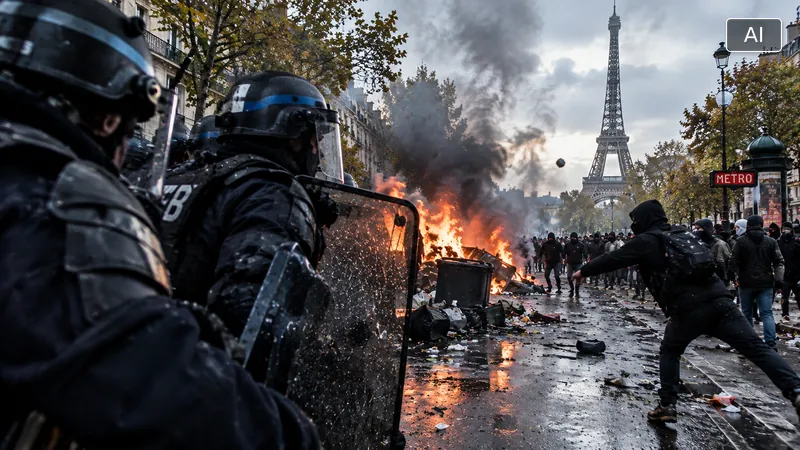
31 October: A third weekend tests France’s response
France faced a third consecutive weekend of demonstrations on 31 October, with the authorities preparing for the possibility that Halloween gatherings could become a new focus for violence.
About 70,000 police officers and gendarmes were deployed across the country, matching the previous weekend. An aide to Interior Minister Laurent Nuñez said police had prepared for violence comparable to that of 17 October, after detecting calls on social media for Halloween gatherings that urged protesters to spark a “revolution”. In Paris, unaccompanied minors faced a 9 p.m. curfew around the Champs-Élysées.
The demonstrations themselves were smaller than on the previous two weekends, according to the government’s national estimate. The Interior Ministry put participation at about 320,000 people, compared with 410,000 on 24 October and 550,000 on 17 October. Organisers, a coalition of youth groups and unions, said nearly half a million took part.
Paris accounted for a significant part of the mobilisation. The authorities counted about 70,000 people in the capital, while organisers claimed 200,000. The main march was moved to the city’s eastern edge after a last-minute court battle, rather than taking a central route. It began peacefully but turned violent near its planned end point, where bins and street furniture were set alight and police fired tear gas. On the outskirts of Paris, masked people threw paving stones and at least one incendiary device at security forces, who responded with tear gas and baton charges. Police also used tear gas in Lyon and Marseille and a water cannon against an unauthorised protest in Toulouse.
Arrests rose through the day. Police had made 27 arrests by 2 p.m., compared with 217 at the same point a week earlier. By 9 p.m., the Interior Ministry put the national total at 565. The Paris police prefecture said five members of the security forces had been injured, three of them by Molotov cocktails; Interior Minister Laurent Nuñez described the attack on one gendarme as attempted murder. Barricades were reported in Marseille and looting in Montpellier.
The authorities’ response was therefore more complicated than a simple return to the scenes of 17 October. The mobilisation remained substantial, but the government’s estimate was lower than on either of the previous weekends. The main Paris march was able to proceed, while police maintained a large security presence and intervened when confrontations developed. Those are the government’s figures and its description of the operation; they are not independent proof that its strategy worked.
The third weekend does not settle the questions raised by the first two. It does, however, show that the movement has continued despite restrictions and a substantial security operation. The next test will be whether the authorities can maintain public order without treating peaceful demonstrators as responsible for the actions of violent groups — and whether the government addresses the economic and public-service grievances that brought many people onto the streets in the first place.
Sources: Al Jazeera: Tension and clashes as hundreds of thousands protest again in France, 31 October 2026; Euronews: France’s third weekend of social protests sees lower turnout and early clashes, 31 October 2026; CBS News / AFP: French police clash with some protesters again, 31 October 2026; Le JDD: 31 October demonstrations — the authorities' official tally, 1 November 2026.
The leadership question cannot be avoided
The contrast leaves a difficult question for the government: how much of the first weekend’s failure was unavoidable, and how much reflected decisions that should have been different?
Crowd estimates are imperfect. Demonstrations can change rapidly, and a fragmented gathering is harder to police than a single march following an agreed route. Officers cannot be everywhere at once. But those limitations are precisely why intelligence, contingency planning and the allocation of reserves matter.
The reporting on 17 October points to several specific weaknesses: turnout was underestimated, violent groups operated across multiple locations, and local deployments were at times too small for the crowds they encountered. The 24 October operation addressed some of those weaknesses through additional personnel, preventive searches and greater mobility.
What remains unclear from public reporting is the precise chain of decisions behind the first deployment. Which warnings reached senior officials? How were those warnings assessed? Why were some cities left with inadequate coverage at critical moments? What operational alternatives were considered? The available public accounts do not provide the complete intelligence assessments, deployment orders or incident logs needed to settle those questions.
That limitation should not become an excuse to avoid accountability. It defines what the next stage of scrutiny should examine.
Leadership is not measured by a promise that disorder will never happen. It is measured by whether warnings are taken seriously, resources are allocated according to risk, mistakes are acknowledged and lessons are carried into future operations. If a larger, better-positioned deployment can reduce the opportunity for looting and attacks, the public has a legitimate interest in knowing why the same protections were not sufficient on the first occasion.
There is also a balance to maintain. An effective response cannot mean treating every demonstrator as a potential criminal or using force indiscriminately. Preventive searches, restrictions and arrests must have a lawful basis, and allegations of police misconduct must be investigated. The purpose of public-order policing is to protect the public and the right to peaceful assembly, not to make dissent itself impossible.
France’s experience illustrates both sides of that responsibility. On 17 October, the state struggled to protect people and property from violent groups. On 24 October, it demonstrated a more organised response, but one that still involved serious clashes and injuries. The task now is to establish which measures worked, at what cost, and whether they can protect public safety without unnecessarily restricting civil liberties.
A protest movement is not a single crowd with a single motive
The violence also raises a question that often gets lost in the immediate images of burning barricades and smashed shopfronts: who was doing what, and why?
The demonstrations brought together students, workers, trade union members and people angry about living costs, education and public services. These are legitimate political concerns, whether or not a reader agrees with the protesters’ demands. The violence involved a different set of actions: assaults, attacks on property, arson and theft.
The two can occur in the same place without having the same cause.
French officials blamed much of the violence on radical-left and ultra-left groups. Their statements are part of the public record, but a political label is not, by itself, proof of who committed a particular offence. Establishing the role of organised groups requires evidence about arrests, alleged conduct, planning and connections between individuals. The reporting by Le Monde also described opportunistic looters whose behaviour appeared to be driven by theft and disorder rather than a clear political programme.
The distinction is more than a matter of terminology. If authorities attribute all violence to a single ideological movement without sufficient evidence, they risk misunderstanding the problem. If commentators describe every person in a demonstration as a rioter, they erase the difference between peaceful dissent and criminal conduct. Both errors make it harder to understand what happened.
There is no need to soften the facts about violence to defend the right to protest. Nor is there a need to dismiss the grievances of peaceful demonstrators in order to condemn arson and looting. A functioning democracy must be capable of holding both positions at once.
France’s debate over the veil reveals a deeper argument about integration
Public disorder has unfolded alongside a wider European dispute over immigration, integration, secularism and the rules that govern shared public spaces. France’s long-running controversy over face coverings offers an example of how sharply those questions divide opinion.
France’s law of 11 October 2010, which came into force on 11 April 2011, prohibits clothing intended to conceal the face in public spaces, subject to exceptions. The law does not ban every form of religious veil: the distinction matters because the hijab, which covers the hair and neck while leaving the face visible, is not the same as a niqab or burqa that conceals the face.
The law was challenged at the European Court of Human Rights. In S.A.S. v France in 2014, the Court found no violation of the relevant rights under the European Convention on Human Rights. It accepted the government’s argument concerning the conditions of social interaction — the idea often summarised in France as “living together”. The ruling did not end the controversy over whether the ban is necessary or fair.
Supporters argue that common rules in public spaces can help sustain social interaction and a shared civic framework. Critics argue that a general ban disproportionately burdens Muslim women who choose to wear face-covering garments, restricting their autonomy and religious expression. The dispute reflects a real tension between the state’s understanding of a common public sphere and individual freedom.
But the existence of that dispute does not establish a cause of the October violence. The French face-covering law has been in force for more than fifteen years. To link it to the recent unrest would require evidence that it played a role in the grievances, mobilisation or actions of the people involved. The public reporting cited here does not establish that connection.
Italy provides a more recent example of immigration policy becoming a political flashpoint. In September 2026, the government of Giorgia Meloni adopted measures restricting face coverings that prevent identification in schools and limiting the proportion of certain foreign pupils in first-year classrooms. The measures, due to take effect in September 2027, also include Italian-language instruction for parents with limited proficiency.
The government presents the changes as a way to improve integration, language learning and identification in schools. Opponents argue that the measures risk singling out immigrant children and turning complicated educational challenges into a political battle over migration. Reporting on the Italian protests identified these policies as grievances for some demonstrators.
That is a relevant part of the political context, but it is not proof that immigration caused the unrest across Europe. It shows that questions of integration and national identity have become part of the argument over public policy — and that such measures can themselves generate protest.
Sources: French law prohibiting concealment of the face in public; European Court of Human Rights: S.A.S. v France; Euronews: Italy’s new school rules on face coverings and foreign pupils.
Europe has several problems, not one identical crisis
The phrase “Europe Burns?” captures the sense of instability created by images of clashes in several countries. But it can also mislead if it suggests that the same movement, grievance or cause is driving events everywhere.
In France, demonstrations have focused on living costs, education funding, inequality and public services, alongside broader opposition to government policy. In Italy, immigration and integration have featured more directly in disputes over school policy. Belgium has seen its own arguments over public spending, education and government decisions. The timing of unrest across countries does not, on its own, establish a shared organisation or a single cause.
The same caution applies to claims of foreign interference. An outside actor may exploit unrest, amplify divisive messages or use images of disorder for political advantage after events begin. That is not the same as proving that the actor organised or caused the unrest. Evidence of coordination, funding, communications or direct involvement is needed before such claims can be treated as established fact.
A serious European analysis should therefore examine several possible sources of tension rather than forcing them into one explanation. Economic insecurity and the cost of living may influence one group; frustration with schools or public services may mobilise another; immigration policy, segregation or distrust of institutions may be important in particular places. The relative weight of those factors has to be established country by country.
That does not mean immigration and integration should be treated as untouchable subjects. They are legitimate areas of public policy, and their consequences should be assessed openly. But the relevant evidence includes language acquisition, educational outcomes, employment, residential patterns, crime data, public trust and the effectiveness of local services — not assumptions about an individual’s background based on appearance or presence in a crowd.
The central test is whether a proposed explanation accounts for the evidence. A theory that explains one incident but ignores others is incomplete. A political argument that assigns collective blame without demonstrating individual responsibility is not analysis.
What Iceland should take from the French experience
For Iceland, the French scenes are a reminder that public order cannot be taken for granted, but the two countries should not be treated as interchangeable.
Icelandic police generally do not carry firearms during routine patrols, while French public-order operations can involve specialist units, armoured vehicles, helicopters and tens of thousands of personnel. The scale and nature of the French mobilisation are different from the conditions under which Icelandic police usually work. Those differences do not automatically prove that one policing model is superior.
The more useful comparison concerns the responsibilities of the state. Authorities need reliable intelligence, clear command structures, enough personnel to protect vulnerable locations and the ability to respond when groups move unpredictably. They also need safeguards against excessive force and clear procedures for investigating alleged misconduct.
For residents, the basic expectation should be straightforward: people should be able to demonstrate peacefully, travel through their cities and run businesses without fearing that a protest will leave them exposed to violence. Police should be equipped and prepared to protect those rights, while remaining accountable for how they use their powers.
Exceptional deployments may be necessary in exceptional circumstances. They should not become a substitute for understanding why disorder develops or for addressing legitimate grievances through democratic politics. Nor should a government use violence by a minority as a reason to restrict peaceful dissent more broadly.
The real test is what France learns
The two October weekends offer a clear contrast, but not a complete explanation. On 17 October, the authorities were caught short by the scale and fragmentation of the mobilisation. Public reporting identified intelligence and deployment failures, and the government acknowledged that its preparation had not been adequate. On 24 October, the state deployed more personnel, carried out preventive checks and adopted a more mobile approach. The reported damage fell substantially, although violence and injuries continued.
That is enough to establish that the second operation differed materially from the first. It is not enough to settle every question about responsibility or prove how much each tactical change contributed to the outcome.
France should now make the answers available through scrutiny of the planning, the intelligence assessments and the operational decisions. It should establish which warnings were missed, which measures proved effective, whether the use of force was proportionate and how suspects will be dealt with through the justice system. The public deserves more than competing claims of success and failure.
The wider European debate requires the same discipline. Governments should address the pressures facing schools, families, workers and public services. They should debate immigration and integration honestly, including policies that affect religious expression and national identity. They should also enforce the law consistently against those who assault people, set fires or loot businesses.
A free society cannot promise that every demonstration will remain peaceful. It can insist that peaceful protest is protected, that violence is not excused as politics, and that the state is prepared to defend people and property without abandoning the civil liberties it exists to protect.
France’s second operation showed that preparation can change the course of a difficult day. The more important question is whether the country will turn that lesson into lasting public confidence — and whether Europe’s leaders can confront the divisions behind unrest without confusing explanation with excuse, or security with the suppression of dissent.
Editorial note — 30 October 2026: This analysis is based on official statements from the French Interior Ministry and the National Gendarmerie, and on reporting by Le Monde and Euronews, linked in each section. Figures for 24 October were provisional when first published and were later revised; the article uses the revised figures where available. The illustrations were created with AI for Fréttir 24/7 and are not photographs of the events. Updated 31 October 2026: added a section on the third weekend of demonstrations, based on reporting by Al Jazeera, Euronews and CBS News/AFP.
Tips, corrections or questions: ritstjorn@frettir247.news
Unrest in Europe
- Europe Burns? France’s October Riots Expose a Crisis of Public Order
- Spain's Unrest: From Housing Anger to a New Wave of Street Disorder
- Spain Investigates Blocus Network as Halloween Mobilisations Test Police Response
More from World
 WORLD · GERMANYGermany's Generation Z Takes to the Streets: Anger Over Military Service, Education and an Uncertain Future31 October 2026
 WORLD · UNITED STATESUS Midterm Elections 2026: Trump Faces a Crucial Test as Control of Congress Goes to the Voters31 October 2026
 WORLD · POLANDPoland's Constitutional Crisis Deepens as President Nawrocki and Prime Minister Tusk Clash Over Control of the Judiciary31 October 2026