
Artificial Intelligence and Icelandic Society: Iceland Sets Out Its Priorities
Iceland does not need to lead the world in building AI to use it well, says a new government working group. Its 69 proposals focus on skills, the Icelandic language and the public sector.
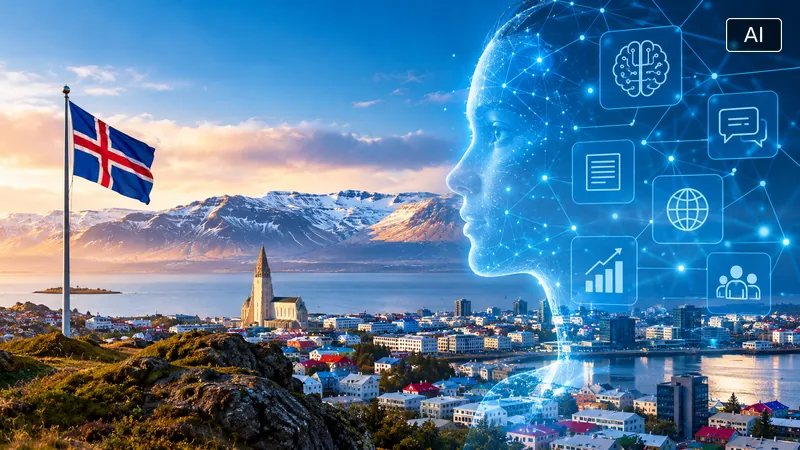
Artificial intelligence is changing how people work, communicate and access information. For Iceland, the challenge is not simply how to adopt the technology, but how to use it in ways that benefit society while protecting trust, skills and the Icelandic language.
The issue gained international attention in September when Iceland's Minister for Foreign Affairs, Þorgerður Katrín Gunnarsdóttir, addressed the United Nations General Assembly. She warned that artificial intelligence was making it easier to produce convincing falsehoods and manipulate public debate.
The speech highlighted a wider challenge facing governments and the public: how to benefit from rapidly developing technology without losing the ability to distinguish reliable information from misleading content.
Iceland develops its approach to AI
A significant domestic development followed on 9 October, when the Icelandic government published a working group's assessment and recommendations on artificial intelligence.
The report, Gervigreind til góðs, sets out 69 proposals across ten policy areas. Its central message is that Iceland does not need to lead the world in developing AI technology to become one of the countries that uses it most effectively.
The working group identified three main priorities.
The first is improving AI skills across society, including education about the technology's benefits and limitations. The proposals also call for a national framework for AI in schools and for measuring its effects on the labour market.
The second is developing artificial intelligence in Icelandic and on Iceland's own terms. This includes making Icelandic language and cultural data more useful for technology development, working with rights holders, and supporting the development and evaluation of Icelandic-language models.
The third is more coordinated use of AI across the public sector. The proposals include better coordination of government information technology and improvements to public-sector data, which can help create the foundations for responsible and effective use.
The government has approved a proposal to establish a ministerial steering group on AI. The wider recommendations are being reviewed as the authorities consider their next steps. They should not be understood as measures that have all been adopted.
Work, education and productivity
AI could help organisations complete certain tasks more efficiently, improve access to information and support public services. However, its effects will depend on how the technology is introduced, the quality of the information it uses and the skills of the people working with it.
Some jobs may change as tasks become automated, while new responsibilities and opportunities may emerge. The Icelandic working group's proposal to measure AI's effects on the labour market reflects the importance of understanding these changes rather than relying solely on predictions.
For a small language community such as Iceland's, the technology also raises a distinct question: will AI systems understand and serve Icelandic speakers as effectively as people using larger languages?
Developing reliable Icelandic-language tools could help make digital services more accessible and allow businesses, public institutions and individuals to benefit from the technology without having to rely exclusively on other languages.
Information, trust and responsibility
The risks are not limited to employment or education. AI tools can produce convincing text, images and audio that may be mistaken for genuine material. Such content can be used to mislead people, distort public debate or make it harder to establish what actually happened.
A few practical habits can help. Readers should check where a claim originated, look for independent reporting, consult primary sources when possible and be cautious about sharing material whose authenticity has not been established.
An image or video that looks convincing is not necessarily authentic. Equally, the presence of AI in the production process does not automatically make information false. The important questions are whether the content is accurate, how it was produced and whether its origin is represented honestly.
News organisations have a particular responsibility to distinguish verified facts from interpretation and illustrative material. AI may assist with language, research and accessibility, but responsibility for published content remains with the publisher.
What happens next?
Iceland's recent government report provides a framework for further work on education, language technology, public services and the wider effects of AI. The outcome will depend on which recommendations are taken forward and how effectively they are implemented.
For the public, the central questions remain practical: how will AI affect work and learning, how can people identify misleading information, and how can Icelandic society make sure the technology serves its needs?
These questions will become more important as AI becomes part of more everyday activities. The challenge is to approach the technology with both ambition and care, making use of its potential while remaining clear-eyed about its limitations.
Sources
- Government of Iceland: Address to the 81st UN General Assembly, 26 September 2026
- Government of Iceland: Working group report on artificial intelligence, 9 October 2026
- Government of Iceland: AI Action Plan 2025–2027
Editorial note — 30 October 2026: This article has been updated to cover the working group report Gervigreind til góðs, published on 9 October 2026. The proposals described are recommendations under review, not adopted government measures. The illustration was created with AI for Fréttir 24/7 and is not a documentary photograph.
Tips, corrections or questions: ritstjorn@frettir247.news
More from Technology
 TECHNOLOGY · AICan AI Think Like a Supreme Court Justice? University Experiment Tests the Limits of Artificial Intelligence in Law31 October 2026
 TECHNOLOGY · AIThe New Economy Forum: How AI Is Reshaping Money, Work and Government31 October 2026
 TECHNOLOGYA Greener Approach to Energy at an Icelandic Riding Hall