
A Greener Approach to Energy at an Icelandic Riding Hall
At Lýsuhóll on Snæfellsnes, Ljósorka has helped bring solar power and battery storage together in a project exploring how an Icelandic business can make better use of renewable electricity.
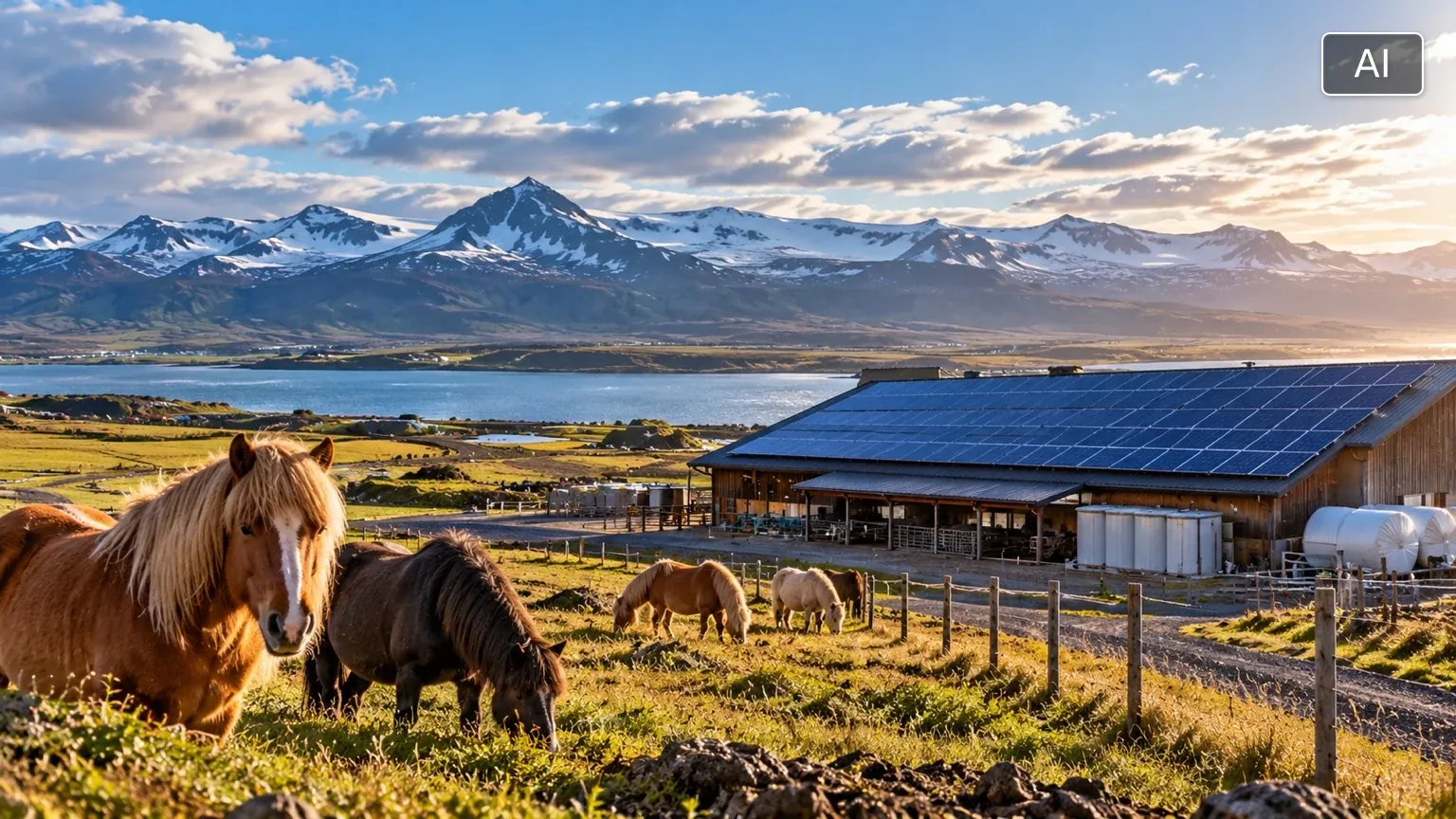
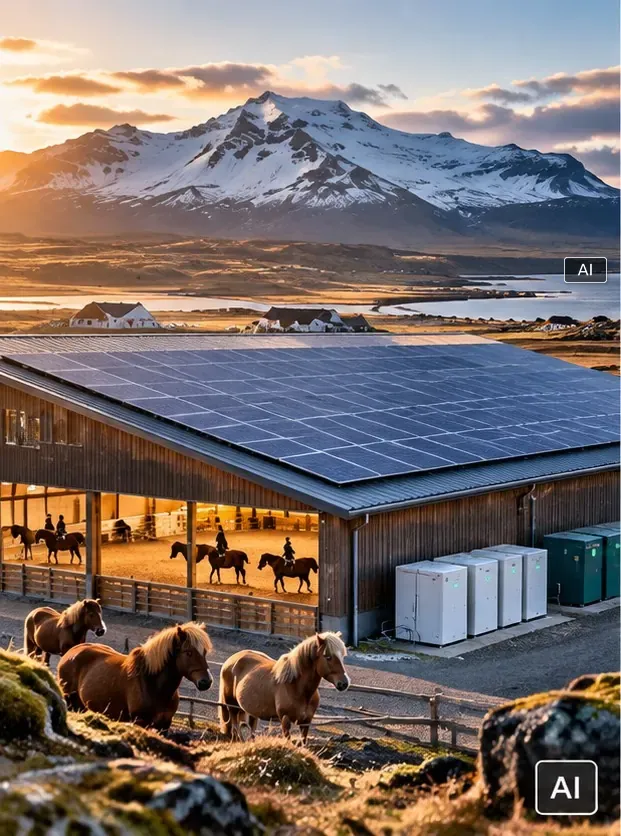
The roof of a riding hall at Lýsuhóll on Iceland’s Snæfellsnes peninsula is doing more than providing shelter. It is also home to a solar power system designed to help the wider operation make better use of the electricity it produces.
The installation comprises 340 solar panels with a rated peak output of 172 kilowatts (kW), alongside battery storage capable of holding 253 kilowatt-hours (kWh) of energy.
Ljósorka, the Icelandic company responsible for the system’s design and equipment, has helped turn an ordinary building roof into a practical part of the facility’s energy supply.
The project was reported by Bændablaðið on 9 October 2026 and covered in greater detail by Eiðfaxi on 20 October 2026.
Finding a better way to use electricity
As the family business at Lýsuhóll has expanded, its electricity needs have grown. Owners Jóhanna Ásgeirsdóttir and Agnar Gestsson told Eiðfaxi that they began looking at ways to generate more of their own electricity, reduce operating costs and make their operation more sustainable.
The property includes a riding hall and hotel, as well as holiday accommodation and other equestrian and tourism activities. According to Eiðfaxi, the operation also uses electricity for heating because it does not have access to district heating.
The solar installation is intended to serve the wider operation rather than the riding hall alone. Its energy-management system coordinates electricity generation, battery charging and consumption to help use as much of the locally generated power as possible.
That is where battery storage becomes useful. Solar panels produce electricity when daylight is available, while a business may need electricity at other times. A battery can store some surplus generation for later use, including during the evening.
What the early figures tell us
According to Eiðfaxi, Ljósorka estimates that the installation could generate approximately 115,000–120,000 kWh of electricity annually.
Eiðfaxi also reported that the system produced almost 5,000 kWh in September, with more than 95 per cent of that production reportedly used on site. The system had only reached full operation around the middle of the month.
These are encouraging early figures, but they are not a full-year assessment. Actual annual production and savings will depend on seasonal daylight, weather, electricity consumption and the way the system operates.
The distinction between power and energy is also important. The 172 kW figure describes the installation’s rated peak power, while 253 kWh describes how much energy the battery storage can hold.
Renewable energy suited to Icelandic conditions
Solar power in Iceland has an important seasonal limitation: production falls considerably during the darkest winter months, when buildings may still require substantial amounts of electricity.
Battery storage can shift electricity use between hours and short periods, but it cannot store summer production until winter. The wider electricity grid therefore remains important when on-site generation is insufficient.
Even so, a well-designed solar installation can help a business use more of the electricity it generates locally. The environmental benefit depends on the electricity displaced, the equipment used and its overall lifecycle; the project’s actual emissions savings have not been established in the reporting reviewed.
The goal is not to suggest that solar power solves every energy challenge. It is to show how a business can explore a practical option suited to its own needs.
Could other riding facilities benefit?
Riding halls, agricultural buildings and other facilities with substantial roof areas may have opportunities to generate electricity on site. Whether solar panels and batteries make sense depends on each building’s energy requirements, roof orientation, structural suitability, installation costs and electricity-use patterns.
Geir Sveinsson of Ljósorka has emphasised in the reporting that a system should be designed around actual electricity consumption rather than simply installing as many panels as possible.
A building that uses a large amount of electricity during daylight hours may benefit from a different setup than one whose demand is concentrated in the evening. Some facilities may benefit from battery storage; others may find that a simpler system better matches their needs.
The Lýsuhóll project gives other operators a real-world example to examine without suggesting that the same solution will suit every property.
A practical step towards better energy use
Ljósorka’s work at Lýsuhóll demonstrates how solar panels, battery storage and energy management can be combined in a working business. It also shows the value of starting with a practical question: how much electricity does the operation use, and when does it need it?
The longer-term contribution of the installation will become clearer after a full year of operation, when measured production, electricity consumption and actual costs can be assessed.
For now, the project offers a constructive example of how an Icelandic business can explore renewable energy in a way that responds to its own needs—and how technical expertise can help turn that ambition into a working system.
Sources
- Bændablaðið — “Orkuver á þaki reiðhallarinnar”, 9 October 2026.
- Eiðfaxi — “Reiðhallarþakið orðið að raforkuveri”, 20 October 2026.
Editorial note: This article draws on reporting by Bændablaðið and Eiðfaxi, with additional explanatory context. Project specifications, early production figures and financial estimates are attributed to published reporting. Frettir247 has not independently audited the figures or measured the installation’s environmental impact.
Tips, corrections or questions: ritstjorn@frettir247.news
More from Technology
 TECHNOLOGY · AICan AI Think Like a Supreme Court Justice? University Experiment Tests the Limits of Artificial Intelligence in Law31 October 2026
 TECHNOLOGY · AIThe New Economy Forum: How AI Is Reshaping Money, Work and Government31 October 2026
 TECHNOLOGY · AIArtificial Intelligence and Icelandic Society: Iceland Sets Out Its Priorities30 October 2026