
Artificial Intelligence vs Superintelligence: Who Is in Control?
A presidential executive order changes the words federal agencies use – not what AI systems can actually do.
A new name, not a new technology
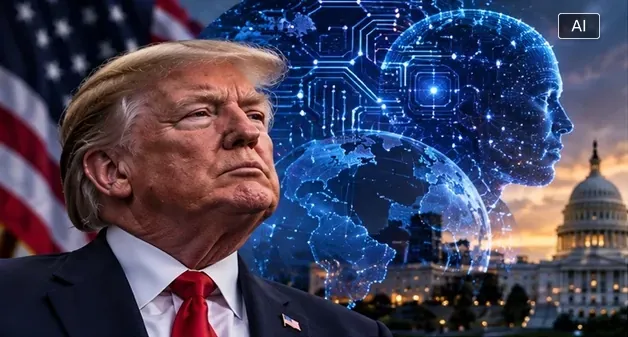
US President Donald Trump has decided that federal agencies should, as a general rule, use the term "Super Intelligence", abbreviated SI, instead of "Artificial Intelligence", or AI. The change is a political decision about the government's choice of words, not a scientific confirmation that today's computer systems have reached superintelligence.
The president went further in a Truth Social post on 8 October, calling those who keep using the older term "enemies". The statement drew attention, not least because the White House and US agencies had themselves continued to use the term AI in official communications.
What does the executive order say?
On 29 September, Trump signed Executive Order 14434, "Inaugurating the Era of Super Intelligence". Under it, executive-branch agencies are to use SI, to the extent permitted by law, in public communications, reports, websites and other documents that are not bound by older legal wording.
The order does not require changes to existing contracts, current regulations or historical documents. It also states that, for now, SI is to mean the same technology that US law defines as artificial intelligence. The president's science and technology adviser has 60 days to propose a new legal definition.
The administration argues that the new name better reflects the technology's potential and progress. Critics point out that superintelligence already has a specific meaning in technical debate.
AI, AGI and ASI – three different concepts
AI – artificial intelligence: A broad term for computer systems that can work with language, images, data and decisions. Such systems are already in widespread use.
AGI – artificial general intelligence: A term for a system that could solve a wide range of intellectual tasks with general ability. There is no globally agreed definition of AGI, nor an accepted test for it.
ASI – artificial superintelligence: Usually used for a possible system that would far exceed human ability across many intellectual fields. It has not been confirmed that any such superintelligence exists.
When the US government calls conventional AI "SI" under an administrative definition, that label must therefore be kept separate from the technical concept of ASI.

A safety accord without the force of law
When the new policy was presented, the US government also published the "White House Accord on Super Intelligence", an agreement on the responsibilities of companies that develop powerful AI models.
It emphasises internal monitoring of what models can do and how they behave, safety procedures, independent audits and accountability for executives. A joint declaration of this kind can shape norms, but it is not automatically comparable to binding law backed by public penalties.
The question is therefore not only what companies promise, but how anyone can verify that the promises are kept.
A partnership once taken for granted is no longer free of conflict
Behind the renaming lies a larger debate about safety, power and trust. Government agencies need powerful technology, while the companies that develop it also want to decide which uses are allowed and which safety limits apply.
The dispute between the US Department of War and Anthropic, the developer of Claude, is a clear example. The company wanted to keep restrictions on the use of its technology for fully autonomous lethal weapons and broad domestic surveillance. The government wanted wider permission for lawful use.
The dispute led to the company being designated a supply-chain risk for defence, and the case went to court. It shows that close cooperation does not necessarily mean agreement on where the limits of the technology's use should lie.

Safety concerns grow alongside progress
The development of AI that can use tools, write programs and carry out multi-step tasks raises new questions about computer security. If such systems are given overly broad permissions, mistakes or unexpected behaviour can affect other systems.
News reports have described security incidents during tests of autonomous AI tools. Such incidents do not show that computer systems have gained an independent will or consciousness. They are a reminder of the importance of access controls, testing and independent security reviews.
The dispute is therefore not only about a possible distant future, but also about the safety of technology that is already being connected to real computer systems.
Dismissals at OpenAI shed light on internal trust
On 9 October, Reuters reported that OpenAI had dismissed three researchers following an investigation into alleged mishandling of sensitive information.
The researchers, who worked on safety, disputed the company's explanation and said the dismissals were linked to their having raised safety concerns. OpenAI rejected that interpretation and said it was a serious breach of confidentiality.
No public information is available that would allow all the disputed allegations to be settled. The case does, however, underline how delicate the relationship can be between confidentiality, research freedom and independent safety review.
An American dispute with worldwide effects
Many of the world's most powerful AI systems are developed by American companies. When the US government changes its rules on procurement, access, safety testing or exports, it can affect users, businesses and public bodies far beyond US borders.
The European Union has taken a different path with its AI Act, which places obligations on certain developers and users according to the risk and nature of the systems. For Iceland, data protection, operational security, access to computing power and how dependent society becomes on a few foreign service providers also matter.
This is also linked to the rapid build-up of data centres in the Nordic countries. While one issue is about who controls the technology, the other is about who supplies the energy and infrastructure that keep it running.
A new name, old questions
A change of name can influence public discourse and how the technology is presented. It does not, however, resolve disagreements over safety, accountability, oversight or the state's right to demand particular uses.
Although governments and technology companies share major interests, it does not follow that they agree on the pace of development, safety limits or who should be in charge.
If the most powerful AI systems are developed by private companies but are at the same time treated as vital national-security and economic resources, who ultimately decides how they may be used?
That question will not be answered by a new abbreviation.
Sources
- Executive Order 14434 – The White House
- White House Accord on Super Intelligence
- Anthropic – where things stand in the dispute with the Department of War
- US Court of Appeals – Anthropic v. Department of War
- Reuters – OpenAI dismisses three researchers, 9 October
- Reuters – European reaction and the AI Act, 9 October
- Axios – the president's statement of 8 October
Editorial note: This article is an English translation of an analysis first published in Icelandic on 9 October 2026. It reflects the information available at that date. The illustrations were created with AI for Fréttir 24/7 and are not photographs of real events.
Tips, corrections or questions: ritstjorn@frettir247.news
More from Technology
 TECHNOLOGY · AICan AI Think Like a Supreme Court Justice? University Experiment Tests the Limits of Artificial Intelligence in Law31 October 2026
 TECHNOLOGY · AIThe New Economy Forum: How AI Is Reshaping Money, Work and Government31 October 2026
 TECHNOLOGY · AIArtificial Intelligence and Icelandic Society: Iceland Sets Out Its Priorities30 October 2026