Two Different Worlds for Women
In the same week, Malala Yousafzai's father urged Iceland to fight "gender apartheid", and the Taliban's leader defended his decrees in a rare speech in Kabul.
Iceland and Afghanistan sit at opposite ends of the world's rankings on the position of women. This week the gap between them was on show in two very different places: Harpa in Reykjavík and Kabul University.
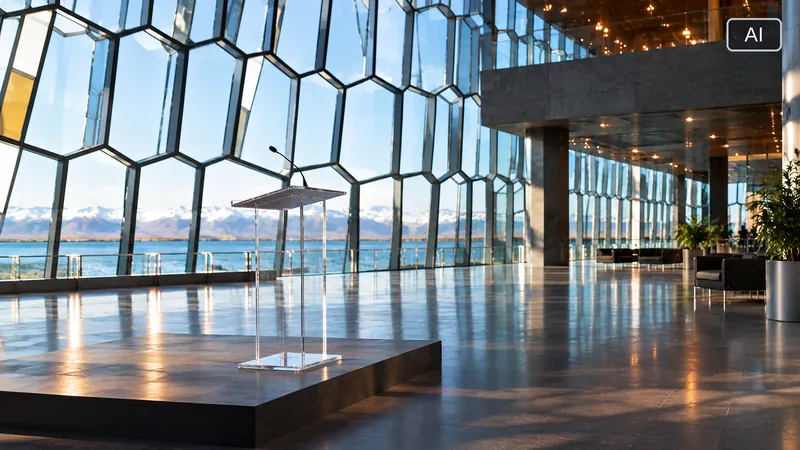
A call from Harpa
Ziauddin Yousafzai, the father of the Nobel Peace Prize laureate Malala Yousafzai, spoke at the Women Leaders Global Forum in Harpa earlier this week, and in an interview with mbl.is. He urged Iceland to lead international efforts to have gender apartheid defined as a crime against humanity under international law, and said he hoped to see that change within one to two years.
According to mbl.is, he said Iceland's small size should not stop it from having influence, and that its support for Afghan women and girls made the country big in the eyes of the world. He thanked the Icelandic government for that support and said girls in Iceland and Afghanistan are alike: they smile, laugh and cry in the same way.
Malala Yousafzai was born in 1997 in Mingora, in the Swat valley in Pakistan, where her father ran a school. In early 2009, at the age of 11, she began writing an anonymous online diary about life under the Taliban, who were then closing girls' schools in the valley, and she went on speaking out for girls' education after her name became known.
On 9 October 2012, when she was 15, a Taliban gunman shot her on her school bus. She was flown to Birmingham in England for treatment, woke from a medically induced coma ten days later and needed many operations. On her 16th birthday, 12 July 2013, she spoke at the United Nations in New York.
In 2014, at 17, she became the youngest person ever awarded the Nobel Peace Prize, which she shared with the Indian children's rights campaigner Kailash Satyarthi. "This award is not just for me. It is for those forgotten children who want education," she said. With her father, she founded the Malala Fund, which works for girls' education around the world.
Iceland's position
Iceland's government has used the same term. In her address to the UN General Assembly in September, the Minister for Foreign Affairs, Þorgerður Katrín Gunnarsdóttir, said the backlash against women's rights was nowhere more extreme than in Afghanistan, "where women and girls have been systematically erased from public life". "For me, this can only be described as gender apartheid," she said.
Iceland sits on the UN Human Rights Council for 2025–2027 and has made the rights of women and girls in Afghanistan a priority there. During the General Assembly week the minister met Malala Yousafzai in New York to discuss them, according to the government's announcement. During its term on UNESCO's Executive Board, from 2021 to 2025, Iceland led negotiations on UNESCO resolutions on Afghan women and girls, and in March 2025 it initiated a UNESCO conference on their situation.
Gender apartheid in international law
Apartheid is already a crime against humanity under international law, but it is defined by race. Countries at the UN are now preparing to negotiate a treaty on crimes against humanity, with negotiations due to begin in January 2028, and campaigners want gender apartheid added to it.
Iceland is one of the countries pushing for that. Together with Mexico and Timor-Leste, it submitted a joint proposal this year to include gender apartheid in the draft treaty, according to Human Rights Watch, Amnesty International and the End Gender Apartheid Campaign. Australia, Spain and Uruguay have made similar proposals. In all, 14 countries have publicly supported making gender apartheid an international crime. The proposals define it as inhumane acts committed within an institutionalised regime of systematic oppression and domination by one gender group over others, with the intention of maintaining that regime.
A rare appearance in Kabul
On Tuesday, 17 November, the Taliban's supreme leader, Hibatullah Akhundzada, made a rare visit to Kabul and spoke at Kabul University, the news agency AFP reported. He is based in Kandahar, has ruled Afghanistan by decree for more than five years and has visited the capital only a handful of times in recent years. The conference, held under heavy security, reviewed the effects of his decrees.
"Make the people love the supreme leader so they would obey and follow the decrees," he said, according to a government audio feed. He also said: "Religious education is more important than modern education."
The International Criminal Court has issued an arrest warrant for Akhundzada over the alleged persecution of women and girls.
Afghanistan in numbers
Under the Taliban's decrees, girls are banned from education beyond the age of 12. Women have been barred from universities since December 2022 and have largely been removed from public life.
UNESCO said in August that about 2.4 million girls in Afghanistan were barred from secondary education, 200,000 more than a year earlier, and that the number could approach 4 million by 2030. Afghanistan is the only country in the world that stops girls and women from attending secondary schools and universities. The Taliban describe the policy as an internal matter.
The bans fall on a young country. The UN Assistance Mission in Afghanistan estimates the population at 48.6 million this year; the Taliban put it at 37.2 million. According to the UN Population Fund, 63% of Afghans are under 24. Iceland, by comparison, has about 397,700 inhabitants, and women there enrol in university at higher rates than men in every age group, according to Statistics Iceland.
Top and bottom
For the 17th year in a row, Iceland tops the World Economic Forum's Global Gender Gap Index, published in September, having closed 93% of its gender gap. Afghanistan is not included this year. In the last three years it was included, from 2021 to 2023, it came bottom each time. In 2023 it had closed 40.5% of its gender gap, compared with 91.2% for Iceland.
In the Women, Peace and Security Index from Georgetown University and the Peace Research Institute Oslo, which also measures safety, justice and inclusion, Iceland is second of 181 countries, after Denmark. Afghanistan is last.
Fréttir 24/7 supports the right of all women and girls to education and equal treatment, wherever they live.
Sources
- mbl.is via Daily Northern — Yousafzai urges Iceland to lead fight against gender apartheid, 20 November 2026 – Ziauddin Yousafzai's interview with mbl.is at Harpa.
- Government of Iceland — Address by the Minister for Foreign Affairs at the 81st UN General Assembly, 26 September 2026 – The minister's words on Afghanistan and gender apartheid.
- Government of Iceland — Forsætisráðherra og utanríkisráðherra sækja allsherjarþing Sameinuðu þjóðanna, 22 September 2026 – The minister's meeting with Malala Yousafzai and the Human Rights Council (in Icelandic).
- Government of Iceland — Utanríkisráðherra ávarpaði ráðstefnu UNESCO um stöðu kvenna og stúlkna í Afganistan, 7 March 2025 – Iceland's work at UNESCO (in Icelandic).
- Human Rights Watch — One step closer to recognizing gender apartheid as an international crime, 6 August 2026 – The treaty proposals, including Iceland's with Mexico and Timor-Leste.
- AFP via Yahoo News — Taliban supreme leader makes rare visit to Afghan capital, 17 November 2026 – Akhundzada's visit and remarks in Kabul.
- Al Jazeera — UNESCO says 2.4 million Afghan girls denied access to further education, 11 August 2026 – UNESCO's figures on girls' education.
- KabulNow — Young people make up 63% of Afghanistan's population, UN agency says, 13 July 2026 – Population figures from UNFPA and UNAMA.
- Statistics Iceland — Population in the 3rd quarter 2026, 13 November 2026 – Iceland's population.
- Statistics Iceland — Students at upper secondary and tertiary level 2025, 3 June 2026 – University enrolment by gender.
- The Nobel Prize — Malala Yousafzai, Biographical – Malala Yousafzai's life and the 2014 Peace Prize.
- National Women's History Museum — Malala Yousafzai – Her treatment and recovery.
- World Economic Forum — Global Gender Gap Report 2026, September 2026 – Iceland at the top for the 17th year.
- World Economic Forum — Global Gender Gap Report 2023 – Afghanistan last in 2023.
- KabulNow — Afghanistan ranks lowest in Global Gender Gap Index, June 2023 – Afghanistan at the bottom in 2021–2023.
- Georgetown Institute for Women, Peace and Security and PRIO — Women, Peace and Security Index 2025/26 – Iceland second, Afghanistan last.
Reporting note: Ziauddin Yousafzai spoke to mbl.is; his remarks are as reported by mbl.is, via Daily Northern, and are summarised rather than quoted because they have been translated twice. The foreign minister's words are from her published address. Akhundzada's remarks are as reported by AFP. The treaty proposals are as described by Human Rights Watch, Amnesty International and the End Gender Apartheid Campaign. The rankings are from the World Economic Forum's Global Gender Gap Reports for 2026 and 2023 and the Women, Peace and Security Index 2025/26.
This article was drafted with AI assistance and reviewed and edited by Fréttir 24/7's editorial team.
Tips, corrections or questions: ritstjorn@frettir247.news