
Spain Investigates Blocus Network as Halloween Mobilisations Test Police Response
The suspected founder of Blocus in Spain has been ordered into provisional custody, ten people have been arrested in a wider operation and police have prepared for further gatherings across the country. The investigation is raising questions about online mobilisation, criminal activity and the influence of unrest beyond Spain's borders.
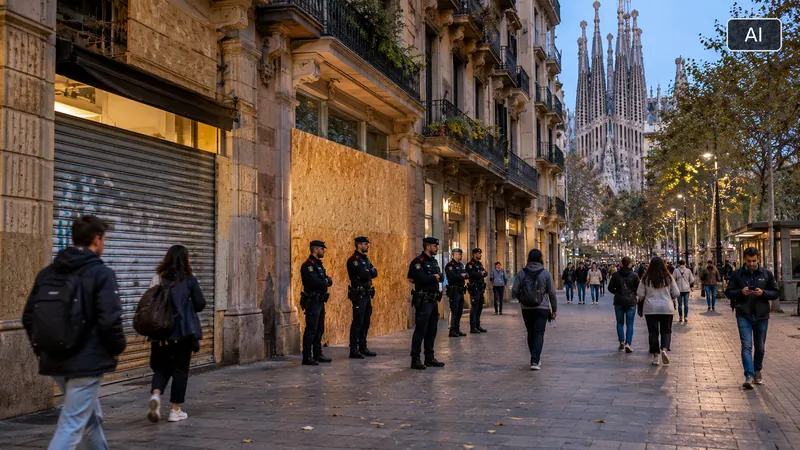
Spain is facing heightened security concerns following a week of arrests, investigations and preparations for possible further disorder linked to an online movement known as Blocus.
The investigation intensified on Friday, 30 October, when the Guardia Civil arrested a 20-year-old man in Picanya, Valencia, whom authorities describe as the suspected founder and principal promoter of Blocus in Spain. A judge then ordered his provisional imprisonment without bail while the investigation continues.
The operation is not limited to Valencia. Police have reported arrests in several regions, including Catalonia, Tenerife, Bilbao and Málaga, involving individuals suspected of using social-media accounts and private messaging groups to encourage looting, vandalism and violence.
Meanwhile, Barcelona's police activated their highest alert level for public demonstrations, businesses protected their premises and authorities prepared for gatherings advertised online for Halloween.
The developments have brought two very different issues into the same national debate: Spain's housing difficulties and the criminal activity that investigators believe some individuals attempted to organise under the appearance of student protest.
It is important to keep those issues separate. Demonstrations for affordable housing and better living conditions are legitimate forms of public participation. The people involved in those campaigns should not be held responsible for the actions of individuals accused of looting, arson or attacks on property.
How we got here
Spain's housing debate reached a new intensity in September with the case of Maricarmen Abascal, an 87-year-old woman evicted on 23 September from the home in Madrid's Retiro district where she had lived for around seven decades. Her case prompted mass demonstrations and a protest camp in the Puerta del Sol. An agreement was reached for her to return under a new rental contract, but she died in hospital on 7 October, the day before she was due to sign it. No medical finding has linked her death to the eviction.
On 2 October, Congress defeated two government housing decrees, and on 5 October Prime Minister Pedro Sánchez called an early general election for 29 November. The full background is set out in our earlier report, Spain's Unrest: From Housing Anger to a New Wave of Street Disorder.
The housing campaign remains a legitimate social and political movement. Its demands should be considered separately from the criminal investigations that have since developed.
Barcelona, 24 October: a gathering turns into disorder
The turning point came in Barcelona on Saturday, 24 October.
A gathering promoted through social media as a student protest brought around 500 young people into the city centre. It developed into widespread disorder, including shop looting, fires, damage to public property and confrontations with the Mossos d'Esquadra, Catalonia's regional police force.
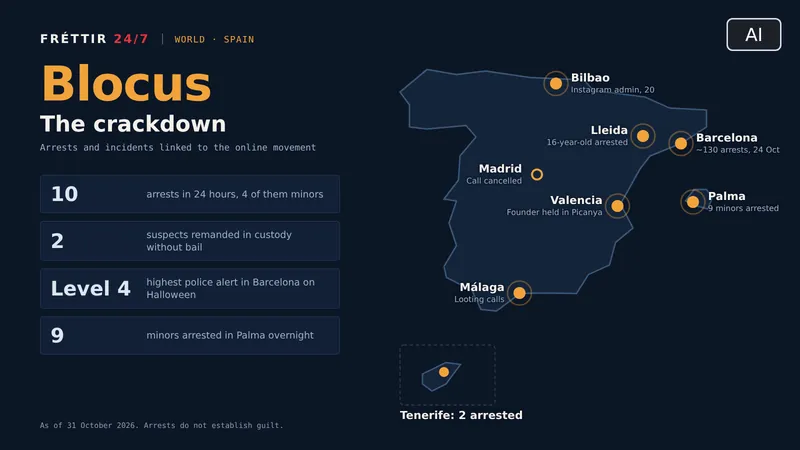
The Mossos initially reported 128 arrests, including 72 minors, and 14 injured officers, four of them seriously. Twenty-three businesses were reported vandalised. By 26 October, the arrest figure had risen to around 130, including 76 minors, and later counts referred to around 30 businesses damaged or looted.
The scale of the incidents raised immediate questions about whether the gathering had been a protest that escalated unexpectedly or whether some of the activity had been organised in advance. The head of the Mossos described small groups gathering to commit acts of vandalism rather than to defend any right.
For the businesses affected, the consequences were immediate: damaged premises, stolen goods, disrupted trading and concerns about whether similar incidents could happen again.
Blocus: the investigation moves beyond Barcelona
Following the Barcelona disturbances, investigators began examining the online networks used to promote the gathering.
The name that emerged was Blocus — French for "blockade", a label taken from youth and student protests in France.
In Spain, calls were circulated through TikTok videos and digital posters, some created with AI, carrying QR codes and links shared in school-related groups. Interested participants were directed towards WhatsApp and Telegram groups and then to private channels.
Investigators allege that some messages encouraged participants to attend with school bags and banners, so the gathering would resemble a student protest, while also wearing dark clothing and masks.
According to the investigation, private communications went further, allegedly discussing commercial targets. Some participants are reported to have proposed setting fire to shops and even Barcelona's city hall.
Investigators attribute to the suspected founder the creation and administration of Telegram groups used to coordinate activity. Some groups were closed and replaced by others, apparently to make them harder to trace. The Mossos asked Spain's counter-terrorism and organised-crime intelligence centre, CITCO, to help shut down Telegram groups calling for looting.
These are allegations contained in an ongoing criminal investigation. They have not been established as findings of guilt by a court.
The significance of the case is that investigators believe some of the activity was planned through private digital channels rather than being entirely spontaneous.
Ten arrests across several regions
The operation expanded considerably in the days leading up to Halloween.
According to the Spanish news agency EFE, ten young people, including four minors, were arrested in the preceding 24 hours in connection with channels associated with Blocus. The arrests were reported in Valencia, Barcelona, Lleida, Tenerife, Bilbao and Málaga, in operations involving the National Police, the Guardia Civil and the Mossos d'Esquadra.
The allegations vary between cases.
In Valencia, the National Police arrested a 17-year-old suspected of creating the "Blocus Vlc" channel, and a man in Alfafar suspected of involvement in the network.
In Lleida, a 16-year-old was arrested as the alleged creator and administrator of the movement's channels in that province.
In Bilbao, police arrested a 20-year-old suspected of administering a Blocus-linked Instagram account and Telegram channel, which investigators allege was used to promote a new gathering on Halloween.
In Málaga, another 20-year-old was arrested on suspicion of encouraging looting on 31 October in Málaga, Fuengirola and Marbella.
Two people, one of them aged 16, were also arrested in Tenerife. The Guardia Civil said they had used a modus operandi "imported from the disturbances in France".
The arrests indicate that investigators are examining a network of local accounts and communication channels across Spain. They do not, by themselves, establish that every incident or gathering was directed by a single organisation.
The suspected founder is remanded in custody
The investigation reached a new stage when a judge at the court of first instance in Torrent, Valencia, ordered provisional imprisonment without bail for the 20-year-old arrested in Picanya.
According to the High Court of Justice of the Valencian Community, he is being investigated for alleged membership of a criminal organisation intended to incite public disorder, robbery with force at commercial premises and property damage, subject to later reclassification.
The custody order also bars him from using computers or other devices in prison that would allow him to access social media.
A second man, the one arrested in Alfafar, was later also ordered into provisional custody without bail by a court in Catarroja, on suspicion of belonging to a criminal group inciting public disorder, robbery at commercial premises and damage to property.
These decisions are significant developments in the investigation, but they are not convictions. Both men remain entitled to the presumption of innocence.
The authorities will now have to establish the extent of each suspect's alleged involvement and whether the communications examined by investigators demonstrate organised criminal activity.
The French connection: influence is not the same as control
One of the most important questions raised by the investigation concerns the relationship between Blocus in Spain and youth mobilisation in France.
Spanish reporting has linked the movement's name, methods and slogans to France. Calls in Spain referred to the French Lycées Indignés movement behind recent student protests there.
However, the precise relationship between the groups remains an open question.
EFE reported that police sources were considering what they described as an efecto espejo, or mirror effect: the possibility that young people are copying demonstrations and tactics seen elsewhere, with social-media algorithms helping similar campaigns spread between countries. The same sources described no defined pattern beyond the copying of actions.
There are several possible explanations for the connection.
A movement can begin in one country and inspire participants in another without its original organisers directing the new activity.
Local groups can adopt similar names, slogans and methods while operating independently.
Individuals may also have personal contacts across borders or share information through online channels.
Actual cross-border coordination is a separate question and requires evidence of communication, planning or direction.
Spain and France share a land border, extensive road connections and substantial movement of people between them, while social-media platforms allow promotional material and organisational methods to spread even more quickly.
However, the available reporting does not establish that French organisers travelled to Spain to direct the Barcelona disturbances or that a central international command structure exists.
The distinction matters. Genuine cross-border influence is worth investigating, but rumours of foreign involvement should not be repeated as facts. Spain's national police have already warned of a hoax campaign online, including a widely shared audio message claiming inside police knowledge of major disturbances planned for central Madrid.
Halloween: police prepare for further disruption
The immediate test for Spanish authorities has been the series of calls for gatherings on 31 October.
The timing, coinciding with Halloween, has added another complication. Some channels urged participants to wear black and Halloween masks, making it harder to identify individuals involved in criminal activity.
In Barcelona, the Mossos d'Esquadra activated level 4, the highest level in their protocol for public demonstrations, with a police operation from 15:00. Calls had been made for 17:00 at Plaça de Catalunya and Passeig de Lluís Companys, near the Arc de Triomf, and for 20:00 on Passeig de Gràcia. The evening also coincided with the city's Castanyada celebrations and an FC Barcelona home match at 21:00.
Police controlled access to the city centre, and some Metro entrances were closed, including at Passeig de Gràcia, Plaça de Catalunya, Urquinaona and Arc de Triomf.
Businesses in central Barcelona protected shopfronts with panels. Many remained open behind boarded-up windows.
By 16:30, according to EFE, there had been no incidents or gatherings at the advertised meeting points. Police had carried out around a hundred identity checks and seized bladed weapons and balaclavas, with no arrests reported by then.
In Madrid, accounts linked to Blocus announced that the planned call had been cancelled, although police maintained their preventive operation.
The important distinction is between police preparations, online calls for mobilisation and incidents that have actually been confirmed. The presence of a large security operation does not itself demonstrate that widespread disorder has taken place.
Palma: tension around the housing protest camp
The situation in Palma, Mallorca, had already produced incidents before Saturday evening.
According to EFE, police operations on Friday night and into Saturday morning resulted in nine minors being arrested, around 200 people being identified and 40 reports being issued for administrative offences.
Weapons and dangerous objects, including corrosive liquids, were found on 14 people. Twenty-one people faced proposed sanctions for covering their faces, and small quantities of drugs were found in five cases.
The night also involved confrontations between a far-right group and people at the housing protest camp in the city's Plaça d'Espanya. Police in riot gear intervened to separate them.
EFE reported that there were no personal injuries or material damage.
Blocus Mallorca called a further gathering for 19:30 on Saturday in the same square. Police maintained a special operation as Halloween celebrations were expected to bring large numbers of young people into the city centre.
The episode illustrates how separate groups can find themselves in the same public space for very different reasons. A housing protest camp and a gathering promoted through Blocus should not be treated as the same organisation or movement.
Who benefits when disorder spreads?
The wider investigation also raises a question that extends beyond the identity of the people arrested: who benefits when public disorder spreads?
There does not have to be one organisation or a shared objective.
Criminal opportunists can use confusion to steal from shops. Online provocateurs can gain attention and followers by circulating dramatic footage. Political extremists may attempt to use disorder to attack opponents or promote their own arguments.
Others may simply seek confrontation with police or public institutions.
These different interests can converge around the same events without the people involved knowing each other or working together.
This does not establish that any of these groups directed Blocus, nor does it demonstrate the existence of a wider conspiracy. Investigators have not publicly established one common ideology or motive shared by everyone involved.
It does, however, explain why the investigation needs to look beyond the people physically present during a disturbance.
Who created the channels? Who administered them? Who selected targets? Who encouraged violence? Were there links between local groups? Did any individuals coordinate activity across national borders?
Those are questions that can be investigated through communications, digital evidence and the accounts of people involved. They are more useful than assuming that every participant had the same purpose.
A wider European challenge
Spain's experience is part of a broader European debate about youth mobilisation, housing affordability, economic pressure and the speed at which online campaigns can move between countries.
France has experienced its own demonstrations and public disorder, while similar social pressures are visible elsewhere.
The events in Spain illustrate how legitimate grievances and criminal activity can become entangled in public debate. Social-media channels can bring participants together quickly, while private messaging groups can make it harder for authorities to understand what is being planned.
The challenge for law enforcement is to identify and prosecute those responsible for criminal activity without treating ordinary demonstrators as part of the same network.
For journalists and the public, the challenge is to separate verified information from speculation.
Spain's housing crisis remains a serious issue. People demanding more affordable homes and greater rental security should not be judged by the actions of individuals accused of looting or violence.
At the same time, legitimate social grievances should not prevent scrutiny of people suspected of using protest movements as cover for criminal activity.
The central question is no longer simply why young people are taking to the streets. It is how online networks are mobilising them, whether criminal activity is being organised across different locations, and what evidence exists of connections beyond Spain.
The answers will matter not only for Spain, but for other European countries facing similar pressures.
Sources and reporting basis
1. Infobae (Europa Press) — judge orders provisional custody without bail for the alleged founder of Blocus Spain, 31 October 2026. The Torrent court, the TSJCV announcement, the suspected offences and the ban on devices. https://www.infobae.com/espana/agencias/2026/10/31/la-jueza-decreta-prision-provisional-y-sin-fianza-para-el-presunto-fundador-de-blocus-espana/
2. The Objective — provisional custody without bail for another Blocus-linked detainee in Valencia, 31 October 2026. The Alfafar detainee remanded by a court in Catarroja and the suspected offences. https://theobjective.com/espana/tribunales/2026-10-31/prision-provisional-sin-fianza-detenido-valencia-blocus/
3. The Objective — Guardia Civil arrests the founder of Blocus in Valencia, 30 October 2026. The Picanya arrest, Telegram groups and replacement channels, the "Blocus Vlc" arrest, proposals to burn shops and city hall. https://theobjective.com/espana/2026-10-30/guardia-civil-valencia-fundador-blocus/
4. EFE (via El Ideal Gallego) — ten young people arrested for instigating Blocus-linked disturbances, 30 October 2026. Ten arrests, four minors, the cities, the "mirror effect", algorithms and the Tenerife modus operandi. https://www.elidealgallego.com/actualidad/sociedad/2026-10-30/detenidos-diez-jovenes-por-instigar-disturbios-vinculados-a-blocus-en-las-calles-de-varias-ciudades-espanolas-888029.html
5. Libertad Digital — founder and coordinators arrested in Valencia, Bilbao, Málaga and Tenerife, 30 October 2026. Recruitment methods, dress instructions, the Bilbao and Málaga arrests. https://www.libertaddigital.com/espana/2026-10-30/operaciones-contra-blocus-la-guardia-civil-detiene-al-fundador-y-la-policia-a-dos-coordinadores-en-valencia-y-bilbao-7484743/
6. Catalunya Press — around ten arrests linked to Blocus before Halloween, 30 October 2026. The Lleida arrest and the national police warning about a hoax audio. https://www.catalunyapress.es/articulo/sucesos/2026-10-30/6072850-decena-detenidos-vinculados-blocus-varias-ciudades-antes-halloween
7. Infobae (EFE) — Mossos control access to central Barcelona, which closes Metro entrances, 31 October 2026. Level 4 alert, meeting points and times, Metro closures, boarded-up shops, the situation at 16:30. https://www.infobae.com/espana/agencias/2026/10/31/los-mossos-controlan-los-accesos-al-centro-de-barcelona-que-cierra-entradas-de-metro/
8. ElNacional.cat — Blocus, second call in Barcelona, live, 31 October 2026. Castanyada and the FC Barcelona match, Halloween masks. https://www.elnacional.cat/es/en-directo/blocus-segunda-convocatoria-en-barcelona-directo-ultima-hora-protesta-hoy_13330_126.html
9. Demócrata — Halloween under surveillance in Madrid and Barcelona, 31 October 2026. The cancelled Madrid call and the police operation that remained in place. https://www.democrata.es/en/society/halloween-under-surveillance-in-madrid-and-barcelona-what-the-police-is-preparing-in-response-to-the-threats-from-blocus/
10. EFE (via Diario de Santiago) — nine minors arrested and 200 identified after the Blocus call in Palma, 31 October 2026. The Palma figures, items seized, the far-right confrontation with the housing camp and the new call. https://www.diariodesantiago.es/espana/nueve-menores-detenidos-y-200-identificados-tras-los-incidentes-por-la-convocatoria-de-blocus-en-palma/
11. The Local Spain — who's really behind the wave of looting and violence in Barcelona, 26 October 2026. Initial Barcelona figures and the Mossos chief's comments. https://www.thelocal.es/20261026/whos-really-behind-the-wave-of-looting-and-violence-in-barcelona
12. Diari de Tarragona (ACN) — Mossos raise arrests to 130, 76 of them minors, 26 October 2026. Updated arrest figures, around 500 participants, around 30 businesses affected. https://www.diaridetarragona.com/catalunya/274022/mossos-elevan-130-detenidos-disturbios-sabado-barcelona-blocus-76-menores.html
13. Euronews — Mossos ask CITCO to help block Blocus groups, 27 October 2026. The request to the counter-terrorism and organised-crime intelligence centre. https://es.euronews.com/2026/10/27/los-mossos-piden-ayuda-al-centro-de-inteligencia-contra-el-terrorismo-para-bloquear-los-gr
14. Euronews — Maricarmen's eviction carried out after 70 years in her Retiro home, 23 September 2026. The eviction date and the Retiro district. https://es.euronews.com/2026/09/23/el-desahucio-de-maricarmen-se-consuma-tras-70-anos-en-su-casa-de-retiro
15. El Salto — Congress defeats both housing decrees, 2 October 2026. The date of the vote. https://www.elsaltodiario.com/politica/congreso-tumba-dos-decretos-vivienda-deja-legislatura-al-borde-del-fin
Reporting note: This is a developing story. The Halloween section reflects reporting available at around 17:00 on 31 October 2026 and will be updated. Arrests and custody orders do not establish guilt, and all those detained are presumed innocent unless convicted.
Sources
Tips, corrections or questions: ritstjorn@frettir247.news
Unrest in Europe
- Europe Burns? France’s October Riots Expose a Crisis of Public Order
- Spain's Unrest: From Housing Anger to a New Wave of Street Disorder
- Spain Investigates Blocus Network as Halloween Mobilisations Test Police Response
More from World
 WORLD · GERMANYGermany's Generation Z Takes to the Streets: Anger Over Military Service, Education and an Uncertain Future31 October 2026
 WORLD · UNITED STATESUS Midterm Elections 2026: Trump Faces a Crucial Test as Control of Congress Goes to the Voters31 October 2026
 WORLD · POLANDPoland's Constitutional Crisis Deepens as President Nawrocki and Prime Minister Tusk Clash Over Control of the Judiciary31 October 2026