COP31 at Halfway: Ministers Arrive for the Hard Part
The UN climate talks in Antalya enter their second week with the biggest fights still ahead: money for adaptation, and how to move away from fossil fuels.
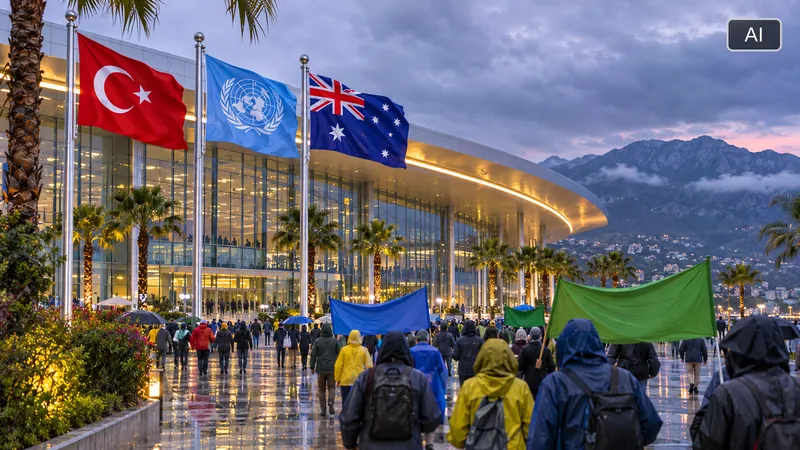
The UN climate conference in Antalya, Türkiye, reached its halfway point on Saturday as ministers arrived to take over from their negotiators. COP31 runs from 9 to 20 November at the Antalya Expo Center, under an unusual shared arrangement agreed a year ago: Türkiye hosts, and its environment minister, Murat Kurum, is COP President, while Australia's climate minister, Chris Bowen, chairs the negotiations.
The UN climate chief, Simon Stiell, called progress so far "constructive". Talks began on time, without the fight over the agenda that has delayed past conferences. But most items still need substantial work, and a stocktaking session on Saturday night was expected to show where countries draw their first red lines.
Money for adaptation
The sharpest dispute is over money to help countries cope with floods, droughts and heat that can no longer be avoided. African countries want adaptation finance tripled to at least $120 billion a year by 2035. A draft text released overnight includes that goal, but also an alternative that would instead start a review of the target. African negotiators are expected to resist it.
Even the full amount would not be enough, the UN Secretary-General, António Guterres, told the conference: "Even if we triple adaptation funding, we would still meet less than 30 percent of the actual needs." A pledging event for a new Pacific resilience fund left it $300 million short of its $500 million target for this year.
Fossil fuels
Brazil, which hosted last year's talks in Belém, has put forward a voluntary roadmap away from fossil fuels: build up clean energy first, then phase out coal, oil and gas after 2031. A draft of the conference's main decision includes a proposal to welcome it. Brazil's President Luiz Inácio Lula da Silva said his country "has the moral obligation" to host the third conference on transitioning away from fossil fuels, likely in 2028. The second is due in Tuvalu next year, with a preparatory meeting in Dublin.
Not everyone is on board. Some large developing countries have pushed back against sector targets, including a new voluntary pledge to raise the share of electricity in energy use to 35% by 2035. A separate proposal from the Arab group, Mexico, South Korea and Switzerland would hold the conferences every two years instead of every year.
Outside the venue
Campaigners marched through rain-soaked streets in central Antalya on Saturday, calling for an end to fossil fuel projects. Organisers said the march had a permit, but Cristina Alonso of Friends of the Earth accused the host of hindering "the right to protest through bureaucratic obstacles, restrictions, and detentions". Local groups also point to Türkiye's plans to expand a coal-fired power plant in the west of the country.
A first draft of the main decision is expected early next week. The talks are scheduled to end on Friday 20 November.
Sources
- Climate Home News — COP31 Bulletin Day 6: Climate marchers call for justice as talks make limited progress, 14 November 2026 – The state of the talks, the adaptation draft, the fossil fuel roadmap and the Pacific fund.
- Climate Home News — COP31 will be hosted by Türkiye but run by Australia, 20 November 2025 – How the shared presidency was agreed.
- A News — Climate activists to protest in Antalya as COP31 hits halfway point, 14 November 2026 – The march, its permit and local criticism of coal plans.
- Newscord — COP31 midpoint plenary in Antalya pressed on climate justice, finance and adaptation targets, 14 November 2026 – A comparison of coverage, including the remarks by António Guterres and Cristina Alonso.
- UNFCCC — UN Climate Change Conference, Antalya, November 2026 – The official conference page.
Reporting note: This article is based on reporting by Climate Home News and the Turkish broadcaster A News, and on a comparison of coverage by Newscord, including UN News. Fréttir 24/7 will report on the outcome of the conference.
This article was drafted with AI assistance and reviewed and edited by Fréttir 24/7's editorial team.
Tips, corrections or questions: ritstjorn@frettir247.news