
South Korea Sails Towards Hormuz, and Stops Short
Seoul is sending a patrol plane, a bomb-disposal team and underwater drones to the waters near the world's most dangerous shipping lane. It is just as careful about where they will not go. The plan says a lot about how America's allies are trying to help without joining a war.
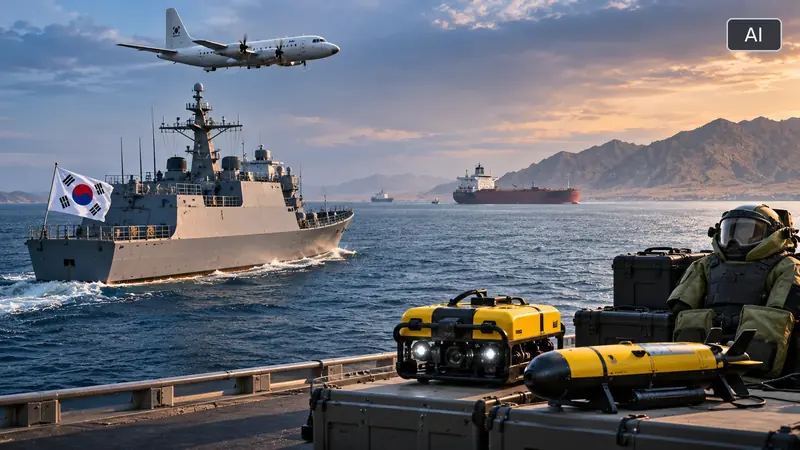
On paper, South Korea is heading for the Strait of Hormuz. Read the plan closely, and it stops well short. On Thursday, after a meeting of vice-ministers, the government in Seoul announced that it would extend the operating area of its Cheonghae naval unit, which has fought pirates in the Gulf of Aden since 2009, roughly to double its current range. The new area reaches the open waters of the Arabian Sea south of Oman. It does not include the strait itself, or the Gulf of Oman in front of it.
"Operations will remain restricted to the open waters south of Oman," a defence ministry official said. Another was blunter: "We will absolutely not be involved in or intervene in the war."
What Seoul is sending
The unit already has a 4,400-tonne destroyer, a naval helicopter and fast boats. It will now add:
- a P-8A Poseidon maritime patrol aircraft;
- a bomb-disposal team;
- unmanned mine-countermeasure systems: underwater drones, unmanned surface vessels and remotely operated vehicles;
- 75 extra personnel, bringing the unit to about 395.
The new aircraft and equipment are to operate from Djibouti, pending talks with its government. The rules are strict. The patrol plane may not watch Iranian territory, Iranian waters or the inside of the strait, and the operation stays under South Korea's own chain of command. The plan still needs approval from the National Assembly, which will receive the revised mandate after the cabinet signs it off next week.
Why now
The war began with American and Israeli strikes on Iran at the end of February. Within weeks, traffic through Hormuz had dwindled to a trickle, and ships were hit by suspected Iranian projectiles. Mines followed. Since then, Washington has pressed its allies to contribute.
South Korea has so far said no. In August, President Donald Trump suggested he had asked President Lee Jae-myung for help and been turned down. According to Korea JoongAng Daily, Washington has privately warned of consequences if Seoul did not make a visible contribution by November.
Seoul's answer is a compromise. It meets part of the American request without putting Korean sailors into the war. Korean officials say the aim is "to protect our citizens and safeguard our economic interests", and the interests are not small. About 70 per cent of South Korea's crude oil comes from the Middle East. The government's own plan, published in September, is to cut that to 50 per cent by 2035, which shows how exposed the country still is.
The mines are the point
The most telling part of the package is not the aircraft but the mine-clearing equipment. Clearing the strait is expected to be one of the biggest jobs once the war ends, and it will need several navies working together. How big a job is disputed. In August the head of US Central Command, Admiral Brad Cooper, declared the international shipping lanes cleared. American allies privately warned that the strait was probably still mined: according to Bloomberg, Iran is estimated to have laid between 80 and 150 mines, and not all of them have been found. US officials called that estimate outdated.
South Korea has promised to take part in clearing the strait, but only in what officials call a "permissive environment", the same condition set by Britain and France. In practice, that means after the fighting stops. Seoul admits it has little experience with unmanned mine countermeasures and wants to test them. "We cannot go unprepared when called upon," an official said.
In other words, the equipment is being sent for the day after the war, not for the war itself.
Not everyone is convinced
The plan has critics at home. Earlier versions stalled amid opposition, including within the ruling camp. Kim Joon-hyung, a lawmaker from the Rebuilding Korea Party, asked the obvious question: "Who can guarantee that an operating area, once expanded, will not become the starting point for the next military demand?"
Nor is it clear that Washington will be satisfied. The last time the unit's area was widened at American request, in 2020, it was extended to include Hormuz itself. This time the strait has been deliberately left out.
Why it matters beyond Korea
The Korean plan is a small deployment, but it is a clear example of how allies are handling this war. They are offering help at the edges, protecting their own ships and preparing for the clean-up, while staying out of the fighting. Others have done much the same: since March, India and Pakistan have used warships to escort their own tankers in the Gulf of Oman.
For countries that depend on Gulf oil, and that is most of Asia, the question is not only when the war ends. It is how long it will take afterwards to make a mined waterway safe again. South Korea is betting that the answer will need underwater drones, and that it would rather learn to use them before it is asked.
Sources
- Korea Herald (Yonhap) — S. Korea to expand anti-piracy mission closer to Hormuz, send more naval assets, 5 November 2026 – The decision, the assets, the operating area and the restrictions on the patrol aircraft.
- Korea JoongAng Daily — Korea expands antipiracy mission toward Oman as US pressure builds over Strait of Hormuz, 5 November 2026 – US pressure on Seoul, the defence ministry's statements and Kim Joon-hyung's criticism.
- Seoul Economic Daily — Korea widens naval zone near Hormuz, stops short of strait, 5 November 2026 – The four principles, the Djibouti base, the 'permissive environment' condition and the 2020 precedent.
- The Korea Times — Middle East conflict raises alarm on Korea's oil dependence, 3 March 2026 – Korea's reliance on Middle East crude.
- Hydrocarbon Processing — South Korea plans to cut its reliance on Middle East crude oil imports to 50% by 2035, 23 September 2026 – The government's 2035 target.
- gCaptain (Bloomberg) — US commander declares Hormuz shipping lanes are mine-free, 28 August 2026 – Admiral Brad Cooper's statement and allies' doubts over the 80–150 mines.
- USNI News — India, Pakistan escort nationally-owned tankers in Gulf of Oman, 17 March 2026 – Indian and Pakistani naval escorts and the effect of the war on traffic through the strait.
Reporting note: This article is based on reporting by Korean news outlets citing South Korean defence officials, and on maritime and defence media. Some officials quoted were not named by the outlets. The plan still requires approval by South Korea's National Assembly. The illustration is AI-generated.
Tips, corrections or questions: ritstjorn@frettir247.news
More from World
 WORLD · HUNGARY · HISTORYHungary Opens the Files: 60,000 Names, and the Questions They Cannot Answer5 November 2026
 WORLD · GERMANYGermany's Generation Z Takes to the Streets: Anger Over Military Service, Education and an Uncertain Future31 October 2026
 WORLD · UNITED STATES · MIDTERMSUS Midterms 2026: Democrats Win Congress — Now Comes the Test of Governing America4 November 2026