
Three Days, a Radio and Some Cash: Iceland Joins Europe's Preparedness Drive
Iceland's civil protection department has published its first preparedness booklet for every household. The advice is modest. The reasons behind it have changed.
There was a time when every Icelandic home kept its emergency advice in the telephone directory, somewhere between the list of fire stations and the plumbers. The directory has gone the way of the fax machine, and on Tuesday the Department of Civil Protection and Emergency Management, part of the National Police Commissioner's office, published its replacement: a booklet called Verum viðbúin, "Let's be prepared".
The first copies were handed to ministers after Tuesday's cabinet meeting. Everyone else gets theirs electronically through Ísland.is, and it is available at verumvidbuin.is in Icelandic, English and Polish, as well as in easy-read form and in sign language. From Wednesday to Sunday, volunteers from the search-and-rescue association Landsbjörg are handing out printed copies around the country while they sell Neyðarkallinn, their annual fundraising figure.
What is in it
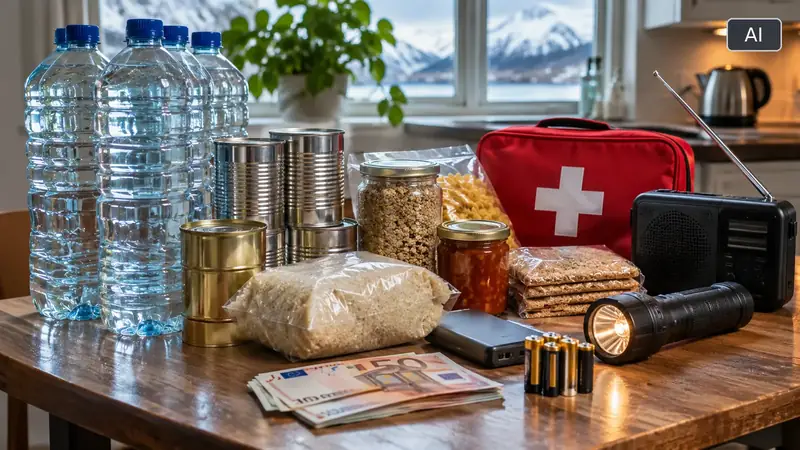
The core recommendation is that every household should be able to look after itself for at least three days. That means food, water and other essentials: tinned and dried food, drinking water, medicines, hygiene products, a first-aid kit, a torch, batteries, a power bank, a camping stove or gas grill, blankets and a printed list of phone numbers. Families with children, older relatives, people with underlying illnesses or pets are asked to plan for them in particular.
Two items stand out. The first is a battery-powered radio: if the phone network and the internet fail, Rás 2 will act as the emergency channel, and official messages will come through it. The second is cash. Households are advised to keep some at home and to have more than one way to pay. In a country where hardly anyone carries cash, the state is quietly suggesting you keep a few notes in a drawer.
The booklet also asks families to agree in advance where they will meet if they cannot reach each other by phone.
"Preparedness is not only the government's job, but all of ours," said Runólfur Þórhallsson, chief superintendent at the department. "When individuals and families take simple steps to prepare for possible disruption, the safety of society as a whole increases."
Why now
Iceland hardly needs reminding that the ground can move. The department points to eruptions, earthquakes, avalanches and storms, all of which the country has had in recent years. But the list of reasons in the booklet is longer than it would once have been. It names cyberattacks, system failures and human error that can knock out card payments and online banking, as well as prolonged power cuts and telecommunications outages. And it adds a sentence that would have read strangely in an Icelandic public-information leaflet a decade ago: tension in international relations and armed conflict in Europe and elsewhere can have effects here.
Europe has just had a reminder of how such disruption can look. On 12 October, hundreds of supermarkets in France found their fridges and freezers running hot, in some cases up to 50°C. Paris prosecutors confirmed a cyberattack, and said overheating equipment had started fires. On 2 November a second wave hit stores in Belgium, Luxembourg, Sweden and Ireland, where units were switched to defrost overnight. Researchers point to internet-connected refrigeration controls made by the Danish company Danfoss, many of them too old to receive security updates. Technicians have been disconnecting units from the network, but no fix covering every store has been announced, and no one has claimed responsibility. Shops threw away large amounts of food. It was, in effect, a cyberattack on the contents of the fridge.
Iceland is not alone. "72 hours of self-sufficiency is what we recommend," Hadja Lahbib, the European commissioner for crisis management, said when the EU published its strategy in March 2025.
Britain followed in October with its own campaign, advising three days of bottled water and food, cash, a torch, a radio and copies of important documents. Ministers cited storms and wildfires alongside hostile activity from Russia and Iran. The government wanted people "alert but not alarmed", in the Defence Secretary's words. According to Bloomberg, the launch was delayed over fears that it would look too gloomy, and the British Retail Consortium warned that telling people to buy specific products could trigger panic buying.
Who is behind it
None of this is a single order from Brussels or from NATO. Iceland is not in the EU, and the EU's 72-hour recommendation is advice to its member states, not law. NATO's role is less direct still. Under Article 3 of the North Atlantic Treaty, members commit to building their own resilience, and in 2016 the alliance agreed seven baseline requirements, from continuity of government and energy supplies to food, water and communications. NATO calls this "primarily a national responsibility". Its requirements concern states, not what households keep in their cupboards.
The Icelandic booklet names neither organisation. The department's announcement says Iceland is doing this "like the other Nordic countries", and the timeline bears that out:
| When | What |
|---|---|
| October 2024 | Sauli Niinistö, the former Finnish president, delivers a report on Europe's civil and military preparedness to the European Commission. |
| November 2024 | Sweden sends every household an updated version of its booklet If Crisis or War Comes. Finland opens a new preparedness website and Norway issues its own advice, including iodine tablets in case of a nuclear incident. |
| March 2025 | The European Commission publishes its first preparedness strategy and recommends 72 hours of household self-sufficiency. |
| October 2026 | Britain launches its own preparedness guidance. |
| November 2026 | Iceland publishes Verum viðbúin. |
Across the Atlantic
The same advice is being repeated in North America, though with less sense of novelty. Public Safety Canada has told Canadians for years to be ready to look after themselves for at least 72 hours, and it reaffirmed that this week after Britain's campaign set off speculation online. "Be ready to take care of themselves and their households for a minimum of 72 hours during an emergency," a spokeswoman, Zarah Malik, told the CBC. The broadcaster found no sign that the recent announcements in different countries had been coordinated or were linked to any particular expected event.
In the United States, the government's Ready.gov campaign still advises a supply of water, food and batteries to last several days, advice that has not changed. A separate figure doing the rounds, 90 days, has nothing to do with households: it comes from a Pentagon push to make military bases able to run for three months without the civilian power grid.
Canadian experts make a point that applies equally in Iceland. "It's just a matter of time before everybody is either indirectly or directly affected by a cyberattack," said Suzanne Bernier of the Disaster Recovery Institute of Canada. Three days is a starting point, not a ceiling.
What the Red Cross recommends
The Icelandic Red Cross, whose campaign 3 dagar – ertu klár? ("3 days – are you ready?") predates the booklet, is more specific. It recommends at least three litres of water per person per day, plus extra water for flushing the toilet; tinned food and dried goods such as pasta, and a can opener to go with them; enough cash to last three days, because card terminals and cash machines may not work; a torch with batteries stored separately; candles and matches; a wind-up or battery radio; daily medicines, painkillers and a first-aid kit; a camping stove with gas; hygiene products; and passports and other important documents in one place.
It also has advice on keeping warm if the heating fails: cover the windows with blankets or mattresses, keep doors closed, live and sleep in one room, and put hot-water bottles, or two-litre bottles filled with hot water, under the duvet. Its helpline is 1717.
Prudence, not panic
It is easy to read sinister meaning into a government asking you to buy tinned beans. The advice itself is more mundane than the headlines it tends to attract. Three days is roughly the length of a bad winter storm or a long power cut, not a siege. Most of the list is what a sensible household in an Icelandic winter already has somewhere in a cupboard.
What has changed is the framing. Preparedness used to be about the weather and the volcanoes. Now it is also about networks, payment systems and the possibility that events far away arrive here faster than they used to. The booklet does not say what anyone expects to happen. It simply asks people not to be the household that has nothing when something does.
That is the point worth getting across. Every household should be able to manage for three days without shops, power or the internet. It costs little, takes an afternoon, and if it is never needed, the beans will keep.
The cheapest item on the list may be the most useful of all: a printed sheet of phone numbers. In a crisis, very few people remember anyone's number but their own.
Sources
- Almannavarnadeild ríkislögreglustjóra — Almannavarnadeild gefur út bæklinginn Verum viðbúin, 3 November 2026 – The press release on the booklet's launch, its distribution and Runólfur Þórhallsson's comments.
- Verum viðbúin — verumvidbuin.is, November 2026 – The booklet itself, in Icelandic, English and Polish, with easy-read and sign-language versions.
- The Irish Times — Stockpile 72 hours of supplies in case of disaster or attack, EU tells citizens, 26 March 2025 – The EU preparedness strategy and Hadja Lahbib's 72-hour recommendation.
- The National — UK government advises stockpiling water and food, 23 October 2026 – Britain's guidance, the threats cited by ministers and the retail industry's warning.
- Rauði krossinn — 3 dagar – ertu klár?, 2026 – The Icelandic Red Cross's full checklist and advice on keeping warm.
- NATO — Resilience, civil preparedness and Article 3, 2026 – Article 3, the seven baseline requirements and NATO's view that resilience is a national responsibility.
- Euronews — EU urgently needs to act on defence, says landmark report, 30 October 2024 – Sauli Niinistö's report on Europe's preparedness.
- Eye on the Arctic — Updated version of Sweden's preparedness guide sent out to households, 19 November 2024 – Sweden's booklet and Norway's advice.
- BNN Bloomberg — Finland unveils preparedness website for citizens in case of crisis, 18 November 2024 – Finland's preparedness website.
- CBC (via Yahoo News Canada) — Ottawa wants us all to have emergency supplies for 3 days, 3 November 2026 – Public Safety Canada's 72-hour advice and the comments of Zarah Malik and Suzanne Bernier.
- Reader's Digest — Should you keep 90 days of supplies?, 2 November 2026 – Ready.gov's advice and the origin of the 90-day figure.
- CBS News (AFP) — Cyberattacks on grocery store refrigerators and freezers across Europe, 2 November 2026 – The supermarket refrigeration attacks in France and the second wave.
- TechCrunch — A fresh wave of cyberattacks has hit Europe's supermarket refrigerators, 2 November 2026 – The second wave in Belgium, Ireland, Luxembourg and Sweden.
Reporting note: This article is based on the press release and booklet from the Department of Civil Protection and Emergency Management, the Icelandic Red Cross's published advice and reporting by Icelandic and international media. Quotes from Icelandic sources have been translated into English by Fréttir 24/7. The illustration is AI-generated.
Tips, corrections or questions: ritstjorn@frettir247.news
More from Iceland
 ICELAND · IMFIceland Takes the Floor for Eight Nations: Ásgeir Jónsson Presents Nordic-Baltic Position at IMF Meetings31 October 2026
 ICELAND · FOREIGN AFFAIRSUS Secretary of State Marco Rubio Visits Iceland: Höfði Hosts a New Chapter in Iceland-US Relations30 October 2026
 ICELAND · VOLCANOESIceland’s Volcanoes Are Quiet — But Magma Continues to Build Beneath Reykjanes30 October 2026