COP31's Final Days: A Draft Deal and Deep Divisions
With two days left in Antalya, a draft calls for a swift exit from fossil fuels and more adaptation money. Oil producers say no; over 20 issues are open.
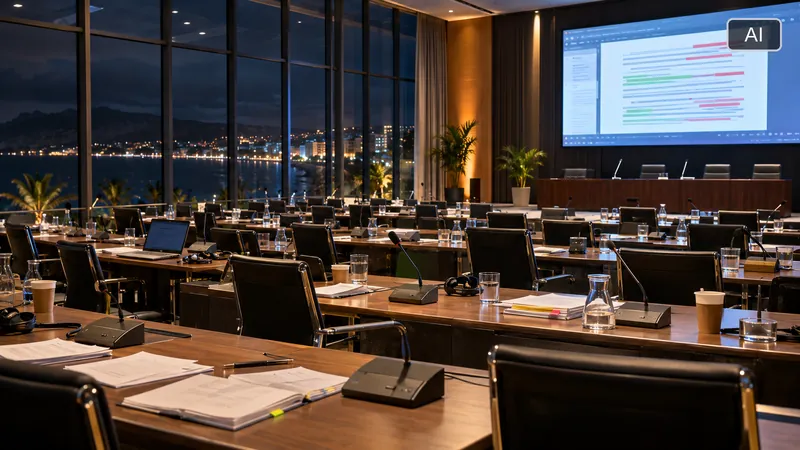
The UN climate conference in Antalya, Türkiye, is due to end on Friday, and the shape of a deal is visible, if not yet agreed. Here is what has happened so far, and what countries are being asked to do. Iceland's own message to the conference is covered in a separate article: Iceland at COP31: AMOC, a Threat to National Security.
Fréttir 24/7 reported on the conference at its halfway point in COP31 at Halfway: Ministers Arrive for the Hard Part.
The draft deal
On Monday Australia, which is chairing the negotiations, released the first draft of the conference's main decision. The 18-page text calls for "accelerated action to phase out fossil fuels" and an "immediate transition away from fossil fuels in energy systems", according to the news agency AFP.
It also asks a lot of countries, and most of all of the wealthy ones:
- Rich countries are called on to reach net zero emissions by 2030, a target few could realistically meet, and to announce pledges to several climate funds by the end of 2027.
- Money for adaptation, to help poorer countries cope with floods, droughts and heat, would at least triple to at least $120 billion a year by 2035. The draft puts developing countries' needs at about $305 billion a year by then.
- Electricity would make up 35% of the world's final energy use by 2035, a goal championed by Türkiye as host.
- The science: the draft expresses "deep concern" that the world is heading past the Paris Agreement's 1.5C limit, and recognises the "central role" of the best available science.
- Brazil's roadmap away from fossil fuels, launched at last year's talks in Belém, would be welcomed.
Australia's climate minister, Chris Bowen, stressed that the text was not final. "There are elements in this draft that not all parties will agree on. That is a given," he said.
The objections
At a meeting of delegation heads on Monday, the Like-Minded Developing Countries, a group that includes China, India and Saudi Arabia, said the draft crossed their red lines, according to the Earth Negotiations Bulletin, an independent reporting service run by the International Institute for Sustainable Development, a Canadian non-profit, which has kept a detailed record of UN environmental negotiations since 1992. Their objections centred on the electrification target, the roadmap away from fossil fuels and calls to cut methane emissions quickly. The Arab Group and Russia rejected the draft entirely on similar grounds.
Money is the other fault line. The poorest countries want a clear goal to triple adaptation funding. The European Union and Switzerland want no text on that point, as they do not want to take on new financial commitments.
By Wednesday more than twenty issues remained unresolved, according to UN News. In one negotiating room on finance, the entire text was still in brackets, meaning nothing had been agreed. "It's kicking the can down the road," said Seher Raheja of India's Centre for Science and Environment.
A new "reality check"
On Wednesday countries also began the second global stocktake under the Paris Agreement: a review, held every five years, of whether national climate plans add up to enough. The first, completed in Dubai in 2023, led to pledges to triple renewable energy and double energy efficiency. This one ends in 2028, the last before 2030.
"Yes, geopolitical headwinds are fierce, but an ambitious outcome is within reach," said the UN climate chief, Simon Stiell. Tuvalu's prime minister, Feleti Teo, spoke for the countries with most at stake: "Resilience has a limit. And beyond that limit is survival."
What happens next
New draft texts on the separate negotiating tracks are due early on Thursday, along with a revised version of the main deal. Nothing is final until the nearly 200 countries taking part reach agreement.
The conference is due to close on Friday, but observers expect the talks to run at least into Saturday. The number of open issues, and much of the wording described here, is likely to change over the coming days. Fréttir 24/7 will publish a follow-up when the talks end.
Sources
- Business Recorder (AFP) — COP31 draft deal calls for 'accelerated action' to exit fossil fuels, 17 November 2026 – The draft's wording on fossil fuels, net zero and electrification, and Chris Bowen's comments.
- The Business Standard — COP31 draft calls for fossil fuel phaseout, at least $120bn in adaptation finance, 16 November 2026 – The adaptation finance goal and campaigners' reactions.
- UN News — COP31 deadlock persists as countries launch new 'climate reality check', 18 November 2026 – The open issues, the global stocktake and the comments from Simon Stiell and Tuvalu.
- Earth Negotiations Bulletin (IISD) — Daily report for 16 November 2026 – Country groups' positions on the draft.
- Climate Home News — COP31 Bulletin Day 8, 17 November 2026 – The objections to the draft and the dispute over adaptation finance.
Reporting note: This article is based on reporting by AFP (via Business Recorder), The Business Standard, UN News and the Earth Negotiations Bulletin, The positions of the country groups are as reported by the Earth Negotiations Bulletin; no spokespeople were named. The draft is still under negotiation and may change.
This article was drafted with AI assistance and reviewed and edited by Fréttir 24/7's editorial team.
Tips, corrections or questions: ritstjorn@frettir247.news